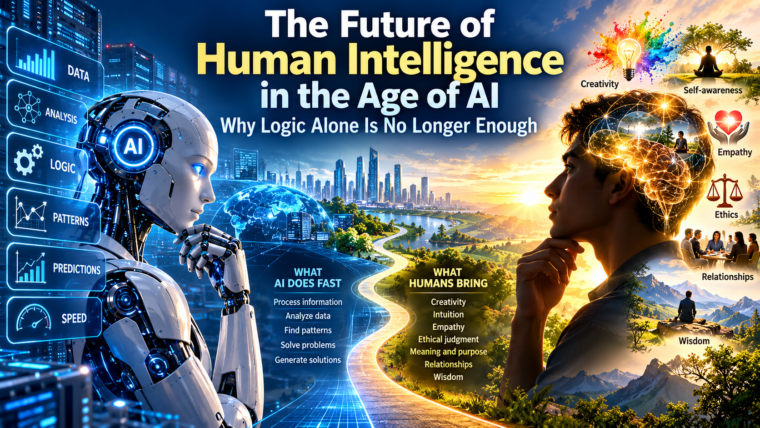
...Dr.Thyagaraju G S and Palguni G T
Source: Inspired by Yuval Noah Harari’s perspectives on “The Future of Human Intelligence in the Age of AI,” exploring key themes such as synthetic intelligence, creativity, empathy, ethical judgment, adaptability, trust, and self-awareness.
Watch the video: https://youtu.be/nde3lK0p8y0
Introduction: When Machines Begin to Think
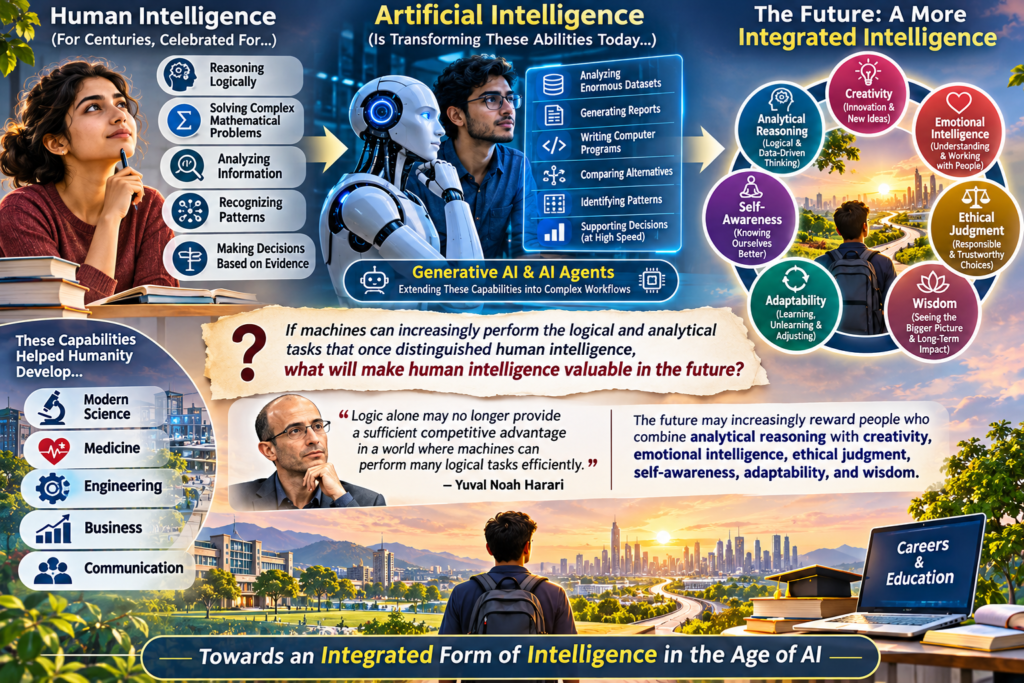
For centuries, human intelligence has been celebrated for its ability to reason logically, solve complex mathematical problems, analyze information, recognize patterns, and make decisions based on evidence. These capabilities have helped humanity develop modern science, medicine, engineering, business, and communication.
Today, artificial intelligence is transforming the value of these abilities.
AI systems can analyze enormous datasets, generate reports, write computer programs, compare alternatives, identify patterns, and support decisions at speeds that would be impossible for an individual human. Generative AI and AI agents are extending these capabilities into increasingly complex workflows.
This transformation raises a fundamental question:
If machines can increasingly perform the logical and analytical tasks that once distinguished human intelligence, what will make human intelligence valuable in the future?
A thought-provoking warning associated with historian and author Yuval Noah Harari invites us to reconsider our traditional understanding of intelligence. The central idea is not that logic has become useless, but that logic alone may no longer provide a sufficient competitive advantage in a world where machines can perform many logical tasks efficiently.
The future may increasingly reward people who combine analytical reasoning with creativity, emotional intelligence, ethical judgment, self-awareness, adaptability, and wisdom.
This article explores that idea, its implications for careers and education, and the importance of developing a more integrated form of intelligence in the age of AI.
1. The Changing Value of Human Intelligence
1.1 Why logic has been so valuable
Logical intelligence enables us to evaluate evidence, identify relationships, test hypotheses, calculate outcomes, and choose between alternatives. It has been essential to the development of civilization.
Consider the following examples:
- An engineer uses mathematics and physics to design a safe bridge.
- A doctor analyzes symptoms and medical test results to identify a possible illness.
- A business analyst studies customer data to understand purchasing patterns.
- A software developer uses computational logic to design an efficient algorithm.
- A financial analyst evaluates risk, cost, revenue, and investment opportunities.
In each case, structured reasoning transforms information into useful conclusions.
For a long time, people who possessed specialized knowledge and strong analytical skills gained an advantage because acquiring, processing, and applying information required considerable time and effort.
AI is changing this situation.
1.2 What happens when machines can perform logical tasks?
AI can already assist with many activities that previously required substantial human analytical effort. Depending on the task, it can summarize documents, generate code, evaluate scenarios, detect patterns, and produce possible solutions in seconds.
Imagine two professionals competing to solve a business problem.
| Professional A: Logic-focused | Professional B: Integrated intelligence |
|---|---|
| Analyzes large datasets | Uses AI to analyze large datasets |
| Generates reports | Interprets reports in business context |
| Compares available alternatives | Questions whether the alternatives are appropriate |
| Recommends a solution based on metrics | Combines metrics with customer needs and ethical considerations |
| Optimizes measurable performance | Considers performance, trust, long-term value, and human consequences |
Professional A’s skills remain useful. However, many of those skills can increasingly be supported or partially automated by AI.
Professional B combines analytical capability with broader judgment and contextual understanding.
The emerging advantage is not simply being more intelligent than a machine at every task. It is knowing how to use AI effectively, identify the right problem, recognize what the available information cannot establish, and make responsible decisions.
1.3 Does this mean logic is becoming obsolete?
No. This distinction is essential.
AI-generated answers can contain errors, rely on incomplete information, or produce conclusions that sound convincing but are unsupported. Human reasoning is necessary to question assumptions, verify results, and evaluate competing explanations.
Logic remains a foundation of sound thinking. What is changing is the need to combine logic with other capabilities.
The goal is not to abandon logical intelligence. It is to develop intelligence that extends beyond logic alone.
2. From Logical Intelligence to Synthetic Intelligence
One of the most important ideas in the supplied speech summary is the concept of synthetic intelligence.
In this context, synthesis means bringing together different forms of understanding to develop a more complete picture of a situation. It is not simply the ability to calculate an answer. It is the ability to integrate evidence, experience, emotions, context, creativity, and values when deciding what to do.
A useful distinction is:
- Logical intelligence: How can I solve this problem?
- Creative intelligence: What other solutions are possible?
- Emotional intelligence: How will this affect the people involved?
- Contextual intelligence: What circumstances, relationships, and constraints matter?
- Ethical intelligence: What should I do, and what consequences are acceptable?
- Reflective intelligence: What assumptions am I making, and what might I be missing?
Synthetic intelligence, as used in this article, brings these capabilities together rather than treating them as separate alternatives.

2.1 A practical example: Should a business open a new store?
Imagine an entrepreneur considering opening a new retail store.
Stage 1: Logical analysis using AI
The entrepreneur asks an AI system to analyze:
- Population and income levels in the locality.
- Customer demand and purchasing patterns.
- Competitor locations and prices.
- Rent, salaries, inventory, and operating costs.
- Estimated revenue, profit, and break-even point.
The AI produces a financial forecast suggesting that the store could be profitable.
Stage 2: Human observation and contextual understanding
Before investing, the entrepreneur visits the location, speaks with residents, observes customer behavior, and investigates the local market.
These observations may reveal that customers prefer home delivery, the area has limited parking, or a nearby competitor already provides a similar service with strong customer loyalty.
The entrepreneur may also discover an unmet need that the original analysis did not consider.
Stage 3: Synthesis and decision-making
The entrepreneur combines AI-generated analysis with customer conversations, personal experience, financial constraints, risk assessment, and long-term business objectives.
The final decision might be to open the store, choose another location, launch an online-first business, or conduct a small pilot before investing.
The entrepreneur has neither rejected AI nor accepted its recommendation blindly.
The decision emerges from the integration of data, context, experimentation, and judgment.
This example illustrates a general principle:
AI can help evaluate possible answers, but humans must also examine whether the right question has been asked, whether the assumptions are justified, and whether the proposed action is worth taking.
Human intuition is not infallible, and AI analysis is not automatically reliable. The strongest approach tests both against evidence and real-world outcomes.
3. Five Human Capabilities That Deserve Greater Attention
The increasing availability of AI-assisted analysis makes it useful to develop abilities that complement computational intelligence. These abilities are not necessarily exclusive to humans, but people can cultivate them through deliberate practice and experience.
3.1 Creativity: Imagining Possibilities Beyond Existing Solutions

Creativity is the ability to generate possibilities, combine ideas in unfamiliar ways, recognize opportunities, and develop something meaningful or useful.
AI can generate stories, designs, code, business plans, images, and product concepts. Consequently, producing an initial idea or draft may become less difficult.
The challenge shifts toward deciding which ideas deserve attention, understanding the needs they address, and transforming them into valuable outcomes.
Example: Creating an educational platform
An AI system can generate a website, prepare lesson summaries, create quizzes, and suggest personalized learning activities. However, developing an effective educational experience also requires understanding students’ difficulties, designing appropriate learning journeys, testing whether students actually understand the concepts, and improving the experience based on feedback.
The value lies not only in generating content but in creating an educational solution that works.
How to develop creativity
- Explore problems from multiple perspectives.
- Combine knowledge from different disciplines.
- Generate several possible solutions before selecting one.
- Build prototypes and learn from experiments.
- Use AI to expand possibilities rather than merely accept its first suggestion.
Creativity becomes especially powerful when imagination is combined with knowledge, experimentation, and critical evaluation.
3.2 Emotional Intelligence: Understanding People Beyond Data

Emotional intelligence involves recognizing emotions, understanding their possible causes, managing emotional responses, and responding constructively to the feelings of others.
Business decisions frequently involve people whose motivations and concerns cannot be fully captured by numerical indicators.
Consider a manager whose team’s productivity has declined. A purely metric-focused response might increase monitoring or impose stricter targets. An emotionally intelligent manager would also investigate workload, unclear responsibilities, communication problems, lack of recognition, or personal difficulties.
The resulting solution might improve both performance and employee wellbeing.
Emotional intelligence matters in:
- Leadership and team management.
- Negotiation and conflict resolution.
- Customer relationships and service.
- Teaching, mentoring, and counselling.
- Collaboration across cultures and professional backgrounds.
AI can assist by identifying patterns in feedback, summarizing conversations, or suggesting communication strategies. However, people must still evaluate the appropriateness of those suggestions and respect the privacy, dignity, and autonomy of others.
How to develop emotional intelligence
Practice active listening. Ask questions before drawing conclusions. Notice your own emotional reactions. Consider alternative explanations for another person’s behavior. Learn to disagree without humiliating or dismissing others.
The objective is not to eliminate emotion, but to understand it and respond wisely.
3.3 Intuition and Self-Awareness: Recognizing What We May Not Yet Understand

Intuition is the ability to arrive at an impression or judgment without consciously tracing every step of the reasoning process.
An experienced teacher may recognize that a student has not understood a concept even when the student answers a question correctly. An experienced engineer may suspect that an apparently normal system is behaving abnormally. An entrepreneur may notice that a customer is hesitant despite expressing interest.
Such intuitions can arise from accumulated experience and subtle patterns that have not yet been explicitly articulated.
However, intuition can also be distorted by fear, prejudice, overconfidence, wishful thinking, and incomplete experience.
Therefore, intuition should be treated as a source of hypotheses—not unquestionable truth.
How to develop self-awareness and better intuition
- Pause before reacting to emotionally charged situations.
- Record the assumptions behind important decisions.
- Compare initial impressions with actual outcomes.
- Identify situations in which your judgment tends to be unreliable.
- Use meditation, reflective writing, or quiet observation to understand your mental habits.
Over time, this practice can help distinguish useful experience-based judgment from automatic reactions and cognitive biases.
3.4 Ethical Judgment: Determining What Should Be Done

A decision can be logically consistent, financially profitable, and technically feasible while still causing harm.
Ethical judgment considers questions such as:
- Who benefits from this decision?
- Who could be harmed?
- Are people’s rights and dignity respected?
- Is the decision fair and proportionate?
- What happens if the system makes a mistake?
- Who is accountable for the consequences?
Consider an AI-powered recruitment system. It may rank thousands of applications quickly and consistently. Yet if its training data reflect historical discrimination, the system may reproduce unfair outcomes.
Optimizing the system for speed alone would not resolve the underlying problem. Responsible deployment also requires examining the data, testing for unfair impacts, protecting applicant information, establishing appeal mechanisms, and defining human accountability.
Ethical judgment is therefore not an optional addition to technical intelligence. It is necessary for deciding how technical capabilities should be used.
How to develop ethical judgment
Examine decisions from the perspectives of different stakeholders. Study real ethical dilemmas. Identify potential harms before deployment. Distinguish what is technically possible from what is socially acceptable. Be willing to revise a decision when its consequences reveal an overlooked problem.
Ethics becomes particularly important as AI systems influence hiring, education, healthcare, finance, public services, and access to opportunities.
3.5 Psychological Adaptability: Learning to Navigate Uncertainty

Psychological adaptability is the ability to respond constructively to changing circumstances, revise assumptions, learn from mistakes, and continue functioning when the future is uncertain.
AI is changing the tasks associated with many occupations. Some skills may lose market value, while new applications and business models emerge. A professional who depends entirely on one fixed method of working may find adaptation difficult.
An adaptable professional asks:
- What has changed?
- Which of my existing skills remain useful?
- What must I learn next?
- Which assumptions should I reconsider?
- How can I test a new approach without taking unnecessary risks?
For example, a data analyst may move from manually preparing reports to designing AI-assisted analytical workflows, validating automated results, explaining business implications, and helping decision-makers act on insights.
The transition requires technical learning as well as a willingness to redefine professional identity.
How to develop adaptability
Learn continuously, experiment with unfamiliar tools, seek constructive criticism, and treat mistakes as opportunities to improve. Maintain a distinction between your identity and your current job title or technical specialization.
The future will not reward every adaptation equally, but the ability to learn and change direction is a valuable response to uncertainty.
4. From Individual Intelligence to Integrated Intelligence
The five capabilities above become more useful when combined with logical reasoning and technical knowledge.
The following model provides a practical framework for thinking about integrated intelligence.
| Component | Fundamental question | Practical contribution |
|---|---|---|
| Logical intelligence | What does the evidence indicate? | Analysis and consistency |
| Creative intelligence | What else is possible? | New ideas and alternatives |
| Emotional intelligence | What are people experiencing? | Relationships and communication |
| Contextual intelligence | What circumstances matter? | Relevant interpretation |
| Ethical judgment | What is responsible and fair? | Values and accountability |
| Self-awareness | What might influence my judgment? | Reflection and bias recognition |
| Adaptability | How should I respond to change? | Learning and resilience |
| Wisdom | What matters most in this situation? | Prioritization and perspective |
This is a conceptual framework developed for this article, not a validated scientific measurement of intelligence.
Its purpose is to show why effective decisions frequently require more than analytical ability alone.
Consider a hospital introducing an AI system to assist in diagnosing diseases. Logical analysis evaluates the system’s performance. Creativity helps redesign clinical workflows. Emotional intelligence supports communication with patients. Contextual understanding considers the patient’s history and circumstances. Ethical judgment addresses privacy, fairness, and accountability. Self-awareness helps clinicians recognize their own limitations. Adaptability supports learning from new evidence.
Wisdom involves integrating these considerations while keeping the patient’s wellbeing central.
No single component is sufficient by itself.
5. The Future of Work: How Careers May Change in the Age of AI
The implications of these ideas extend beyond personal development. They affect how organizations recruit, how students prepare for careers, and how professionals create value.
It is important to distinguish between a task being automated and an entire occupation disappearing. Many jobs contain a mixture of routine activities, complex decisions, interpersonal interactions, and responsibilities that may change at different rates.
5.1 The evolution of professional roles
| Traditional emphasis | Emerging emphasis |
|---|---|
| Preparing reports manually | Interpreting AI-generated analysis and verifying results |
| Writing routine code | Designing, testing, integrating, and maintaining AI-assisted systems |
| Collecting information | Evaluating information quality and drawing relevant conclusions |
| Producing standard content | Developing distinctive ideas and creating valuable experiences |
| Following established procedures | Identifying when procedures should change |
| Making decisions from predefined metrics | Combining metrics with context, risks, and human consequences |
| Performing isolated tasks | Coordinating people, AI tools, and complex workflows |
These are illustrative transitions, not universal replacements. Traditional technical skills remain important, and some occupations may be substantially automated while others change only partially.
5.2 Careers that combine AI and human judgment
Several areas offer opportunities to apply technical expertise alongside broader human capabilities.

AI product management
Understanding user needs, defining product objectives, evaluating AI capabilities, prioritizing features, and measuring outcomes.

AI-powered business analytics
Using Python, SQL, analytics platforms, and AI to identify patterns and translate findings into decisions that improve business performance.

AI governance and responsible innovation
Assessing privacy, fairness, safety, transparency, regulatory obligations, and organizational accountability.

AI-enabled education and learning design
Developing learning experiences that combine intelligent tutoring, personalization, critical thinking, and meaningful human interaction.

Entrepreneurship and innovation
Discovering unmet needs, testing business ideas, building products, establishing trust, and adapting to customer feedback.
The common theme is integration: technical competence must be connected with a clear understanding of the people, organizations, and problems being served.
5.3 What should students learn?
Students do not need to choose between technical knowledge and human development. They need both.
A useful learning strategy is to build four complementary layers:
- Technical foundation: Programming, data analysis, statistics, AI tools, and the fundamentals of computing.
- Problem-solving ability: Defining problems, examining assumptions, testing solutions, and interpreting results.
- Human understanding: Communication, empathy, teamwork, cultural awareness, and ethical reasoning.
- Adaptive learning: Experimentation, reflection, continuous skill development, and the ability to learn unfamiliar technologies.
For MBA students specializing in AI and Data Science, this means learning not only how to build dashboards or use AI tools, but also how to determine which business questions matter, whether the data are trustworthy, what actions the analysis supports, and how those actions affect customers and employees.
For engineering students, it means going beyond implementation to consider usability, security, reliability, sustainability, and the real-world consequences of the systems they develop.
For educators, it means helping students become independent thinkers who can question, verify, create, and apply knowledge—not merely reproduce information.
6. Trust, Information, and Truth in the AI Era
The supplied speech summary extends beyond intelligence and careers to three related concerns: trust, the reliability of information, and self-understanding.
These concerns are particularly important in a world where digital information can be generated and distributed at enormous scale.
6.1 More information does not automatically produce more knowledge
Information is the raw material of understanding, but information can be incomplete, inaccurate, misleading, or presented without sufficient context.
AI makes it easier to produce plausible explanations, images, videos, reports, and synthetic conversations. The appearance of confidence or sophistication does not guarantee accuracy.
Consider a student researching a medical topic. An AI system may produce a clear explanation with references, but some statements may be inaccurate or the references may not support the claims.
The student must verify important facts using reliable sources and distinguish established evidence from speculation.
The same principle applies to business reports, scientific research, public policy, and personal decisions.
A useful progression is:
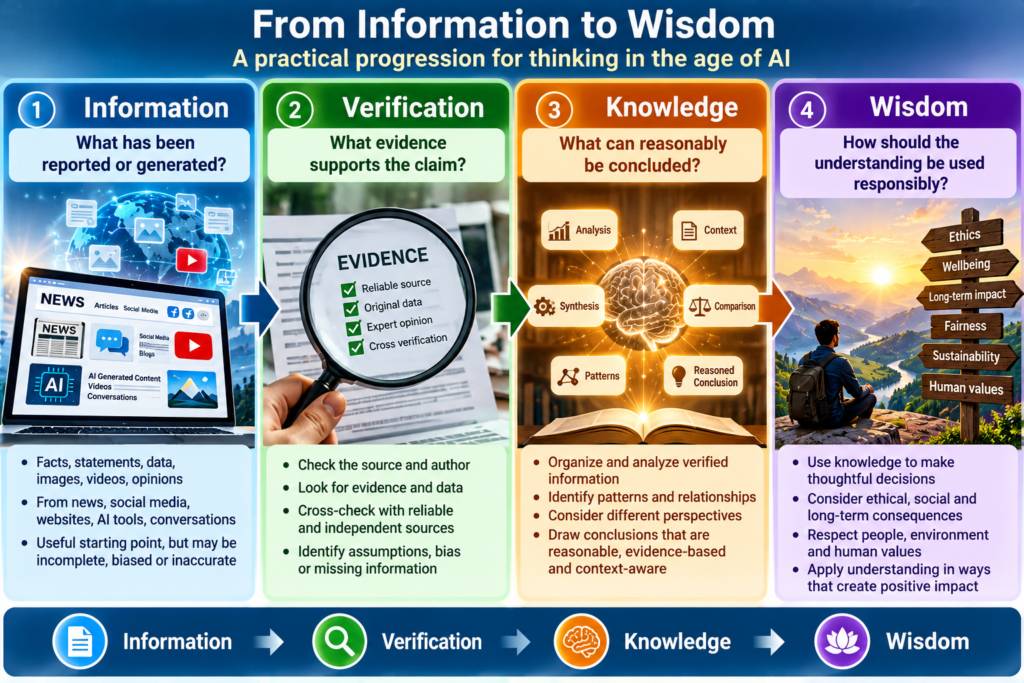
How should the understanding be used responsibly?
This is a simplified conceptual model, not a strict sequence followed by every learning process.
The important lesson is that generating information and understanding its reliability are different activities. Using information wisely requires considering its limitations, context, and consequences.
6.2 Why trust matters
Trust enables people to cooperate, exchange knowledge, conduct research, operate businesses, and participate in democratic institutions.
When trust is damaged by deliberate deception, misinformation, or repeated failures of accountability, collaboration becomes more difficult.
However, trust should not mean accepting every claim or institution without question. Healthy trust is supported by transparency, evidence, accountability, independent verification, and the willingness to correct mistakes.
In the AI era, responsible information practices include:
- Checking important claims against reliable, independent sources.
- Distinguishing facts from interpretations and opinions.
- Verifying original documents, data, and research where possible.
- Recognizing that AI-generated material can be wrong.
- Correcting misinformation when credible evidence establishes an error.
- Remaining open to revising one’s beliefs.
The objective is neither blind trust nor universal suspicion. It is informed trust supported by evidence and accountability.
6.3 Critical thinking in an age of persuasive machines
An AI system may present an argument in a convincing tone. Yet persuasive presentation and factual correctness are not the same.
A critical thinker asks:
- What is the actual claim?
- What evidence supports it?
- What assumptions does it depend on?
- Are there credible alternative explanations?
- What evidence would change my conclusion?
These questions remain valuable whether information comes from a person, a news organization, an academic paper, or an AI system.
The more easily information can be generated, the more important it becomes to develop the ability to evaluate it.
7. Self-Awareness, Meditation, and Understanding the Mind
One of the most interesting themes in the supplied summary is the importance of self-understanding.
People often assume that understanding the external world is sufficient for making good decisions. Yet decisions are also influenced by internal processes: emotions, expectations, fears, habits, desires, memories, and unconscious assumptions.
A person may possess extensive technical knowledge but repeatedly make poor decisions because of overconfidence, impatience, anger, or an inability to recognize personal biases.
Self-awareness helps us examine these influences.
7.1 What does self-awareness mean?
Self-awareness is the ability to observe and understand aspects of one’s own thoughts, emotions, motives, habits, and behavior.
It involves recognizing the difference between an experience and our interpretation of that experience.
For example:
- Experience: A colleague disagrees with my proposal.
- Immediate interpretation: The colleague does not respect me.
- Reflective question: Could the disagreement be based on different evidence, priorities, or concerns?
This pause creates an opportunity to respond thoughtfully rather than react automatically.
Self-awareness does not eliminate mistakes. It can, however, help us recognize them earlier and respond more constructively.
7.2 Meditation and reflective practices
Meditation, including mindfulness and contemplative practices, can provide opportunities to observe thoughts and emotions without immediately acting on them.
A person may notice frustration arising during a difficult conversation, recognize the urge to respond defensively, and choose to listen before replying.
Other useful practices include reflective writing, quiet walks, careful observation, discussions with trusted people, and reviewing important decisions.
The supplied summary mentions Vipassana meditation as a personal example while emphasizing that one practice may not suit everyone. This is a useful reminder to explore different approaches rather than assuming that one method is universally appropriate.
Meditation is not a substitute for evidence, professional guidance when needed, or practical problem-solving. Its potential value lies in helping people examine their experiences and develop greater awareness of their responses.
7.3 The connection between self-awareness and AI
AI can provide summaries of our writing, help us examine alternative perspectives, or suggest questions for reflection. Such assistance may reveal patterns we had not noticed.
However, AI-generated interpretations of personality or motivation can be incomplete or mistaken. They should be treated as prompts for reflection rather than definitive assessments of who we are.
Ultimately, self-understanding requires attention to lived experience, behavior, relationships, and the willingness to examine uncomfortable possibilities.
AI can help us explore information about ourselves, but we must remain active participants in understanding our own minds.

8. Intelligence, Consciousness, and Wisdom: Three Different Questions
The discussion about human intelligence becomes deeper when we distinguish intelligence from consciousness and wisdom.
These concepts are related, but they are not interchangeable.
8.1 Intelligence: The ability to solve problems
Intelligence broadly concerns abilities such as learning, reasoning, recognizing patterns, adapting to circumstances, and solving problems.
AI systems demonstrate impressive capabilities across many such tasks. The extent and nature of these capabilities vary by system and task.
8.2 Consciousness: The question of subjective experience
Consciousness raises a different question: whether and how a being experiences sensations, feelings, or a first-person perspective.
An AI system may generate a statement about sadness or awareness, but producing such a statement does not establish that the system subjectively experiences sadness or possesses consciousness.
The scientific and philosophical questions surrounding machine consciousness remain unresolved. We should avoid assuming either that sophisticated language proves consciousness or that every aspect of the issue has been conclusively settled.
This distinction matters because observable performance and subjective experience are different kinds of claims.
8.3 Wisdom: Knowing what matters and acting responsibly
Wisdom involves more than possessing information or solving a problem efficiently. It includes perspective, judgment, consideration of consequences, recognition of limitations, and sensitivity to what matters in a particular situation.
A company might use AI to maximize short-term profit. A wiser decision-maker would also examine long-term sustainability, employee wellbeing, customer trust, environmental effects, and the possibility of unintended harm.
Wisdom is not simply a synonym for emotion or intuition. It can draw upon logic, knowledge, experience, reflection, ethical principles, and an understanding of human needs.
These distinctions can be summarized as follows:
| Concept | Central question |
|---|---|
| Intelligence | What problems can be solved? |
| Consciousness | Is there subjective experience? |
| Wisdom | What is worth doing, and how should it be done? |
This distinction offers a useful perspective for TOCXTEN’s exploration of AI, consciousness, and the future of human wellbeing.
It encourages us to appreciate technological achievements without confusing computational capability with every other dimension of human experience.
9. A Practical Daily Framework for Developing Integrated Intelligence
Understanding these ideas is useful, but applying them consistently is what makes them meaningful.
The following routine is a practical framework for students, teachers, researchers, business leaders, and professionals who want to strengthen their thinking while using AI effectively.
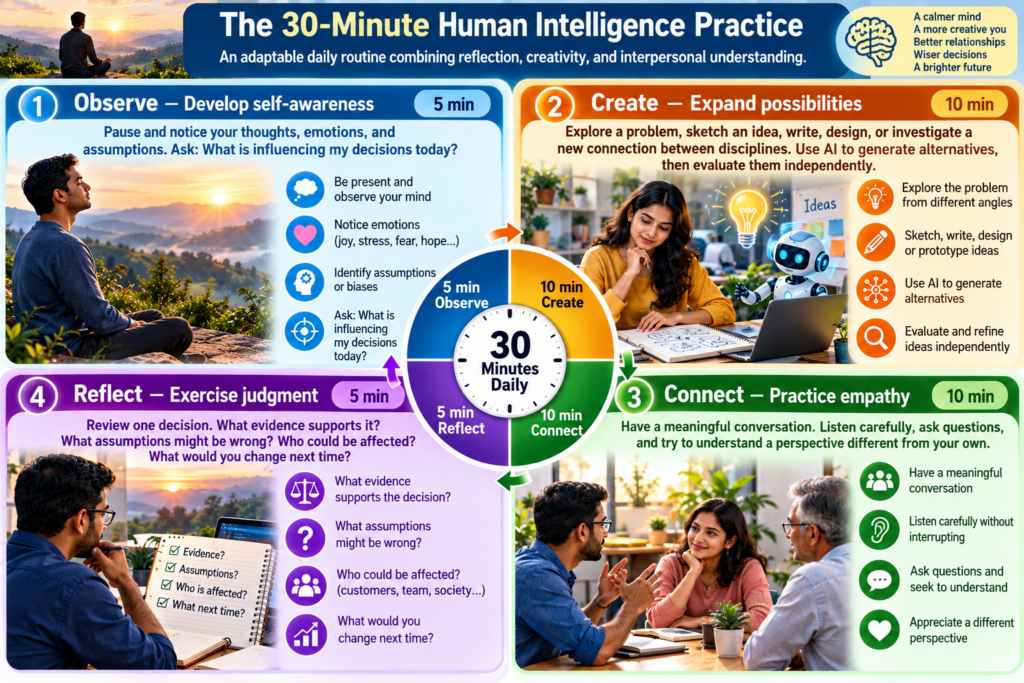
Review one decision. What evidence supports it? What assumptions might be wrong? Who could be affected? What would you change next time?
The duration is only a starting point. The routine can be adapted to individual circumstances and does not need to be followed rigidly.
A weekly exercise: Combine AI and human judgment
Choose one real problem from your work, studies, or personal projects.
- Define the problem yourself before consulting AI.
- Ask AI to analyze the problem and generate alternative solutions.
- Verify important claims and identify missing information.
- Speak with people who understand the problem or experience its consequences.
- Evaluate the alternatives using evidence, context, ethical considerations, and practical constraints.
- Test a solution on a small scale and review the results.
This process develops more than familiarity with AI tools. It encourages independent thinking, responsible experimentation, and the ability to combine different forms of knowledge.
10. How Educational Institutions Must Rethink Intelligence
If education continues to reward only memorization, rapid calculation, and the reproduction of established answers, it risks preparing students for a world in which AI can perform many of those activities.
The solution is not to remove examinations, technical subjects, or logical reasoning. It is to broaden the educational objectives.
10.1 From answering questions to asking better questions
Students should learn to identify meaningful problems, challenge assumptions, compare possible explanations, and formulate questions that lead to deeper investigation.
For example, instead of merely asking students to produce a business report, an educator might ask them to investigate a real business problem, use AI to analyze available data, verify the findings, interview stakeholders, and defend their recommendations.
The assessment then measures reasoning, application, judgment, and understanding—not merely the production of a polished document.
10.2 From individual knowledge to collaborative problem-solving
Real-world challenges frequently cross disciplinary boundaries.
Climate change, healthcare, education, economic inequality, cybersecurity, and responsible AI require combinations of technical expertise, scientific understanding, institutional knowledge, and human cooperation.
Educational institutions should create opportunities for students from different disciplines to work together on complex projects.
10.3 From technical competence to responsible innovation
Students should learn to ask not only whether a system works, but also whether it is safe, fair, useful, sustainable, and appropriate for its intended purpose.
A technically impressive AI application may still fail if people cannot trust it, understand its limitations, or access its benefits.
Responsible innovation connects technical excellence with social value.
10.4 A broader model of education
| Traditional educational emphasis | Complementary future-oriented emphasis |
|---|---|
| Remembering information | Evaluating information |
| Solving predefined problems | Identifying important problems |
| Producing one correct answer | Comparing and testing alternatives |
| Individual performance | Collaboration and communication |
| Technical implementation | Responsible application |
| Completing a qualification | Continuous learning |
| Measuring achievement | Reflecting on impact and consequences |
These approaches complement rather than replace foundational knowledge and disciplined study.
For teachers and institutions, the objective should be to develop graduates who can use AI competently while retaining the ability to think independently, understand others, and make responsible decisions.
11. Challenges and Cautions: What We Should Not Assume
The argument that human capabilities beyond logic will become more important is compelling, but it must be interpreted carefully.
First, AI progress does not mean all analytical jobs will disappear. Many occupations involve responsibilities, physical activities, legal obligations, complex environments, or relationships that cannot be reduced to information processing alone. The extent of automation will vary.
Second, human intuition is not always better than AI analysis. People can be biased, emotional, poorly informed, or overconfident. Intuition should be tested against evidence, just as AI-generated conclusions should be verified.
Third, creativity and empathy are not exclusively human in every observable form. AI can generate creative outputs and simulate empathetic communication. Important questions remain about the quality, limitations, and nature of those capabilities. Their presence does not automatically establish subjective experience or genuine understanding.
Fourth, developing personal skills cannot solve every employment problem. If automation reduces demand for certain kinds of labor, individuals may need new skills, but society may also need better education systems, worker protections, income-support mechanisms, and policies that distribute productivity gains more broadly.
Fifth, wisdom cannot be measured by a single score. Ethical decisions involve competing values, uncertainty, and differences in circumstances. No checklist can eliminate the need for careful judgment.
Finally, the title and framing of the source material refer to 2026 as a turning point. This should be understood as a warning about the direction of technological change, not proof that a particular year marks the end of human analytical advantage. The supplied text is a summary of the speech’s ideas, not a verified word-for-word transcript. The framework developed in this article is an interpretation and practical extension of those ideas, rather than a claim that every concept or recommendation was stated directly by Harari.
Recognizing these limitations strengthens the argument. The goal is not to predict every development accurately, but to prepare for change without exaggerating either AI’s capabilities or human uniqueness.
12. The Future of Human Intelligence: From Competition to Complementarity
The future need not be understood as a competition in which humans must outperform machines at every task.
A more productive approach is to explore how human capabilities and AI capabilities can complement one another.

Imagine an AI system that can rapidly analyze thousands of research papers. A scientist can use that capability to explore possibilities, but must still evaluate the evidence, design appropriate experiments, and determine whether the conclusions are justified.
Imagine an AI tutor that adapts explanations to a student’s learning pace. A teacher can use it to support personalized learning while also helping the student develop curiosity, confidence, critical thinking, and the ability to work with others.
Imagine an AI assistant that supports business decisions. A leader can use its analysis while considering employees, customers, social responsibilities, and long-term objectives.
In each example, AI expands what people can accomplish. The quality of the outcome depends on how the technology is integrated into a larger process of understanding, decision-making, and responsibility.
This relationship can be expressed as:
AI capability + Human judgment + Real-world feedback + Ethical responsibility = More meaningful innovation
This is a conceptual relationship, not a mathematical law. It emphasizes that powerful technology does not automatically produce beneficial outcomes. Those outcomes depend on the way people design, deploy, evaluate, and govern it.
The most effective professionals may increasingly be those who understand both what AI can do and what must be considered beyond its outputs.
Conclusion: Use Logic to Understand, Wisdom to Decide
The rise of AI invites us to reconsider what it means to be intelligent.
For generations, knowledge, calculation, memory, and analytical reasoning have provided important advantages. These capabilities remain essential, but AI is making many forms of information processing more accessible and increasingly automatable.
The response should not be to reject logic, fear technology, or assume that human beings possess an automatic advantage in every nontechnical domain.
Instead, we should develop a broader approach to intelligence—one that combines rigorous reasoning with creativity, emotional understanding, contextual awareness, ethical judgment, adaptability, and self-reflection.
We should learn to ask better questions, verify information rather than merely consume it, understand people rather than treat them as data points, and evaluate success by more than efficiency or profit.
Educational institutions should prepare students for continuous learning. Organizations should use AI responsibly and invest in the people affected by technological change. Individuals should develop both technical competence and the capacity to reflect on their choices.
Most importantly, humanity should consider what its increasing technological capabilities are ultimately intended to achieve.
If AI helps us produce more information, we must learn to distinguish knowledge from noise. If it helps us make decisions faster, we must become more thoughtful about the consequences. If it automates more work, we must ensure that technological progress contributes to dignity, opportunity, and shared prosperity.
The future of intelligence should not be measured solely by how quickly a problem can be solved. It should also be measured by whether the solution serves worthwhile human purposes.
Let AI help us process information. Let logic help us test our conclusions. Let creativity help us imagine possibilities, empathy help us understand others, and wisdom help us decide what truly matters.
That is the opportunity before us: not to become less logical in the age of AI, but to become more complete, reflective, responsible, and humane in the way we think and act.