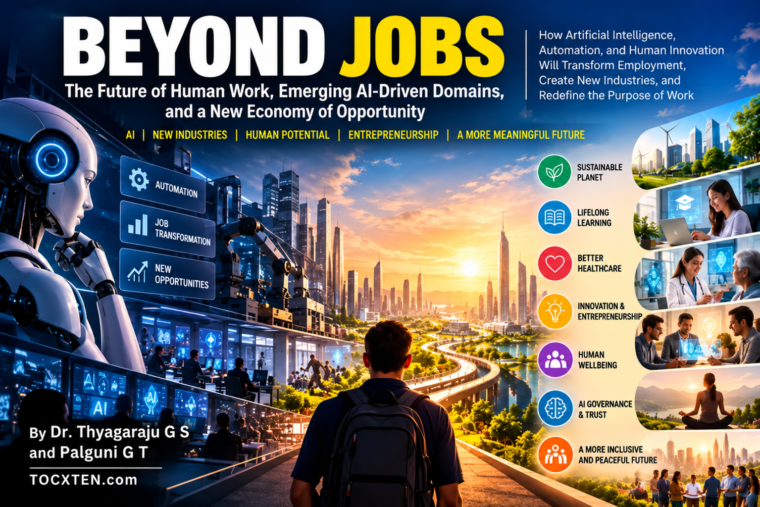
Imagine a world where AI can write software, diagnose diseases, teach students, manage businesses, design products, drive vehicles, and perform most routine human tasks.
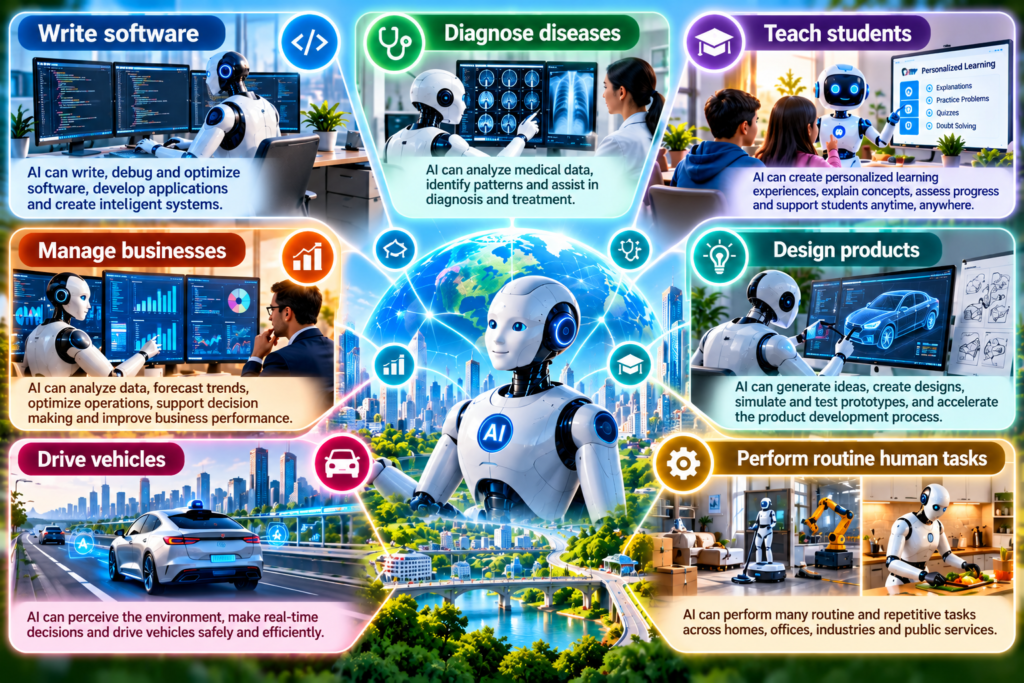
- What will happen to human employment?
- Will people lose their jobs?
- Will new careers emerge? Or
- Will society need an entirely new economic system?
The most important question is not whether AI can do our jobs. It is how humans, businesses, and society will create value when AI can perform much of today’s work.
My central view is that the future of employment will depend on three factors:
- the capabilities of AI,
- the speed at which organizations adopt it, and
- how effectively society distributes the benefits of automation.
1. Three possible futures of employment

Scenario 1: AI replaces a large share of existing jobs
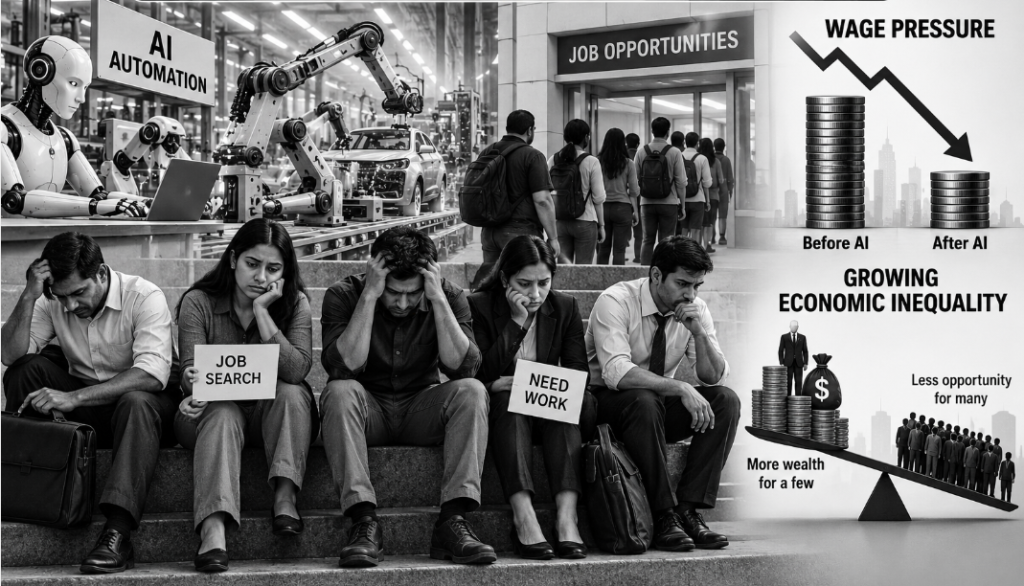
AI systems and robots perform many tasks previously handled by people. Organizations need fewer employees for routine work, repetitive analysis, basic customer support, documentation, and standardized operations.
Risk: unemployment, wage pressure, and growing economic inequality if workers cannot transition quickly.
Scenario 2: Humans work alongside AI
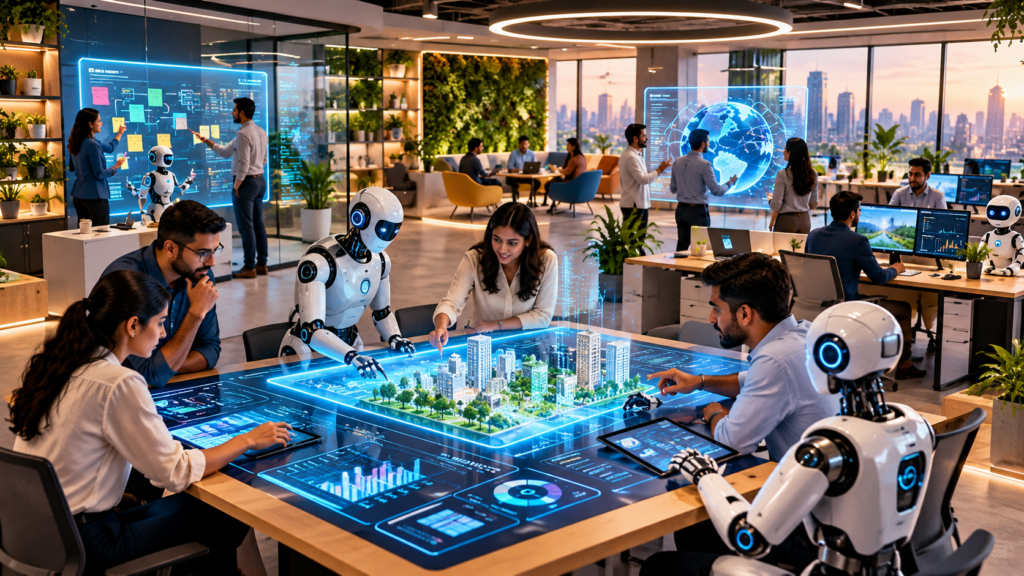
AI handles repetitive tasks while humans provide judgment, creativity, accountability, relationships, domain expertise, and strategic direction. Many existing occupations change rather than disappear.
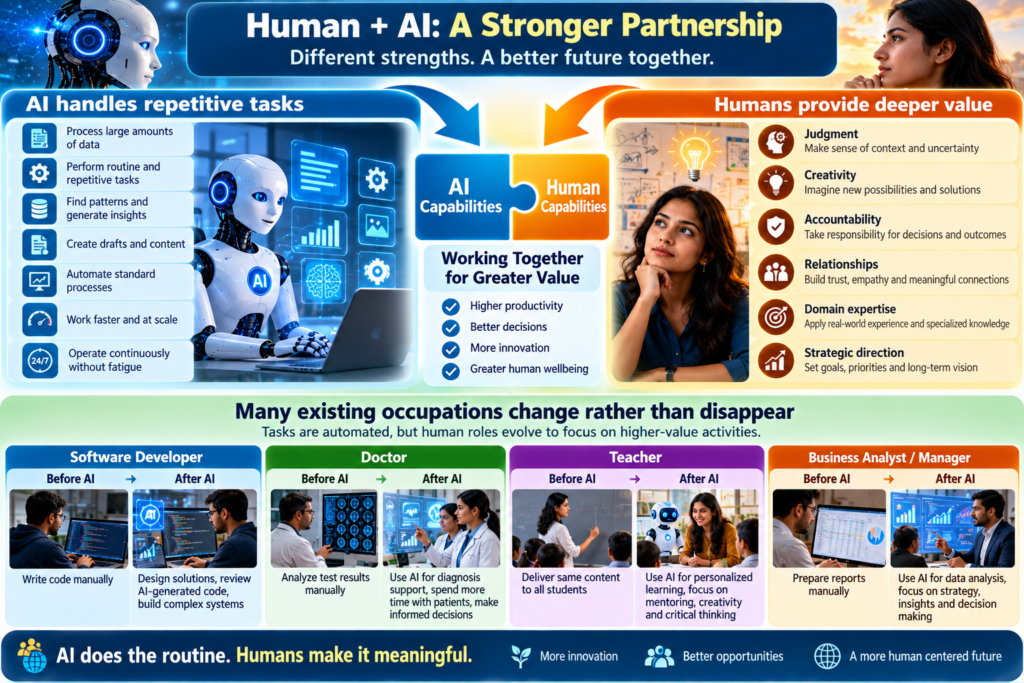
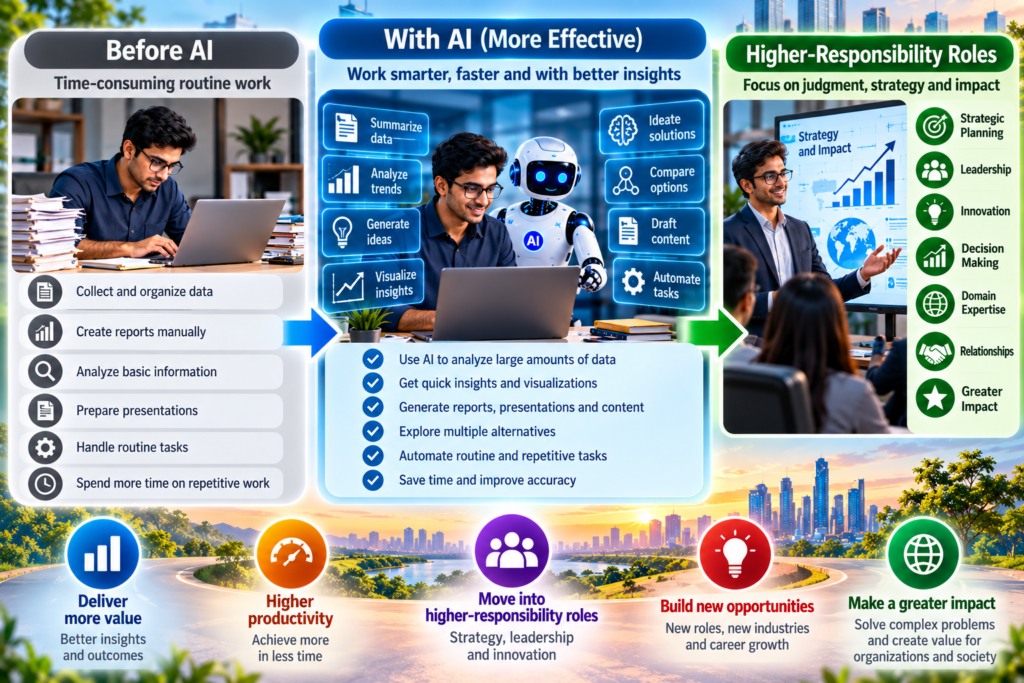
Opportunity: professionals who can use AI effectively may deliver more value and move into higher-responsibility roles.
Scenario 3: Society redesigns work and income
If AI and robotics can supply most goods and services, society may explore shorter working weeks, universal basic income, public dividends from automated production, and new forms of creative, social, and community contribution.
Possibility: people spend less time earning a living and more time learning, caring, creating, researching, and contributing to society—if institutions make this possible.
These scenarios can coexist. Different industries and countries may experience them at different speeds.
2. What does current research tell us?
The future is uncertain, but available research offers useful evidence. World Economic Forum · Future of Jobs Report 2025
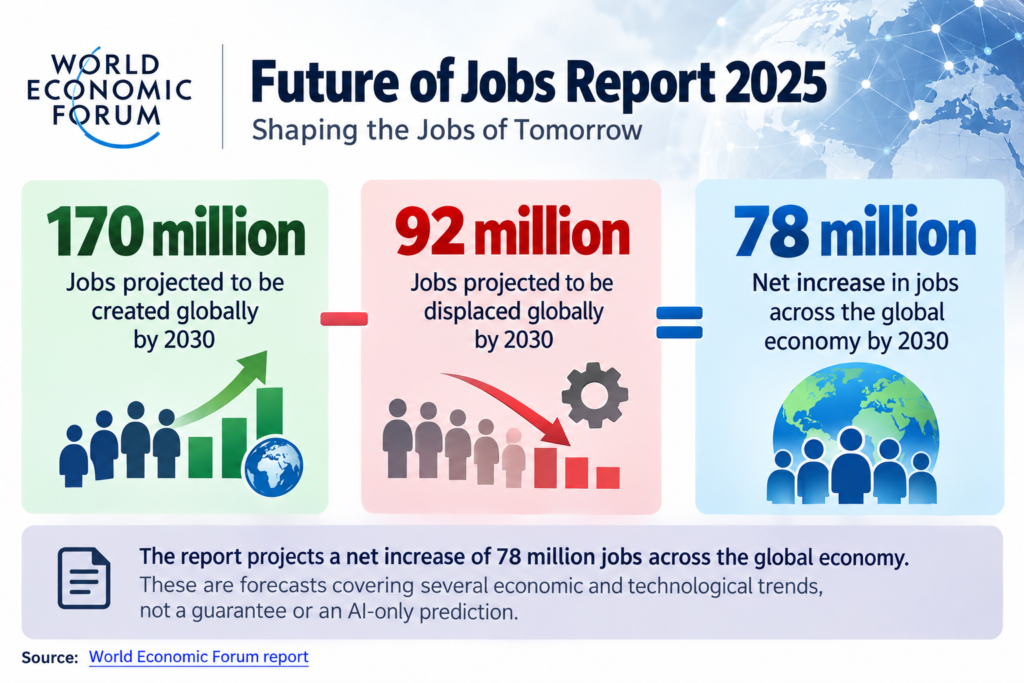
Source: World Economic Forum report
The International Labour Organization’s 2025 research found that roughly one in four jobs worldwide has some exposure to generative AI, but concluded that transformation of jobs is more likely than complete replacement for most occupations. Exposure does not mean a job will necessarily disappear.
The distinction is important: AI may automate 70% of a job’s tasks without automating the entire job. But if an organization can reorganize its work around AI, it may still need fewer employees.
3. If AI performs almost all work, where will job opportunities come from?
The following are plausible areas of opportunity, not guarantees that every category will grow.

1. AI creation, development and control
AI engineers, AI infrastructure specialists, agentic AI developers, AI evaluators, AI security specialists, model auditors and human-AI systems designers.
Longer-term question: when AI builds AI, humans may shift toward architecture, oversight, verification and defining objectives.

2. AI-driven business and decision-making
AI product managers, business intelligence specialists, AI strategy consultants, decision scientists, AI transformation managers and domain-specific AI consultants.
Key capability: Converting a business problem into a measurable result using data and AI.

3. Human-centered professions
Healthcare, education, counselling, rehabilitation, social care, leadership, negotiation and other work requiring trust, responsibility, complex judgment or physical interaction.
These fields can also be affected by AI; human involvement will depend on quality, cost, regulation and public expectations.
4. Physical-world technology
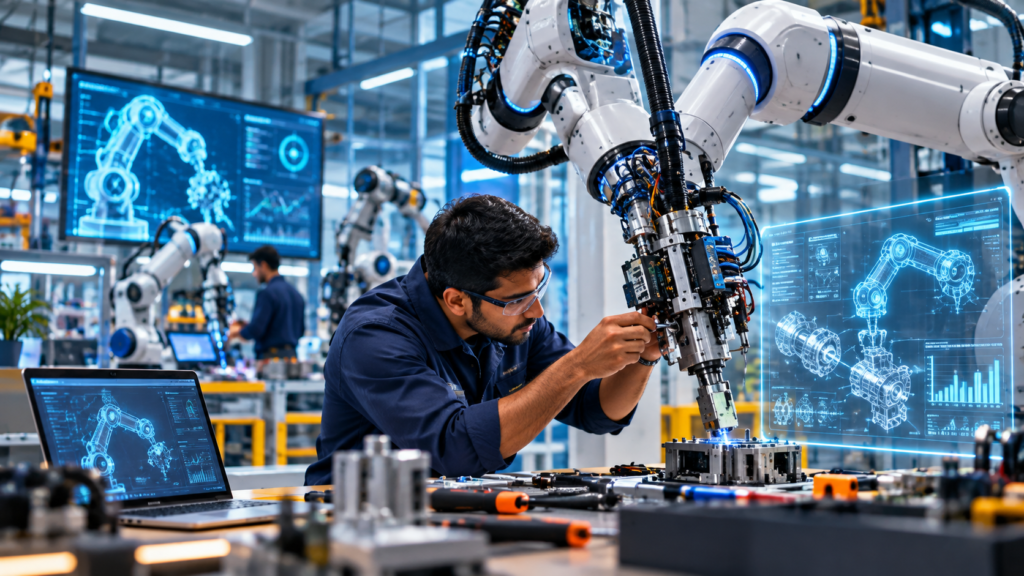
Robotics technicians, automation engineers, renewable energy specialists, smart infrastructure professionals, precision agriculture specialists and advanced manufacturing experts.
Software automation does not automatically eliminate the challenges of operating safely in the physical world.

5. Entrepreneurship and independent work
One-person AI businesses, niche software products, AI-powered education, research services, specialized consulting and digital products.
AI can reduce the cost of starting a business, although competition, customer acquisition and the ability to earn revenue remain major challenges.

6. New forms of human contribution
Environmental restoration, community development, scientific exploration, creative arts, cultural preservation, mentorship and wellbeing initiatives.
Some may become paid careers; others may be supported through public funding, community institutions or new income-sharing systems.
The World Economic Forum identifies AI and machine learning, big data, cybersecurity, education, care work and green-transition occupations among areas of expected growth through 2030.
4. The biggest challenge: What if AI also takes over the new jobs?
This is the deeper question.
Suppose AI can develop software, manage businesses, perform research, teach, diagnose illnesses and even design better AI systems. Simply advising everyone to learn AI may not be a permanent solution.
We must distinguish between two different futures.
Future A: AI creates wealth, but employment remains essential
- People compete for the remaining jobs.
- Education focuses on continuously changing skills.
- Human professionals supervise AI and manage complex situations.
- Governments and companies invest in retraining and job transitions.
Future B: AI and robotics produce most economic value
- Traditional full-time employment could become less necessary.
- Income may become less dependent on wages.
- Society may experiment with shorter working weeks, universal basic income, public ownership or dividends from automated production.
- Human achievement may be measured more by contribution, creativity, relationships and wellbeing than by occupation alone.
Future B is a possible long-term scenario, not an established forecast. It would require major changes to economic institutions, ownership, taxation and income distribution.
The critical issue may eventually shift from “How do we create enough jobs?” to “How do we distribute the wealth produced by intelligent machines?”
If a small number of organizations own the most productive AI systems, technological abundance could coexist with unemployment and inequality. If productivity gains are widely shared, the same technology could reduce poverty and give people more freedom.
5. What should students prepare for between 2026 and 2035?
For students entering the workforce today, the practical response is to build capabilities that remain valuable even as individual tools change.
| Capability | What students should learn |
|---|---|
| AI literacy | Generative AI, AI agents, automation and responsible AI use |
| Data skills | Python, SQL, statistics and business intelligence |
| Problem-solving | Identifying real problems and evaluating possible solutions |
| Domain expertise | Finance, healthcare, education, manufacturing or another sector |
| Human skills | Communication, empathy, leadership, negotiation and collaboration |
| Business creation | Product development, entrepreneurship, customer discovery and sales |
| Critical judgment | Verifying AI outputs, assessing risk and taking responsibility |
6. What should colleges and universities do?
Engineering colleges and business schools must prepare students for a world where job descriptions can change faster than traditional curricula.
Move from knowledge delivery to capability development
Students should build, test, deploy and evaluate AI systems rather than only study theoretical concepts.
Connect education directly with real-world problems
Every major project should address a real problem faced by a business, institution or community.
Make lifelong learning part of education
Students must learn how to adapt, acquire new skills and transition between careers.
Encourage entrepreneurship, not just placement preparation
Students should learn to create products, start small businesses, identify underserved markets and generate employment for others.
Preserve human values and social responsibility
Ethical judgment, compassion, cooperation, human dignity and responsible technology use should remain central to education.
7. My vision: From an employment economy to a contribution economy
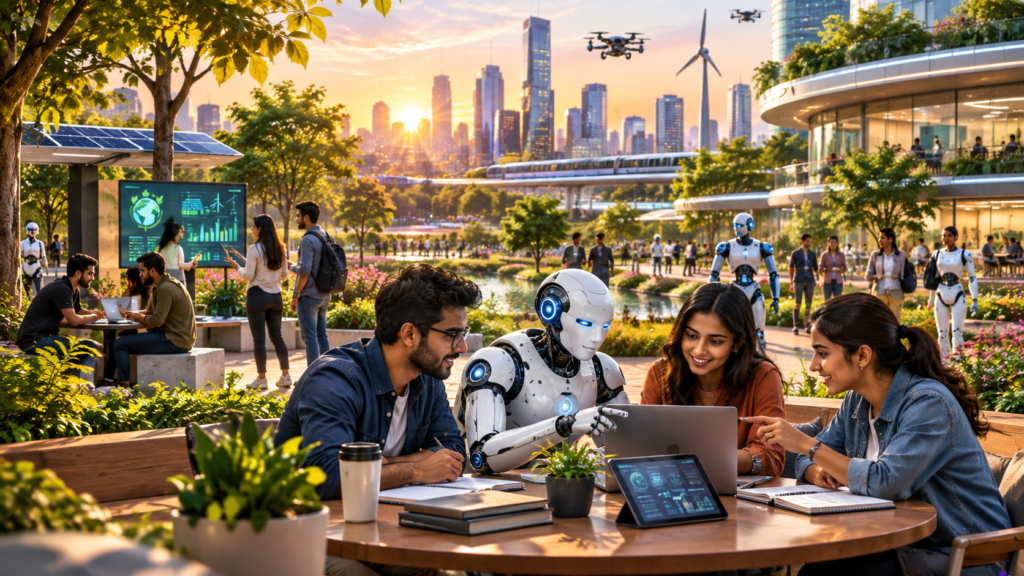
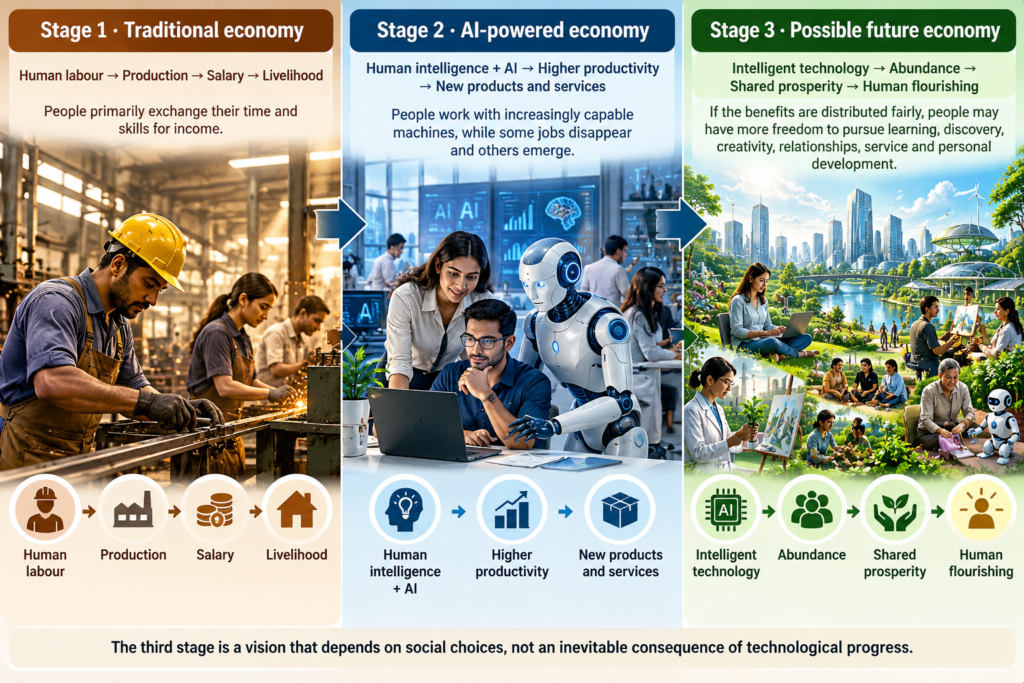
Consider three stages in the evolution of work.
Stage 1 · Traditional economy
Human labour → Production → Salary → Livelihood
People primarily exchange their time and skills for income.
Stage 2 · AI-powered economy
Human intelligence + AI → Higher productivity → New products and services
People work with increasingly capable machines, while some jobs disappear and others emerge.
Stage 3 · Possible future economy
Intelligent technology → Abundance → Shared prosperity → Human flourishing
If the benefits are distributed fairly, people may have more freedom to pursue learning, discovery, creativity, relationships, service and personal development.
The third stage is a vision that depends on social choices, not an inevitable consequence of technological progress.
8. The ultimate question: What will humans do when machines can do everything?
Perhaps human life has been too closely connected with earning a livelihood. Employment provides income, but it also provides identity, purpose, community and a sense of achievement.
If AI eventually performs most economically necessary work, society will need to rethink these connections.
People may devote more time to:
- Discovery: science, space exploration, philosophy and understanding consciousness.
- Creativity: art, music, storytelling, design and new forms of expression.
- Care: raising children, supporting older people and strengthening communities.
- Wisdom: understanding the mind, developing awareness and making ethical choices.
- Peaceful living: improving wellbeing, relationships and harmony with nature.
These activities will not automatically replace lost wages. Society must first solve the questions of income, access, ownership and meaningful participation.
For me, the most important distinction is between intelligence and wisdom. AI may become exceptionally capable at solving problems, but deciding what is worth solving, what constitutes a good life and how humanity should share its resources remains a profound social and philosophical challenge.
Final perspective
The future of jobs is not simply about finding work that AI cannot do. It is about creating a society in which technological progress benefits people, whether or not traditional employment remains the primary source of income.
In the near term, students should develop AI, analytical, business and human skills. In the longer term, governments, educational institutions, businesses and communities must prepare for the possibility that economic systems will need to evolve beyond today’s employment model.
The ultimate measure of progress should not be how many jobs machines eliminate or create, but whether people can live with dignity, purpose, opportunity and peace.
“The purpose of intelligence is not merely to produce more, but to help humanity live better.”
…Dr.Thyagaraju G S and Palguni G T