
1.Introduction
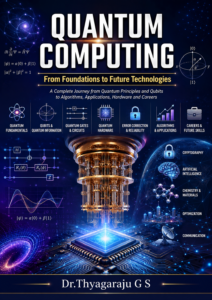
The evolution of computation has been one of humanity’s most transformative journeys—from mechanical calculators to silicon-based microprocessors that power today’s digital world. Yet, as classical computing approaches its physical and architectural limits, a new paradigm has emerged—Quantum Computing. Rooted in the principles of quantum mechanics, this field promises to revolutionize computation by enabling machines to perform certain tasks that are infeasible for even the most powerful classical supercomputers.
Quantum computing represents a fusion of physics, mathematics, and computer science, offering a fundamentally different approach to processing information. While classical computers use bits that exist in one of two states—0 or 1—quantum computers use quantum bits (qubits) that can exist in multiple states simultaneously. This capacity to explore a vast computational space concurrently makes quantum computing a powerful tool for solving complex problems in optimization, cryptography, materials science, and artificial intelligence.
•Quantum computing is a type of computing that leverages the principles of quantum mechanics to process the information.
•Quantum mechanics is the theory that describes the behavior of microscopic systems, such as photons, electrons, atoms, molecules, etc.
1.2 Classical vs Quantum Computation
To appreciate the essence of quantum computing, it is essential to contrast it with classical computation
| Aspect | Classical Computing | Quantum Computing |
|---|---|---|
| Basic Unit | Bit (0 or 1) | Qubit (superposition of 0 and 1) |
| Information Processing | Deterministic | Probabilistic and parallel |
| Logic Gates | Boolean gates (AND, OR, NOT) | Quantum gates (Hadamard, Pauli, CNOT) |
| Data Representation | Binary states | Quantum states represented by vectors in Hilbert space |
| Key Principle | Boolean algebra | Quantum mechanics (superposition, entanglement, interference) |
| Scalability | Linear with number of bits | Exponential with number of qubits |
In classical computing, doubling the number of bits doubles the representational power. In contrast, adding one qubit doubles the computational space, making n qubits capable of representing 2ⁿ states simultaneously. This exponential growth is what gives quantum computers their theoretical advantage.
1.3 The Foundations of Quantum Mechanics in Computing
Quantum computing rests on four key principles derived from quantum mechanics:
1.3.1 Superposition
A classical bit can be either 0 or 1, but a qubit can exist in a combination of both states simultaneously, represented as:

Superposition allows quantum computers to process multiple possibilities at once.
1.3.2 Entanglement
When two or more qubits become entangled, the state of one qubit becomes correlated with the state of another, regardless of the distance between them. This phenomenon enables quantum computers to perform coordinated computations across qubits—a resource that Einstein famously described as “spooky action at a distance.”
1.3.3 Interference
Quantum states can interfere constructively or destructively, amplifying the probability of correct outcomes while canceling incorrect ones. Quantum algorithms exploit interference to enhance computational efficiency.
1.3.4 Measurement
Measuring a qubit collapses its superposition into one of its basis states (0 or 1) with probabilities determined by its amplitudes. Measurement is thus both a source of information and a limitation, as it destroys the quantum state.
1.4 The Building Blocks of a Quantum Computer
A quantum computer consists of several interconnected components designed to manipulate and preserve delicate quantum states.
1.4.1 Qubits
Physical implementations of qubits vary across technologies:
- Superconducting Qubits (IBM, Google)
- Trapped Ions (IonQ)
- Topological Qubits (Microsoft)
- Photonic Qubits (Xanadu)
Each technology offers trade-offs between scalability, stability, and error rates.
1.4.2 Quantum Gates
Quantum gates perform operations on qubits through unitary transformations. Common gates include:
- Hadamard (H) – creates superposition.
- Pauli-X, Y, Z – quantum analogues of NOT operations.
- CNOT (Controlled-NOT) – enables entanglement between qubits.
1.4.3 Quantum Circuits
Quantum algorithms are expressed as circuits, where qubits flow through a sequence of gates, analogous to logic circuits in classical computation.
1.4.4 Quantum Error Correction
Quantum states are fragile and susceptible to noise and decoherence. Quantum error correction codes (like the Shor or Surface code) encode logical qubits into multiple physical qubits to protect against errors.
1.5 Quantum Algorithms
Quantum algorithms leverage the principles of superposition, entanglement, and interference to achieve speedups over classical methods.
- Shor’s Algorithm (1994): Efficient integer factorization, threatening classical cryptography (RSA).
- Grover’s Algorithm (1996): Quadratic speedup for unstructured search problems.
- Quantum Fourier Transform (QFT): Core of many quantum algorithms, enabling phase estimation and period finding.
- Quantum Approximate Optimization Algorithm (QAOA) and Variational Quantum Eigensolver (VQE): Hybrid algorithms suited for near-term quantum devices.
These algorithms highlight quantum computing’s potential to outperform classical computation in select domains, though not universally.
1.6 Quantum Hardware and Architectures
Quantum computers exist in various forms depending on qubit implementation:
- Superconducting Quantum Computers (e.g., IBM Quantum, Google Sycamore)
- Ion Trap Systems (e.g., IonQ, Honeywell)
- Photonic Systems (e.g., Xanadu, PsiQuantum)
- Quantum Annealers (e.g., D-Wave) — specialized for optimization problems.
Each platform faces engineering challenges—maintaining qubit coherence, minimizing gate errors, and achieving scalability to thousands or millions of qubits.
1.7 Quantum Supremacy and Beyond
In 2019, Google announced achieving quantum supremacy, claiming its 53-qubit Sycamore processor performed a specific computation faster than any classical supercomputer could. While the claim remains debated, it marked a milestone in demonstrating the feasibility of quantum computation at scale.
However, the true goal extends beyond supremacy toward quantum advantage—where quantum computers solve practical, real-world problems more efficiently than classical systems.
1.8 Applications of Quantum Computing
Quantum computing holds transformative potential across diverse fields:
| Domain | Potential Application |
|---|---|
| Cryptography | Breaking RSA, developing quantum-safe encryption |
| Optimization | Portfolio management, logistics, scheduling |
| Materials Science | Simulating molecular structures, new materials |
| Drug Discovery | Predicting molecular interactions |
| Artificial Intelligence | Quantum machine learning, faster training, and feature extraction |
| Climate and Energy | Modeling energy systems, optimizing grids |
1.9 Challenges in Quantum Computing
Despite rapid advances, several challenges remain:
- Decoherence and Noise: Quantum states are highly sensitive to environmental disturbances.
- Error Correction: Requires large numbers of physical qubits per logical qubit.
- Scalability: Building systems with millions of stable qubits is a major engineering hurdle.
- Algorithmic Development: Few algorithms currently exploit quantum advantage.
- Resource Requirements: Cryogenic environments and precise control systems are costly and complex.
1.10 The Future of Quantum Computing
The future of quantum computing is hybrid—integrating quantum and classical processors to solve complex tasks collaboratively. Emerging paradigms such as Quantum Machine Learning (QML), Quantum Artificial Intelligence (QAI), and Quantum Internet signal a transformative future where computation, communication, and cognition converge.
As research progresses, Quantum Artificial Intelligence may redefine how machines learn and reason—leveraging quantum principles to emulate aspects of human cognition, parallelism, and uncertainty.
1.11. Where quantum computers help — and where they don’t
Quantum computers are expected to help where quantum resources naturally map to the problem:
- Excellent candidates: quantum chemistry and materials simulation (simulating quantum systems), some optimization problems, certain linear algebra subroutines, cryptographic tasks (Shor).
- Less promising / unchanged: general-purpose classical tasks (word processing, most web tasks) will still be done by classical computers. There is no known quantum algorithm that gives a superpolynomial speedup for every machine learning task or everyday computation.
Quantum advantage means a quantum device performs a useful task faster or more efficiently than the best classical algorithm on the best classical hardware. Demonstrating practical quantum advantage for real-world tasks beyond synthetic benchmarks is a major research goal.
1.12. Quantum hardware (overview)
Quantum computers are physical devices. Several platforms are under active development:
- Superconducting qubits: fast gates, used by many major labs. Qubits are superconducting circuits operating at millikelvin temperatures.
- Trapped ions: long coherence times and high-fidelity gates; qubits are internal states of ions held in electromagnetic traps.
- Photonic systems: use light (photons) as qubits — promising for room-temperature systems and communication.
- Spin qubits (silicon): leverage semiconductor fabrication techniques.
- Neutral atoms / Rydberg: arrays of atoms manipulated by lasers.
All platforms face noise: decoherence, gate errors, measurement errors. Near-term devices are called NISQ (Noisy Intermediate-Scale Quantum) devices: tens to low hundreds of qubits but noisy and without full error correction.
1.13. Noise, error correction, and scalability
- Noise: random errors caused by environment interactions and imperfect gates. Noise limits the depth of quantum circuits we can execute reliably.
- Error mitigation: NISQ-era techniques that reduce the effect of noise without full error correction (e.g., extrapolation, probabilistic error cancellation).
- Error correction: logical qubits built from many physical qubits using quantum error-correcting codes (e.g., surface codes). Full fault-tolerant quantum computing requires significant overhead.
Scaling to millions of physical qubits (for useful fault-tolerant machines for algorithms like Shor on RSA-sized numbers) is a huge engineering challenge.
1.14. Programming quantum computers
Programming quantum computers currently involves:
- Circuit-level languages: describe gates and measurements (e.g., OpenQASM-style).
- Higher-level frameworks: libraries that integrate with classical optimization loops for variational algorithms (Qiskit, Cirq, Pennylane, TensorFlow Quantum, etc.).
- Hybrid algorithms: classical code controls parameter updates for parameterized quantum circuits (variational quantum eigensolver, quantum approximate optimization algorithm).
A typical workflow: prepare initial state → apply parameterized circuit → measure to obtain expectation values → use classical optimizer to update parameters → repeat.ryptography when scaled and error-corrected.
1.15 Conclusion
Quantum computing represents not merely an incremental technological advance but a paradigm shift in how we conceptualize information and computation. It embodies the intersection of physics and computation, promising exponential acceleration for certain classes of problems while inviting profound philosophical and scientific questions about the nature of information, randomness, and reality itself.
In essence, quantum computing stands as the frontier of the next computational revolution, one that may ultimately redefine our understanding of intelligence—both artificial and natural.