
4.1 Introduction
For over half a century, classical computers have been the backbone of human progress — driving scientific discovery, communication, and automation. Built on the foundation of binary logic, these machines process information using bits, which can be in one of two states: 0 or 1.
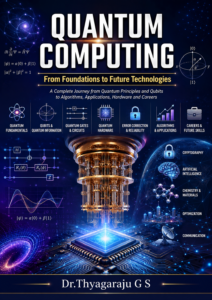
However, as problems grow more complex and data sets larger, classical computing approaches reach physical and practical limits. Enter quantum computing, a revolutionary paradigm that leverages the laws of quantum mechanics to process information in ways unimaginable for classical systems.
This chapter explores the key differences between classical and quantum computing — from their physical principles to their computational power — and examines how quantum mechanics transforms computation.
4.2 Fundamentals of Classical Computing
4.2.1 The Bit: Building Block of Classical Information
In a classical computer, all information is encoded in bits — the smallest unit of data. A bit can be in one of two definite states, 0 or 1, corresponding to low or high voltage in electronic circuits.
For example:
- A byte is made up of 8 bits.
- The binary number
10110010represents a particular configuration of voltages in hardware.
4.2.2 Logic Gates and Deterministic Processing
Classical computation operates through logic gates such as AND, OR, and NOT. These gates manipulate bits according to deterministic rules.
Example:
- AND gate outputs 1 only if both inputs are 1.
| Input A | Input B | Output (A AND B) |
|---|---|---|
| 0 | 0 | 0 |
| 0 | 1 | 0 |
| 1 | 0 | 0 |
| 1 | 1 | 1 |
4.3 Fundamentals of Quantum Computing
4.3.1 The Qubit: Quantum Unit of Information
In contrast to bits, quantum bits (qubits) are governed by quantum mechanics. A qubit can exist not just in a definite 0 or 1 state but in a superposition of both.
Mathematically, a qubit’s state is represented as:
∣ψ⟩=α∣0⟩+β∣1⟩

This means that before measurement, the qubit simultaneously represents 0 and 1 in a weighted combination — enabling massive parallelism in computation.
4.3.2 Superposition: Computing in Many States at Once
Consider a classical 3-bit system: it can be in one of 2**3 = 8 possible states at any given time. But 3 qubits can represent all 8 states simultaneously due to superposition.
Example: A quantum computer with 50 qubits can represent 2**50 states at once — over a quadrillion possible combinations.
4.3.3 Entanglement: Correlation Beyond Classical Limits
Entanglement is a uniquely quantum phenomenon where the state of one qubit is linked to another, no matter how far apart they are.
If two qubits are entangled, measuring one instantly determines the state of the other.
This property allows quantum algorithms to coordinate qubits in ways impossible for classical bits.
For instance:

Here, measuring one qubit as 0 immediately means the other is also 0; if one is 1, so is the other.
4.3.4 Quantum Gates: Rotations Instead of Logic
Quantum gates manipulate qubits through unitary transformations — reversible operations that rotate the qubit’s state on the Bloch sphere.
Examples:

Unlike classical gates, quantum gates are reversible, ensuring that no information is lost — a core requirement of quantum evolution.
4.4 Comparison Between Classical and Quantum Computing
| Feature | Classical Computing | Quantum Computing |
|---|---|---|
| Unit of information | Bit (0 or 1) | Qubit (superposition of 0 and 1) |
| Processing model | Deterministic | Probabilistic (wavefunction collapse) |
| Information representation | Binary logic | Quantum states (complex amplitudes) |
| Parallelism | Sequential or limited (multi-core) | Exponential through superposition |
| Error correction | Straightforward | Complex due to decoherence |
| Hardware | Transistors, silicon chips | Superconducting circuits, trapped ions, photons |
| Example algorithm | Binary search, sorting, encryption | Shor’s algorithm, Grover’s algorithm |
| Best use cases | General-purpose computing | Optimization, simulation, cryptanalysis |
4.5 Example: Searching a Database
Let’s illustrate the power difference through searching an unsorted database.
Classical Approach
If you have N entries, a classical computer must check — on average — N/2 entries to find the target.
Quantum Approach
Using Grover’s algorithm, a quantum computer can find the correct entry in approximately

steps — a quadratic speed-up.
For example:
- With N=1,000,000 entries
- Classical search: ~500,000 steps
- Quantum search: ~1,000 steps
This efficiency grows dramatically with larger datasets.
4.6 Example: Breaking RSA Encryption
Modern internet security (RSA) relies on the difficulty of factoring large numbers.
Classical Computation
Factoring a 2048-bit number would take classical supercomputers billions of years.
Quantum Computation
Using Shor’s algorithm, a quantum computer could factor it in hours — exploiting quantum parallelism to test multiple factors simultaneously.
This is why quantum computing represents both a promise and a threat to cybersecurity.
4.7 Practical Challenges
Despite their theoretical power, quantum computers face significant hurdles:
- Decoherence — Qubits lose their quantum state due to interaction with the environment.
- Error Correction — Quantum states are fragile and require redundancy through quantum error correction codes.
- Scalability — Building and maintaining thousands of stable qubits is technologically demanding.
- Cryogenic Requirements — Superconducting qubits often operate near absolute zero.
Currently, most quantum computers are in the noisy intermediate-scale quantum (NISQ) era — useful for experimentation but not yet outperforming classical systems broadly.
4.8 The Future: Hybrid Computing
Many experts envision a hybrid model — combining classical and quantum systems.
Classical computers handle control, input/output, and data management, while quantum processors (QPUs) perform specific sub-tasks like optimization, molecular modeling, or cryptography.
Example:
A hybrid system could:
- Use a classical machine to preprocess molecular data.
- Use a quantum computer to simulate molecular interactions.
- Feed results back to the classical system for analysis.
This synergy could unlock breakthroughs in:
- Drug discovery
- Climate modeling
- Financial optimization
- Artificial intelligence
4.9 Conclusion
The difference between classical and quantum computing is not just one of speed — it’s one of nature. Classical computers are like precise calculators following deterministic rules; quantum computers are probabilistic explorers navigating the vast landscape of possibilities simultaneously.
While practical quantum computers are still in their infancy, their potential is transformative. As technology advances, the line between classical and quantum computation will blur — leading to a new era of quantum-enhanced intelligence.
….Dr.Thyagaraju G S