Abstract
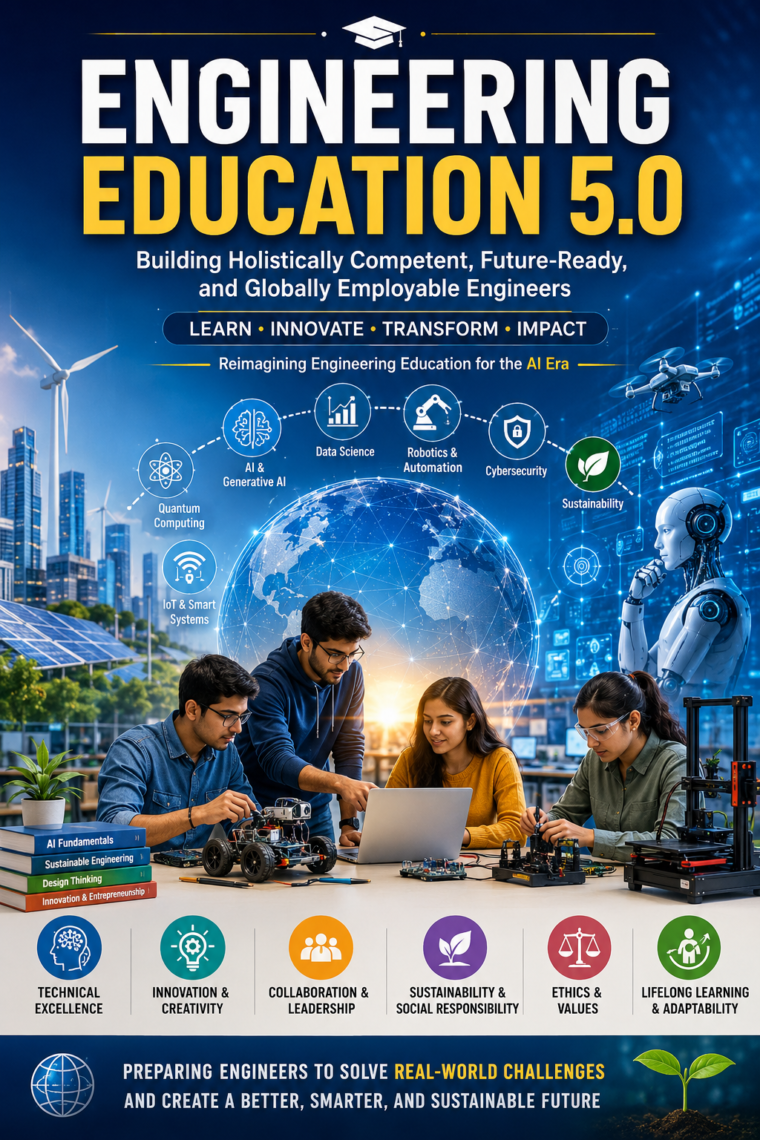
The twenty-first century is witnessing an unprecedented convergence of Artificial Intelligence (AI), Quantum Computing, Robotics, Biotechnology, Sustainable Engineering, Digital Transformation, and Human-Centered Innovation. Engineering graduates are expected not only to possess technical knowledge but also to demonstrate creativity, ethical responsibility, adaptability, emotional intelligence, entrepreneurial thinking, interdisciplinary collaboration, and lifelong learning abilities. While India has significantly expanded engineering education over the last three decades, employability, innovation capability, and global competitiveness remain major concerns. The challenge is no longer producing more engineering graduates but producing engineers capable of solving complex societal, industrial, and global problems.
This article proposes a transformative framework—Holistic Engineering Education 5.0 (HEE 5.0)—that integrates technical excellence with human values, contextual intelligence, sustainability, innovation, entrepreneurship, and AI-enabled lifelong learning. The proposed framework aims to prepare engineering graduates who are technically competent, emotionally intelligent, ethically responsible, globally employable, and future ready.
1. Introduction
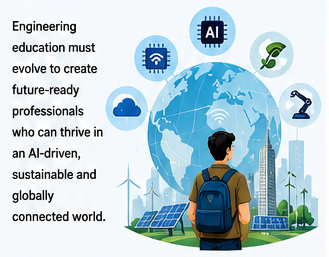
Engineering education has always been the backbone of technological progress. From the Industrial Revolution to the Information Age, engineers have transformed societies through innovation. Today, however, the world is entering an era fundamentally different from previous technological revolutions.
Consequently, engineering education must evolve beyond teaching technical concepts. Future engineers must be capable of integrating technology with humanity, innovation with ethics, and intelligence with wisdom.
- Artificial Intelligence is automating cognitive tasks.
- Generative AI is reshaping software development.
- Quantum Computing promises computational breakthroughs.
- Industry 5.0 emphasizes collaboration between humans and intelligent machines.
- Climate change demands sustainable engineering.
- Global industries require engineers capable of continuous adaptation rather than static expertise.
2. Why Traditional Engineering Education Is Becoming Obsolete
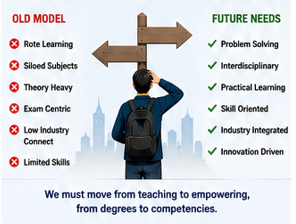
The conventional engineering education model primarily focuses on
- Curriculum completion
- Semester examinations
- Memorization-based learning
- Branch-specific specialization
- Laboratory experiments
- Placement-oriented preparation
Unfortunately, this approach creates graduates who possess degrees but often lack industrial competence.
Today’s employers seek engineers who can
- Solve unfamiliar problems.
- Learn emerging technologies independently.
- Collaborate globally.
- Work with AI systems.
- Lead innovation.
- Think critically.
- Design sustainable solutions.
The mismatch between education and industrial expectations has become the primary reason behind declining employability.
3. The Changing Global Engineering Landscape
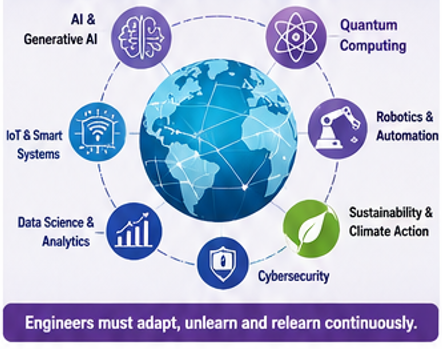
The engineering profession is undergoing one of the most significant transformations in history. Rapid advancements in Artificial Intelligence (AI), Generative AI, Quantum Computing, Robotics, the Internet of Things (IoT), Cloud Computing, Cybersecurity, and Sustainable Technologies are redefining how industries operate and how engineers solve real-world problems. Engineers are no longer expected to possess expertise only in their core discipline; they must also integrate digital technologies, data-driven decision-making, interdisciplinary collaboration, and human-centered innovation into their professional practice.
As organizations worldwide embrace Industry 5.0 and Society 5.0, the demand is shifting toward engineers who can continuously learn, adapt to emerging technologies, and develop sustainable, intelligent, and ethical solutions. Consequently, engineering education must evolve to equip graduates with the competencies required to thrive in this dynamic and technology-driven global ecosystem.
The following table highlights some of the major technological trends shaping the future of engineering and the corresponding competencies expected from modern engineering graduates.
| Emerging Trend | Engineering Requirement |
|---|---|
| Artificial Intelligence | AI Literacy |
| Generative AI | Prompt Engineering |
| Quantum Computing | Quantum Awareness |
| Robotics | Human–Robot Collaboration |
| Internet of Things (IoT) | Smart Systems Integration |
| Cybersecurity | Secure Engineering Practices |
| Data Science | Data-Driven Decision Making |
| Cloud Computing | Distributed and Cloud-Based Engineering |
| Digital Twins | Simulation and Virtual Engineering |
| Blockchain | Trustworthy Digital Systems |
| Clean Energy | Green Engineering Solutions |
| Sustainability | Sustainable Design and Circular Economy |
Engineering graduates must continuously learn, unlearn, and relearn to remain relevant in an era of rapid technological disruption. Future success will depend not only on mastering engineering fundamentals but also on embracing innovation, adaptability, ethical responsibility, and lifelong learning.
4. From Knowledge-Based Education to Competency-Based Education
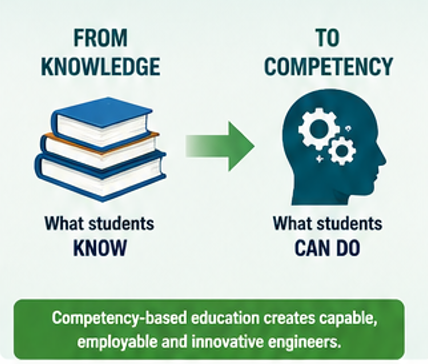
The primary objective of engineering education is no longer limited to imparting theoretical knowledge; it is to develop graduates who can effectively apply their knowledge to solve real-world engineering problems. In today’s rapidly evolving technological landscape, industries seek professionals who are capable of designing innovative solutions, working collaboratively in multidisciplinary teams, adapting to emerging technologies, and continuously upgrading their skills. Consequently, engineering education must transition from a knowledge-based approach to a competency-based approach.
Traditional engineering education has predominantly emphasized lectures, textbook learning, laboratory experiments with predefined outcomes, and semester-end examinations. While this approach provides a strong theoretical foundation, it often measures students based on their ability to recall concepts rather than their ability to apply them in practical situations. As a result, many graduates possess academic qualifications but face challenges in solving industrial problems, adapting to new technologies, or contributing effectively in professional environments.
Competency-Based Education (CBE) addresses this gap by focusing on the development of measurable knowledge, practical skills, professional attitudes, ethical values, and lifelong learning capabilities. It emphasizes what students are capable of doing rather than what they have memorized. Learning outcomes are clearly defined, and students demonstrate their competence through projects, prototypes, internships, research, innovation challenges, industry certifications, and real-world problem-solving activities.
For example, in a traditional programming course, students may be evaluated by writing code to solve textbook problems during examinations. In contrast, a competency-based approach requires students to design and develop a complete software application, integrate Artificial Intelligence tools, collaborate using version-control systems, deploy the application on cloud platforms, document the project professionally, and present their work before industry experts. Such experiences better reflect the expectations of modern employers.
Similarly, a Mechanical Engineering student should not merely study the theory of machine components but should be able to design a component using CAD software, perform simulation and finite element analysis, fabricate a prototype using additive manufacturing techniques, evaluate its performance, and recommend design improvements based on testing results.
In Civil Engineering, instead of focusing solely on structural analysis calculations, students should participate in smart city projects, use Building Information Modeling (BIM), Geographic Information Systems (GIS), drone-based surveying, and sustainability assessment tools to design resilient and environmentally responsible infrastructure.
Likewise, Electronics and Electrical Engineering students should gain hands-on experience in designing Internet of Things (IoT) systems, embedded devices, intelligent control systems, renewable energy applications, and AI-enabled automation solutions rather than limiting their learning to circuit analysis and simulations.
Competency-based engineering education also encourages interdisciplinary learning, where students from different engineering disciplines collaborate to solve complex societal challenges. For instance, developing an autonomous electric vehicle requires expertise in mechanical design, electronics, artificial intelligence, computer vision, cybersecurity, communication systems, and business management. Such interdisciplinary projects cultivate teamwork, leadership, creativity, communication, and systems thinking.
To achieve this transformation, engineering institutions should adopt innovative teaching-learning methodologies such as Project-Based Learning (PBL), Problem-Based Learning, Experiential Learning, Design Thinking, Challenge-Based Learning, Industry-Sponsored Projects, Hackathons, Research Internships, Virtual Laboratories, and AI-assisted Personalized Learning. These approaches enable students to learn by doing, experimenting, reflecting, and continuously improving their performance.
The assessment system must also evolve accordingly. Instead of relying predominantly on written examinations, student performance should be evaluated using multiple evidence-based methods, including project demonstrations, design portfolios, research publications, prototype development, industry certifications, internships, technical presentations, peer evaluation, and community engagement activities. Such comprehensive assessment provides a more accurate measure of students’ competencies and professional readiness.
The shift from knowledge-based education to competency-based education aligns with the principles of Outcome-Based Education (OBE), the Washington Accord Graduate Attributes, National Education Policy (NEP) 2020, NBA accreditation standards, and the emerging requirements of Industry 5.0. It prepares graduates not only to secure employment but also to become innovators, entrepreneurs, researchers, technology leaders, and responsible global citizens.
Table 4.1: Knowledge-Based Education vs. Competency-Based Education
| Knowledge-Based Education | Competency-Based Education |
|---|---|
| Focuses on content coverage | Focuses on demonstrable competencies |
| Teacher-centered learning | Student-centered learning |
| Emphasizes memorization | Emphasizes application and problem-solving |
| Theory-oriented | Practice- and project-oriented |
| Examination-driven assessment | Continuous competency assessment |
| Individual learning | Collaborative and interdisciplinary learning |
| Fixed curriculum | Flexible and adaptive curriculum |
| Limited industry exposure | Strong industry integration |
| Degree-oriented | Skill- and career-oriented |
| Learning ends with graduation | Promotes lifelong learning and continuous upskilling |
Ultimately, the future of engineering education lies not in producing graduates who merely possess knowledge, but in nurturing professionals who can think critically, innovate creatively, solve complex problems, collaborate effectively, lead responsibly, and adapt confidently to an ever-changing technological world. Competency-based education is therefore the foundation for creating engineers who are holistically competent, globally competitive, and future-ready.
5. Holistic Engineering Education 5.0 Framework
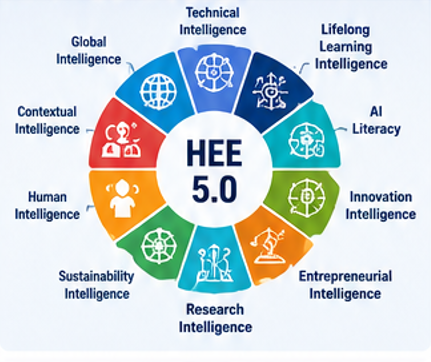
A future-ready engineer should be developed across ten interconnected dimensions.
A. Technical Intelligence
Students should master
- Core Engineering
- Mathematics
- Programming
- AI
- Data Science
- Robotics
- Cloud Computing
- Cybersecurity
B. Contextual Intelligence
Students should learn to understand
- User needs
- Business context
- Social impact
- Environmental conditions
- Cultural diversity
- Economic feasibility
Technology without context often fails.
C. Human Intelligence
Engineering graduates should possess
- Emotional Intelligence
- Empathy
- Self-awareness
- Stress management
- Ethical reasoning
- Conflict resolution
The future engineer will work with humans as much as with machines.
D. Artificial Intelligence Literacy
Every engineering graduate should understand
- Machine Learning
- Deep Learning
- Generative AI
- Large Language Models
- AI Agents
- AI Ethics
- AI Governance
AI should become a foundational skill similar to computer literacy.
E. Innovation Intelligence
Students should continuously engage in
- Design Thinking
- Reverse Engineering
- Product Innovation
- Patent Development
- Prototype Creation
- Startup Incubation
F. Entrepreneurial Intelligence
Graduates should learn
- Business Models
- Financial Literacy
- Product Commercialization
- Marketing
- Venture Creation
- Intellectual Property
Job creators are as important as job seekers.
G. Research Intelligence
Every undergraduate should experience
- Literature Review
- Scientific Writing
- Experimental Design
- Data Analysis
- Publication
- Patent Filing
Research develops analytical thinking.
H. Sustainability Intelligence
Future engineers must understand
- Green Engineering
- Circular Economy
- Renewable Energy
- Carbon Reduction
- Sustainable Manufacturing
Engineering should benefit both humanity and the planet.
I. Global Intelligence
Students should develop
- Cross-cultural communication
- International collaboration
- Global engineering standards
- Washington Accord Graduate Attributes
- Digital collaboration
J. Lifelong Learning Intelligence
Since technologies evolve rapidly, engineers must continuously learn through
- Micro-credentials
- MOOCs
- Online certifications
- Industry workshops
- Research communities
Graduation should mark the beginning—not the end—of learning.
6. AI-Integrated Engineering Curriculum
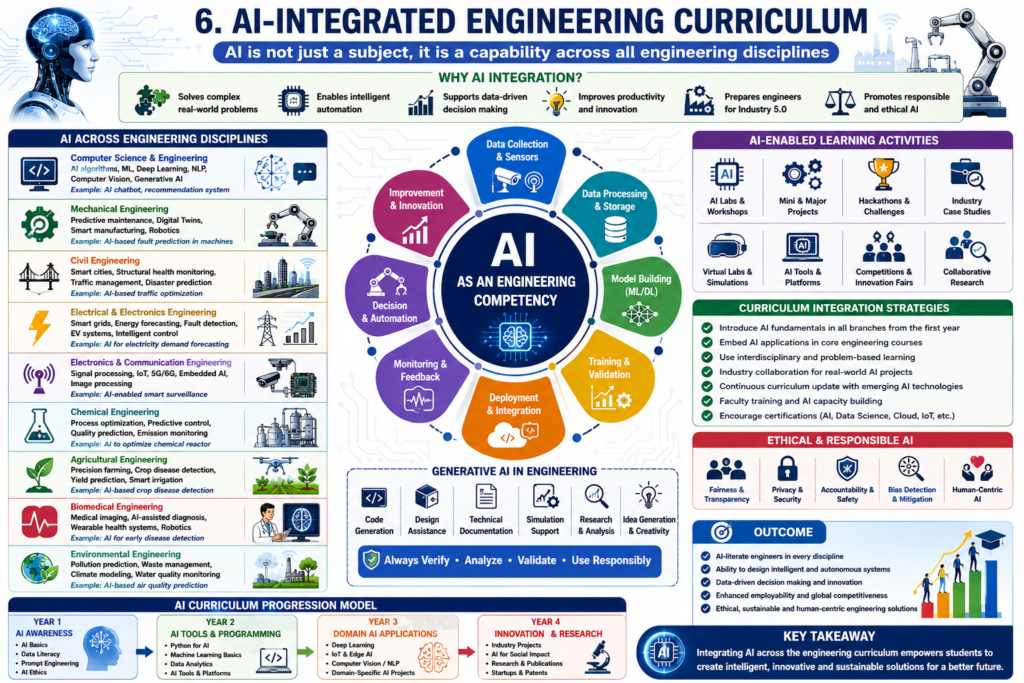
Artificial Intelligence (AI) has emerged as one of the most transformative technologies of the twenty-first century, reshaping nearly every engineering discipline and industrial sector. From intelligent manufacturing and autonomous vehicles to smart healthcare, precision agriculture, sustainable energy, cybersecurity, and digital governance, AI is driving innovation at an unprecedented pace. Consequently, engineering education must move beyond offering AI as an elective or standalone specialization and instead integrate AI concepts, tools, and applications throughout the engineering curriculum.
The objective is not to transform every engineering student into an AI scientist, but to ensure that every engineering graduate understands how AI can enhance problem-solving, improve decision-making, automate complex processes, and create intelligent engineering systems within their respective domains. AI literacy should become as fundamental as mathematics, programming, and engineering science.
Why AI Integration Is Essential
Industries are increasingly seeking engineers who can work effectively with intelligent systems rather than compete against them. AI-powered tools are now assisting engineers in product design, simulation, predictive maintenance, quality assurance, software development, customer support, project management, and research. Engineers who understand how to leverage AI will be significantly more productive, innovative, and adaptable than those who rely solely on conventional methods.
An AI-integrated curriculum equips students to:
- Analyze and interpret large volumes of engineering data.
- Design intelligent and autonomous systems.
- Develop AI-assisted engineering solutions.
- Use Generative AI for design, coding, documentation, and simulation.
- Make data-driven engineering decisions.
- Improve productivity through intelligent automation.
- Understand ethical, legal, and societal implications of AI.
- Continuously adapt to rapidly evolving technological advancements.
Thus, AI should be viewed not merely as a programming tool but as a thinking partner that augments human creativity, engineering judgment, and innovation.
AI Across Engineering Disciplines
Instead of confining AI to Computer Science programs, engineering institutions should embed AI applications into every engineering discipline through contextual learning and domain-specific projects.
Computer Science and Engineering
Students should learn to develop intelligent software systems using Machine Learning, Deep Learning, Natural Language Processing, Computer Vision, Generative AI, AI Agents, and Large Language Models. Practical activities may include designing AI-powered chatbots, recommendation systems, autonomous coding assistants, fraud detection systems, intelligent search engines, and virtual assistants.
Mechanical Engineering
Mechanical engineers increasingly rely on AI for predictive maintenance, digital twins, smart manufacturing, autonomous robots, additive manufacturing, and intelligent quality inspection. Students should work on projects involving machine health monitoring using sensor data, AI-based fault prediction, robotic assembly systems, and optimization of manufacturing processes.
Example: Developing an AI system that predicts bearing failures in industrial machines using vibration sensor data can significantly reduce maintenance costs and unplanned downtime.
Civil Engineering
AI is revolutionizing infrastructure planning, structural health monitoring, traffic management, disaster prediction, and smart city development. Students should learn to analyze satellite imagery, drone-based inspection data, and sensor information to improve infrastructure safety and sustainability.
Example: Designing an AI-enabled traffic management system that optimizes traffic signal timing based on real-time vehicle density to reduce congestion and fuel consumption.
Electrical and Electronics Engineering
Modern power systems, renewable energy grids, electric vehicles, and intelligent control systems increasingly depend on AI. Students should explore AI-based energy forecasting, smart grid management, intelligent fault detection, embedded AI systems, and power optimization.
Example: Developing an AI model to forecast electricity demand enables power utilities to optimize energy generation and distribution efficiently.
Electronics and Communication Engineering
AI applications include wireless communication optimization, image processing, intelligent signal analysis, 5G/6G networks, embedded vision systems, and Internet of Things (IoT) devices. Students should integrate AI with sensors, microcontrollers, communication protocols, and edge computing platforms.
Example: Designing a smart surveillance system capable of automatically detecting suspicious activities using computer vision algorithms.
Chemical Engineering
Chemical engineers can leverage AI for process optimization, predictive control, quality assurance, energy-efficient production, and environmental monitoring.
Example: Using Machine Learning algorithms to optimize chemical reactor parameters, reducing energy consumption while maximizing production efficiency.
Agricultural Engineering
AI supports precision agriculture through intelligent irrigation, crop disease detection, yield prediction, autonomous farming equipment, and climate-smart agriculture.
Example: Developing a smartphone-based AI application that identifies crop diseases from leaf images and recommends appropriate treatment.
Biomedical Engineering
Healthcare has become one of the largest beneficiaries of AI technologies. Biomedical engineers should understand AI-assisted diagnosis, medical imaging, wearable health monitoring devices, robotic surgery, and personalized healthcare.
Example: Designing an AI-assisted diagnostic system capable of detecting diabetic retinopathy from retinal images with high accuracy.
Environmental Engineering
AI enables intelligent environmental monitoring, pollution prediction, waste management, biodiversity conservation, and climate change mitigation.
Example: Building an AI-based air quality prediction model that provides early warnings and supports environmental policy decisions.
Integrating Generative AI into Engineering Education
The emergence of Generative AI has fundamentally changed engineering workflows. Engineers can now generate design alternatives, write software code, prepare technical documentation, analyze research papers, create simulations, and develop prototypes with the assistance of AI-powered systems.
Engineering students should be trained to use Generative AI responsibly for:
- Software development and debugging.
- CAD model generation and optimization.
- Technical report writing.
- Research literature review.
- Engineering calculations.
- Simulation assistance.
- Technical presentations.
- Documentation and project planning.
- Requirement analysis.
- Rapid prototyping.
However, students must also learn to critically evaluate AI-generated outputs, verify technical accuracy, and maintain professional responsibility rather than relying blindly on automated systems.
AI-Enabled Learning Activities
Engineering curricula should include diverse AI-driven learning experiences such as:
- AI-assisted laboratory experiments.
- Intelligent simulation exercises.
- Industry-sponsored AI projects.
- Hackathons focusing on societal challenges.
- Smart product development competitions.
- AI-powered virtual laboratories.
- Digital twin simulations.
- Robotics and automation projects.
- Multidisciplinary innovation challenges.
- Community-based AI solutions.
These activities encourage experiential learning while strengthening creativity, collaboration, and innovation.
Ethical and Responsible AI Education
Technical proficiency alone is insufficient for future engineers. Students must also understand the ethical implications of AI, including fairness, transparency, accountability, privacy, cybersecurity, intellectual property, environmental sustainability, and human rights.
Topics such as Responsible AI, Explainable AI, AI Governance, Bias Detection, Data Privacy, and Ethical Decision-Making should be integrated throughout engineering education to ensure that graduates develop trustworthy and socially responsible AI solutions.
Curriculum Transformation Strategies
To successfully integrate AI across engineering education, institutions should adopt the following strategies:
- Introduce AI fundamentals during the first year for all engineering students.
- Embed AI applications into every engineering discipline rather than treating AI as an isolated subject.
- Encourage interdisciplinary AI projects involving multiple departments.
- Partner with industries to offer AI-based internships, live projects, and certification programs.
- Establish AI Innovation Labs equipped with modern software platforms, GPUs, robotics kits, IoT devices, and cloud-based computing resources.
- Train faculty members in emerging AI technologies and modern pedagogical practices.
- Continuously revise curricula to incorporate the latest developments in AI, Generative AI, Agentic AI, Edge AI, Quantum AI, and Human-AI Collaboration.
AI Curriculum Progression Model
An effective AI-integrated curriculum can be progressively structured across four years:
| Academic Year | AI Learning Focus | Representative Learning Activities |
|---|---|---|
| First Year | AI Awareness and Digital Literacy | Fundamentals of AI, Prompt Engineering, Data Literacy, AI Ethics |
| Second Year | AI Tools and Programming | Python, Machine Learning Basics, Data Analytics, Intelligent Simulations |
| Third Year | Domain-Specific AI Applications | AI Projects within Engineering Disciplines, IoT, Robotics, Computer Vision |
| Fourth Year | Innovation, Research, and Entrepreneurship | Industry Projects, AI Startups, Research Publications, Patents, Capstone Projects |
Outcome of an AI-Integrated Curriculum
An AI-integrated engineering curriculum prepares graduates who can confidently collaborate with intelligent technologies, solve multidisciplinary problems, and create innovative solutions for society and industry. Rather than replacing engineers, AI empowers them to become more productive, creative, and strategic in addressing complex engineering challenges.
The engineering graduate of the future will therefore be distinguished not merely by technical expertise but by the ability to integrate engineering knowledge, artificial intelligence, human intelligence, ethical reasoning, and lifelong learning to build intelligent, sustainable, and socially beneficial technologies for an increasingly connected world.
7. Industry-Integrated Learning Ecosystem
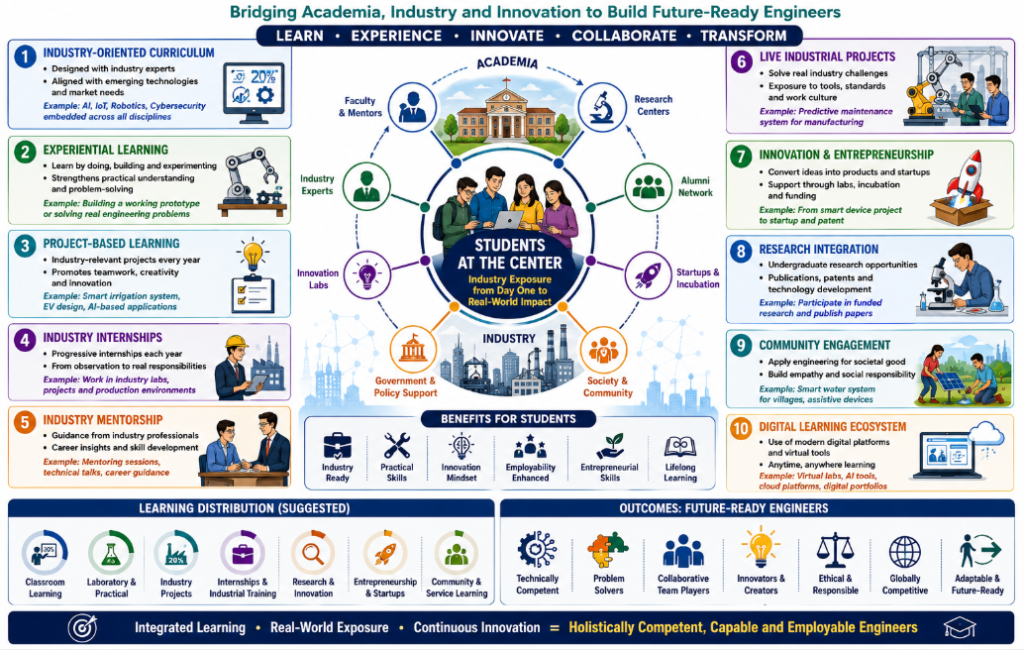
The rapid pace of technological innovation has fundamentally changed the expectations of employers worldwide. Modern industries no longer seek graduates who merely possess theoretical knowledge; instead, they require professionals who can immediately contribute to solving real-world problems, collaborate effectively in multidisciplinary teams, utilize emerging technologies, and continuously adapt to changing industrial environments. Consequently, engineering institutions must transform from being knowledge-delivery centers into innovation ecosystems where students acquire practical competencies through continuous interaction with industry.
An Industry-Integrated Learning Ecosystem (IILE) is a collaborative educational model in which academic institutions, industries, research organizations, startups, government agencies, alumni, and society jointly contribute to developing future-ready engineers. In this ecosystem, learning extends beyond classrooms and laboratories into manufacturing industries, research laboratories, innovation centers, incubation hubs, community projects, and digital learning platforms.
Unlike the traditional model, where industry interaction is often limited to a short internship during the final year, the Industry-Integrated Learning Ecosystem embeds industrial exposure throughout the entire engineering program. Students progressively develop technical expertise, professional skills, innovation capability, and entrepreneurial thinking by working on authentic industrial challenges from the first year onwards.
Objectives of an Industry-Integrated Learning Ecosystem
The primary objectives of integrating industry into engineering education are to:
- Bridge the gap between academic learning and industrial practice.
- Improve graduate employability by developing job-ready competencies.
- Enhance practical problem-solving and engineering design skills.
- Promote innovation, product development, and entrepreneurship.
- Encourage interdisciplinary collaboration and systems thinking.
- Strengthen research and technology transfer.
- Cultivate lifelong learning habits aligned with rapidly evolving technologies.
- Develop engineers capable of contributing to national and global technological advancement.
By integrating industrial practices into the curriculum, students gain confidence, professional maturity, and a deeper understanding of engineering applications.
Key Components of the Industry-Integrated Learning Ecosystem
1. Industry-Oriented Curriculum
Engineering curricula should be developed collaboratively with industry experts to ensure alignment with current and emerging technological requirements. Curriculum revision should be a continuous process rather than occurring once every few years.
Topics such as Artificial Intelligence, Data Analytics, Cybersecurity, Robotics, Internet of Things, Cloud Computing, Digital Twins, Sustainable Engineering, Electric Vehicles, Semiconductor Technologies, Industry 5.0, and Human-AI Collaboration should be incorporated across relevant disciplines.
Example: An Electronics Engineering course on Embedded Systems may include AI-enabled IoT device development using Raspberry Pi or ESP32 platforms, enabling students to work on technologies currently used in smart industries.
2. Experiential Learning
Students learn engineering most effectively by designing, building, testing, experimenting, and improving real systems. Therefore, experiential learning should become a core component of every engineering program.
Learning activities may include:
- Laboratory experiments
- Mini-projects
- Product development
- Reverse engineering
- Prototype fabrication
- Community engineering projects
- Design competitions
- Industrial simulations
Example: Mechanical Engineering students can design and fabricate a low-cost automated material handling system for a local manufacturing company instead of performing only predefined laboratory experiments.
3. Project-Based Learning (PBL)
Project-Based Learning encourages students to integrate knowledge from multiple subjects while solving practical engineering problems. Projects should gradually increase in complexity from the first year to the final year.
Examples include:
First Year
- Smart home automation system.
- Water quality monitoring device.
- Solar-powered mobile charger.
Second Year
- AI-based attendance system.
- Autonomous line-following robot.
- Smart irrigation controller.
Third Year
- Electric vehicle battery monitoring system.
- AI-enabled crop disease detection.
- Intelligent traffic monitoring.
Final Year
- Industry-sponsored automation project.
- Digital Twin for manufacturing.
- AI-powered predictive maintenance platform.
- Sustainable energy optimization system.
Such projects encourage teamwork, creativity, communication, documentation, and innovation.
4. Industry Internships
Internships should no longer be viewed as isolated academic requirements but as structured learning experiences integrated throughout the curriculum.
A progressive internship model may include:
| Academic Year | Internship Focus |
|---|---|
| First Year | Industrial Visits and Observation |
| Second Year | Skill Development Internship |
| Third Year | Domain-Specific Industrial Internship |
| Final Year | Research, Innovation, Product Development, or Startup Internship |
Example: A Computer Science student may spend the second year learning software development practices, the third year working on AI-based applications in a software company, and the final year developing an industrial product under joint academic and industrial supervision.
5. Industry Mentorship
Every student should have access to both an academic mentor and an industry mentor. While faculty members guide conceptual understanding and academic progress, industry mentors provide insights into professional practices, emerging technologies, workplace expectations, and career planning.
Industry mentorship enables students to understand:
- Industrial workflows.
- Software development practices.
- Engineering standards.
- Professional ethics.
- Team collaboration.
- Project management.
- Career opportunities.
Regular mentor interactions significantly improve students’ confidence and professional readiness.
6. Live Industrial Projects
Instead of relying solely on hypothetical case studies, students should work on actual industrial challenges provided by partner organizations.
Examples include:
- AI-based predictive maintenance for manufacturing equipment.
- Energy optimization in industrial plants.
- Warehouse automation using autonomous robots.
- Smart campus management systems.
- Healthcare monitoring applications.
- Intelligent transportation systems.
Working on live projects exposes students to customer requirements, engineering constraints, budgets, deadlines, and quality standards.
7. Innovation and Entrepreneurship
Engineering education should encourage students to become technology creators rather than merely technology users.
Institutions should establish:
- Innovation Labs
- Maker Spaces
- Fabrication Laboratories
- Startup Incubation Centers
- Entrepreneurship Development Cells
- Intellectual Property Cells
Students should be encouraged to:
- Develop innovative products.
- File patents.
- Participate in startup competitions.
- Launch technology ventures.
- Commercialize research outcomes.
Example: A multidisciplinary team may develop an AI-enabled healthcare monitoring device that evolves from a classroom project into a commercial startup.
8. Research Integration
Research should begin at the undergraduate level rather than being limited to postgraduate education.
Students should participate in:
- Faculty research projects.
- Industry-sponsored research.
- National innovation challenges.
- International competitions.
- Scientific conferences.
- Research publications.
- Patent development.
This exposure develops analytical thinking, scientific inquiry, and evidence-based problem-solving.
9. Community and Societal Engagement
Engineering education should also prepare students to address societal needs through technology.
Community-based engineering projects may involve:
- Smart village initiatives.
- Renewable energy systems.
- Water conservation.
- Assistive technologies for persons with disabilities.
- Healthcare monitoring.
- Waste management.
- Sustainable agriculture.
Example: Civil, Electrical, and Computer Science students can collaboratively develop a smart water management system for rural communities using IoT sensors and AI-based analytics.
Such projects cultivate empathy, ethical responsibility, leadership, and sustainable thinking.
10. Digital Learning Ecosystem
Modern engineering education should integrate digital platforms that support flexible, personalized, and continuous learning.
Students should regularly use:
- Virtual Laboratories.
- Cloud Computing Platforms.
- AI-assisted Learning Systems.
- Digital Twin Simulations.
- Online Industry Certifications.
- Learning Management Systems.
- Collaborative Development Platforms.
- Version Control Systems.
- Digital Portfolios.
These platforms enable students to learn anytime, anywhere while collaborating with peers and industry professionals globally.
Recommended Learning Distribution
To create a balanced learning ecosystem, engineering education should combine theoretical understanding with practical exposure.
| Learning Component | Recommended Weightage |
|---|---|
| Classroom Learning | 30% |
| Laboratory and Practical Sessions | 20% |
| Industry Projects | 20% |
| Internships and Industrial Training | 10% |
| Research and Innovation | 10% |
| Entrepreneurship and Startup Activities | 5% |
| Community Engagement and Service Learning | 5% |
This balanced distribution ensures that students develop technical knowledge, practical skills, innovation capability, professional competence, and social responsibility simultaneously.
Expected Outcomes
An effective Industry-Integrated Learning Ecosystem produces graduates who are:
- Technically competent and industry-ready.
- Skilled in solving real-world engineering problems.
- Proficient in emerging technologies such as AI, Robotics, IoT, and Cloud Computing.
- Effective communicators and collaborative team members.
- Innovative thinkers capable of designing commercially viable products.
- Entrepreneurial and research-oriented.
- Ethically responsible and environmentally conscious.
- Adaptable to technological disruptions and lifelong learning.
- Globally competitive professionals equipped for Industry 5.0.
Rather than waiting until graduation to experience professional practice, students continuously engage with industry throughout their academic journey. This seamless integration of academia, industry, research, innovation, entrepreneurship, and societal engagement transforms engineering education into a dynamic learning ecosystem that develops holistically competent, capable, adaptable, and highly employable engineers ready to contribute to a rapidly evolving global economy.
8. The New Engineering Graduate Profile
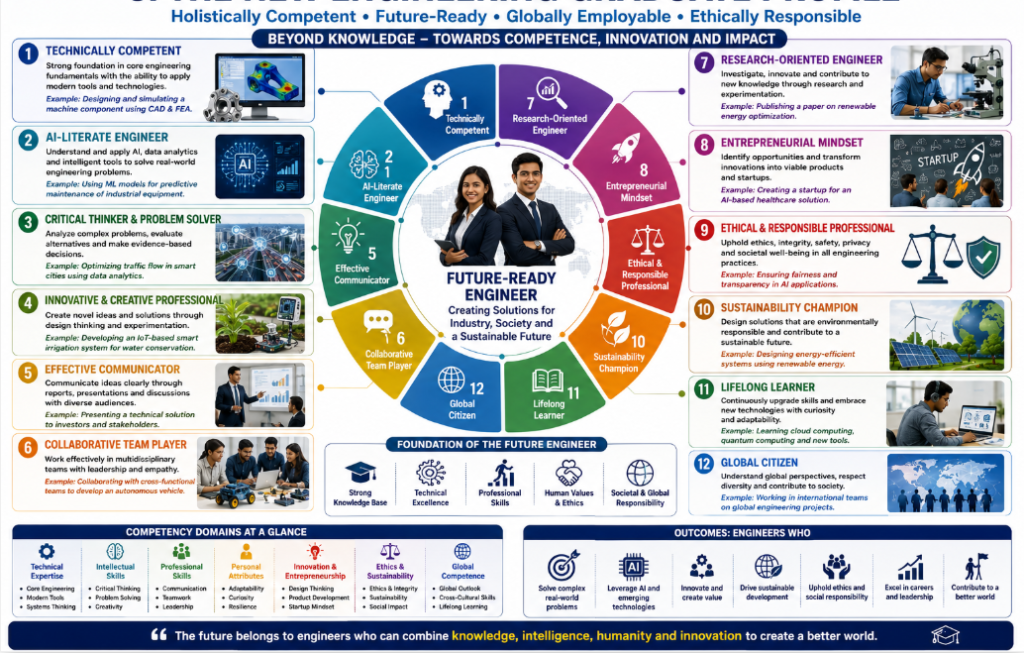
The engineering profession is undergoing a profound transformation driven by Artificial Intelligence (AI), Industry 5.0, automation, digital transformation, sustainability, and globalization. Consequently, the expectations of employers, society, and governments have evolved far beyond traditional technical competence. Modern engineers are expected to solve complex interdisciplinary problems, collaborate with intelligent systems, innovate continuously, uphold ethical standards, communicate effectively, and contribute meaningfully to sustainable societal development.
The engineering graduate of the future is therefore not defined solely by academic qualifications or technical knowledge but by a balanced combination of knowledge, technical skills, professional competencies, human values, innovation capability, and lifelong learning ability. Engineering institutions must prepare graduates who are capable of adapting to emerging technologies while remaining socially responsible, environmentally conscious, and globally competitive.
The New Engineering Graduate Profile represents a holistic framework that integrates technical excellence with cognitive, professional, ethical, entrepreneurial, and societal competencies required for success in the rapidly evolving global engineering ecosystem.
Characteristics of the Future Engineering Graduate
1. Technically Competent
Engineering graduates must possess a strong foundation in mathematics, science, engineering principles, programming, and domain-specific knowledge. However, technical competence should extend beyond theoretical understanding to include the practical application of engineering concepts in solving real-world challenges.
Students should be proficient in:
- Engineering analysis and design.
- Computer programming and computational thinking.
- Digital modeling and simulation.
- Modern engineering software and tools.
- Laboratory experimentation.
- System integration and optimization.
Example: A Mechanical Engineering graduate should be able to design a machine component using CAD software, perform stress analysis using simulation tools, manufacture a prototype using additive manufacturing, and evaluate its performance through testing.
2. AI-Literate Engineer
Artificial Intelligence has become a fundamental engineering capability rather than an optional specialization. Every engineering graduate should understand how AI can augment engineering design, automation, decision-making, and innovation within their respective disciplines.
Graduates should possess knowledge of:
- Machine Learning.
- Deep Learning.
- Generative AI.
- Prompt Engineering.
- Intelligent Automation.
- AI-assisted Engineering Tools.
- AI Ethics and Responsible AI.
Example: A Civil Engineering graduate should be capable of using AI models to predict traffic congestion or monitor the structural health of bridges through sensor data analytics.
3. Critical Thinker and Problem Solver
Modern engineering challenges rarely have straightforward solutions. Engineers must analyze ambiguous situations, identify root causes, evaluate alternatives, and develop innovative, evidence-based solutions.
Critical thinking enables graduates to:
- Analyze complex engineering systems.
- Evaluate risks and uncertainties.
- Optimize engineering processes.
- Make informed technical decisions.
- Solve multidisciplinary problems.
Example: Instead of replacing a malfunctioning production line, an engineer investigates operational data, identifies inefficiencies using AI analytics, and redesigns the workflow to improve productivity while reducing operational costs.
4. Innovative and Creative Professional
Innovation is the driving force behind technological advancement. Future engineers should move beyond implementing existing solutions to creating new products, services, and technologies that address emerging societal and industrial needs.
Students should develop competencies in:
- Design Thinking.
- Creative Problem Solving.
- Product Development.
- Rapid Prototyping.
- Intellectual Property Management.
- Startup Development.
Example: A multidisciplinary student team develops an AI-enabled smart waste segregation system that later evolves into a startup addressing urban waste management challenges.
5. Effective Communicator
Engineering solutions create value only when they are communicated clearly to diverse stakeholders, including engineers, managers, policymakers, investors, and customers.
Graduates should be able to:
- Prepare professional technical reports.
- Deliver persuasive presentations.
- Write research papers.
- Document engineering projects.
- Explain complex concepts to non-technical audiences.
- Collaborate effectively in multicultural teams.
Example: During a product demonstration, an engineer explains technical specifications to engineers while simultaneously presenting business benefits to investors and usability features to customers.
6. Collaborative Team Player
Modern engineering projects involve experts from multiple disciplines working together to solve complex challenges. Successful engineers therefore require excellent teamwork, leadership, negotiation, and interpersonal skills.
Graduates should be capable of:
- Working in multidisciplinary teams.
- Managing engineering projects.
- Resolving conflicts constructively.
- Sharing knowledge effectively.
- Leading collaborative innovation.
Example: Developing an autonomous electric vehicle requires collaboration among mechanical, electrical, electronics, computer science, business management, and industrial design specialists.
7. Research-Oriented Engineer
Engineering innovation depends upon continuous research and scientific inquiry. Every engineering graduate should develop the ability to investigate problems systematically, analyze evidence, validate assumptions, and generate new knowledge.
Students should gain experience in:
- Literature review.
- Experimental design.
- Data analysis.
- Research methodology.
- Scientific writing.
- Patent drafting.
- Publication ethics.
Example: An undergraduate student investigates energy-efficient AI algorithms for smart sensors and publishes the findings in a national engineering conference.
8. Entrepreneurial Mindset
Future engineers should not only seek employment but also create employment by transforming innovative ideas into commercially viable products and services.
Graduates should understand:
- Business model development.
- Market analysis.
- Technology commercialization.
- Financial planning.
- Startup incubation.
- Venture creation.
Example: Students developing an IoT-based smart irrigation controller establish a startup that provides affordable precision agriculture solutions to farmers.
9. Ethical and Responsible Professional
Rapid technological advancement introduces ethical challenges related to privacy, security, bias, sustainability, intellectual property, and societal impact. Engineers must therefore demonstrate integrity, accountability, fairness, and professional responsibility.
Graduates should understand:
- Engineering ethics.
- Responsible AI.
- Data privacy.
- Cybersecurity.
- Intellectual property rights.
- Environmental responsibility.
- Professional standards.
Example: While developing facial recognition software, engineers ensure fairness across demographic groups, protect user privacy, and comply with applicable ethical and legal guidelines.
10. Sustainability Champion
Engineering solutions should balance economic growth with environmental protection and social well-being. Future engineers must contribute to achieving the United Nations Sustainable Development Goals (SDGs) through responsible innovation.
Students should understand:
- Green engineering.
- Circular economy.
- Renewable energy.
- Carbon footprint reduction.
- Sustainable manufacturing.
- Environmental impact assessment.
Example: A Chemical Engineering graduate redesigns an industrial process to reduce water consumption and greenhouse gas emissions while maintaining production efficiency.
11. Lifelong Learner
Technologies evolve rapidly, making continuous learning an essential professional competency. Graduates should cultivate curiosity, adaptability, and a commitment to lifelong personal and professional development.
Lifelong learning may include:
- Professional certifications.
- Online courses.
- Micro-credentials.
- Industry workshops.
- Higher education.
- Research participation.
- Professional networking.
Example: A software engineer continuously upgrades skills in cloud computing, Generative AI, cybersecurity, and quantum computing to remain competitive throughout a dynamic career.
12. Global Citizen
Engineering projects increasingly involve international collaboration, multicultural teams, and global supply chains. Future graduates should possess a global outlook while respecting cultural diversity and societal needs.
Graduates should develop:
- Cross-cultural communication.
- International engineering standards awareness.
- Global sustainability perspectives.
- Multilingual collaboration.
- Social responsibility.
- Inclusive engineering practices.
Example: Engineers from India, Germany, Japan, and the United States collaborate virtually to develop intelligent healthcare systems for global deployment.
Holistic Competency Matrix for Future Engineering Graduates
| Competency Domain | Graduate Capability | Illustrative Example |
|---|---|---|
| Technical Competence | Apply engineering fundamentals to solve real-world problems | Designing and testing an autonomous robotic system |
| AI Literacy | Integrate AI tools into engineering workflows | AI-assisted predictive maintenance for industrial machines |
| Critical Thinking | Analyze complex systems and make informed decisions | Optimizing traffic flow using AI and data analytics |
| Innovation | Develop creative and practical solutions | Smart healthcare wearable device |
| Communication | Present technical ideas effectively | Delivering technical and business presentations |
| Collaboration | Work effectively in multidisciplinary teams | Developing an autonomous electric vehicle |
| Research | Conduct scientific investigations and publish findings | Undergraduate research publication on renewable energy |
| Entrepreneurship | Convert innovations into startups | Launching an IoT-based precision agriculture company |
| Ethics | Practice responsible engineering | Designing transparent and fair AI systems |
| Sustainability | Create environmentally responsible technologies | Smart energy management systems |
| Lifelong Learning | Continuously acquire new competencies | Completing professional certifications in emerging technologies |
| Global Competence | Collaborate across cultures and borders | Participating in international engineering design competitions |
Outcome of the New Engineering Graduate Profile
Graduates developed through this holistic framework are not merely degree holders but innovators, researchers, entrepreneurs, leaders, responsible citizens, and lifelong learners. They possess the technical expertise to solve engineering challenges, the creativity to develop transformative technologies, the ethical awareness to use technology responsibly, and the adaptability to thrive in an era of continuous technological disruption.
Such graduates become valuable contributors to industry, academia, government, startups, and society while driving sustainable development, technological innovation, and global competitiveness. The New Engineering Graduate Profile therefore serves as the cornerstone of Engineering Education 5.0, ensuring that institutions produce professionals who are holistically competent, capable, adaptable, ethical, innovative, and globally employable.
9. Redefining Faculty Roles
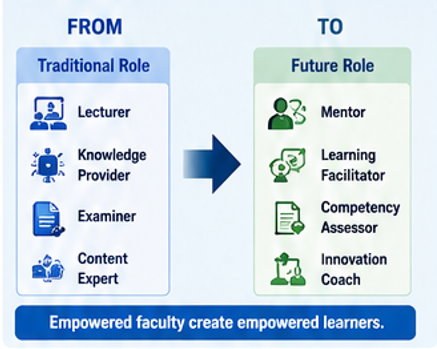
Faculty should evolve from
Lecturer → Mentor
Teacher → Learning Facilitator
Knowledge Provider → Innovation Coach
Examiner → Competency Assessor
Content Expert → Lifelong Learning Guide
Faculty development should emphasize AI integration, interdisciplinary collaboration, industrial exposure, and educational innovation.
10. Assessment for the Future
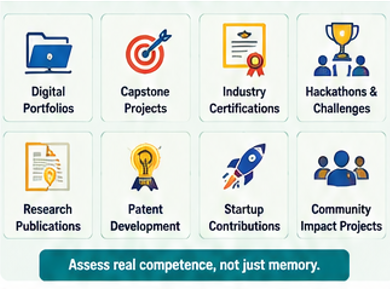
Traditional examinations should be complemented with
- Digital Portfolios
- Capstone Projects
- Industry Certifications
- Hackathons
- Design Challenges
- Research Publications
- Patent Development
- Startup Contributions
- Community Impact Projects
- Peer Assessment
Assessment should reflect real-world competence rather than memorization.
11. The Holistic Competency Model
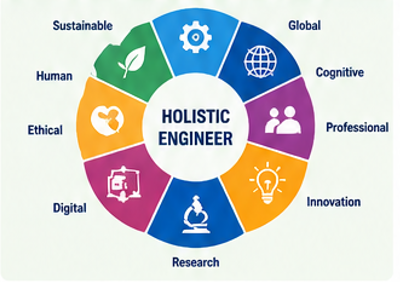
An engineering graduate should develop competencies across the following domains:
| Domain | Core Competencies |
|---|---|
| Technical | Engineering fundamentals, AI, programming, mathematics |
| Cognitive | Critical thinking, systems thinking, problem-solving |
| Professional | Communication, teamwork, leadership |
| Innovation | Creativity, design thinking, entrepreneurship |
| Research | Scientific inquiry, experimentation, publication |
| Digital | AI, cybersecurity, cloud computing, data analytics |
| Ethical | Professional ethics, responsible AI, integrity |
| Human | Emotional intelligence, empathy, adaptability |
| Sustainable | Environmental responsibility, SDGs, green engineering |
| Global | Cultural awareness, international collaboration |
12. Engineering Education 5.0 Ecosystem
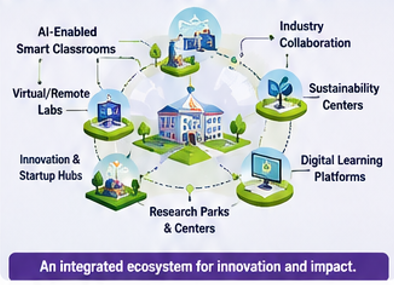
A future-ready engineering institution should integrate:
- AI-Enabled Smart Classrooms
- Digital Twin Laboratories
- Virtual and Remote Labs
- Industry Innovation Centers
- Startup Incubation Hubs
- Research Parks
- Community Innovation Labs
- Sustainability Centers
- Multidisciplinary Project Studios
- AI-Powered Personalized Learning Platforms
This ecosystem fosters experiential, collaborative, and technology-driven education aligned with global engineering practices.
13. The Engineering Employability Pyramid
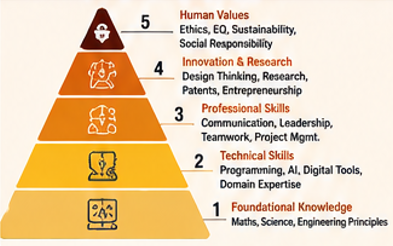
Graduate employability can be viewed as a pyramid:
- Foundational Knowledge – Mathematics, Science, Engineering Principles.
- Technical Skills – Programming, AI, Digital Tools, Domain Expertise.
- Professional Skills – Communication, Teamwork, Leadership, Project Management.
- Innovation & Research – Design Thinking, Research, Patents, Entrepreneurship.
- Human Values – Ethics, Emotional Intelligence, Sustainability, Social Responsibility.
Only graduates who develop all five levels become globally competitive professionals.
14. Strategic Recommendations
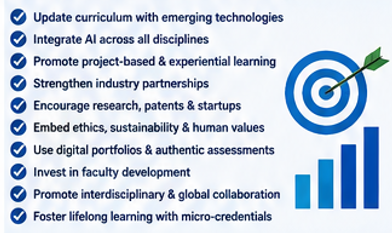
To transform engineering education, institutions should:
- Continuously update curricula with emerging technologies.
- Integrate AI across all engineering disciplines.
- Adopt competency-based and outcome-driven education.
- Strengthen academia–industry partnerships through internships and live projects.
- Promote undergraduate research, patents, and startups.
- Embed sustainability, ethics, and human values throughout the curriculum.
- Implement digital portfolios and authentic competency assessments.
- Invest in continuous faculty development and industry immersion.
- Encourage interdisciplinary learning and global collaborations.
- Foster a culture of lifelong learning through micro-credentials and professional certifications.
15. Conclusion
Engineering education stands at a defining moment. The future will not reward graduates solely for what they know but for how effectively they apply knowledge, collaborate with intelligent systems, innovate responsibly, and adapt to continuous technological change.
The next generation of engineers must combine Technical Intelligence (TQ), Artificial Intelligence Quotient (AIQ), Digital Intelligence (DQ), Emotional Intelligence (EQ), Creativity Quotient (CQ), Ethical Intelligence (EthQ), Sustainability Intelligence (SQ), and Lifelong Learning Quotient (LLQ) to address the complex challenges of an AI-driven world.
Transforming engineering education is therefore more than an academic reform—it is a national imperative. Institutions must move beyond producing degree holders to cultivating holistic professionals who are technically proficient, ethically grounded, socially responsible, innovative, and globally competitive. Such graduates will not merely secure employment; they will create new technologies, generate employment opportunities, drive sustainable development, and shape the future of society.
Engineering Education 5.0 is thus a paradigm shift—from knowledge acquisition to competency creation, from classroom learning to lifelong learning, from isolated disciplines to interdisciplinary innovation, and from employability to societal impact. By embracing this holistic vision, engineering institutions can prepare graduates who are capable of thriving in a rapidly evolving world while contributing meaningfully to humanity, industry, and the global knowledge economy.