Introduction
Every generation grows up under a different combination of technology, economy, culture, education, family structures and global events. These experiences influence how people think, communicate, learn, work, consume, lead and respond to change.
Generational labels such as Gen X, Millennials, Gen Z, Gen Alpha and Gen Beta are useful for understanding broad social trends, but they should not be treated as rigid scientific categories. Even Pew Research Center cautions that generational boundaries are analytical tools rather than absolute divisions.
The fascinating story is therefore not simply about different age groups. It is about humanity’s transition from an industrial and information society toward a digital, intelligent and increasingly AI-mediated society.
A Journey Through Five Generations
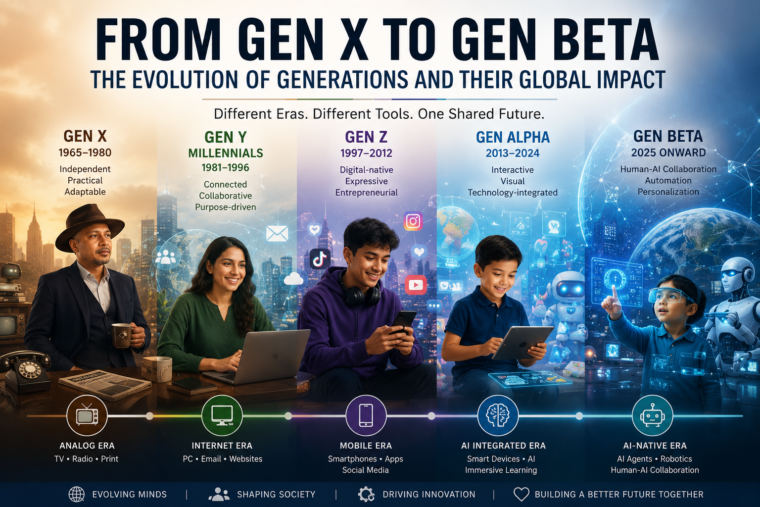
Evolution of Generations
| Generation | Common Birth Range* | Dominant Environment | Emerging Characteristics |
|---|---|---|---|
| Gen X | 1965–1980 | Analog → Digital | Independent, practical, adaptable |
| Gen Y / Millennials | 1981–1996 | Internet Revolution | Connected, collaborative, purpose-driven |
| Gen Z | 1997–2012 | Mobile + Social Media | Digital-native, expressive, entrepreneurial |
| Gen Alpha | 2013–2024 | AI + Smart Devices | Interactive, visual, technology-integrated |
| Gen Beta | 2025 onward** | AI-Native World | Human–AI collaboration, automation, personalization |
* Generational birth-year boundaries vary among researchers.
** Gen Beta is a newer generational label and its boundaries are not yet universally established.
Gen X — The Bridge Between Two Worlds
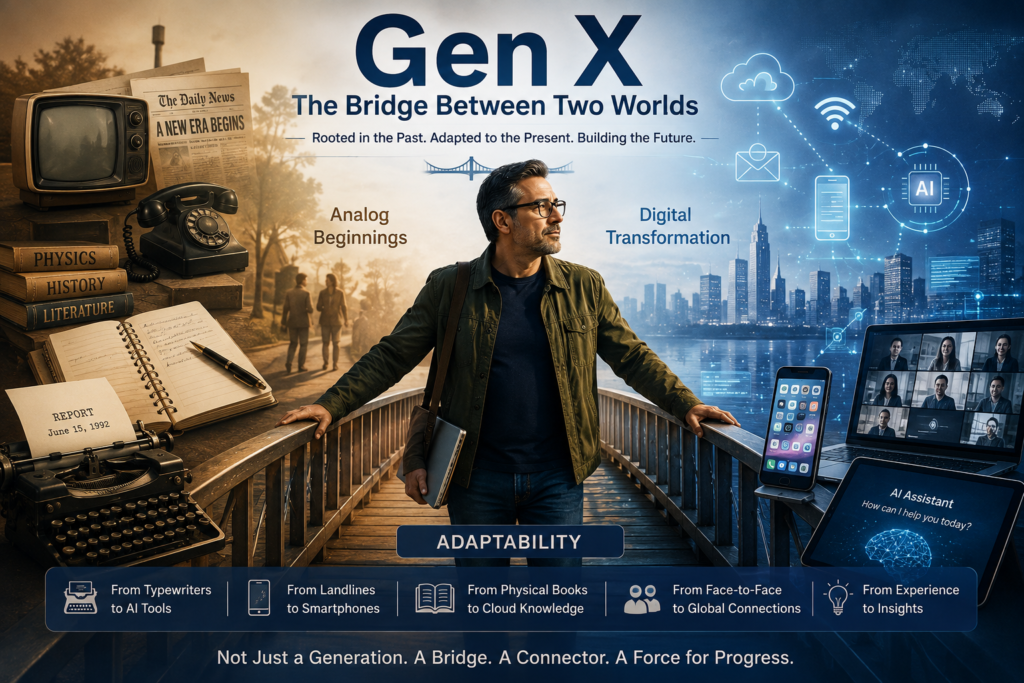
Gen X experienced childhood largely in an analog world. Television, newspapers, landline telephones, physical books and face-to-face communication dominated everyday life. As adults, however, they experienced computers, the internet, mobile phones and digital transformation.
Their distinctive strength is therefore adaptability.
A Gen X professional might have written reports by hand or on a typewriter, moved to desktop computers, adopted email, learned smartphones and now uses AI tools. They often provide an important bridge between traditional institutional knowledge and modern technology.
Gen Y — The Internet Generation
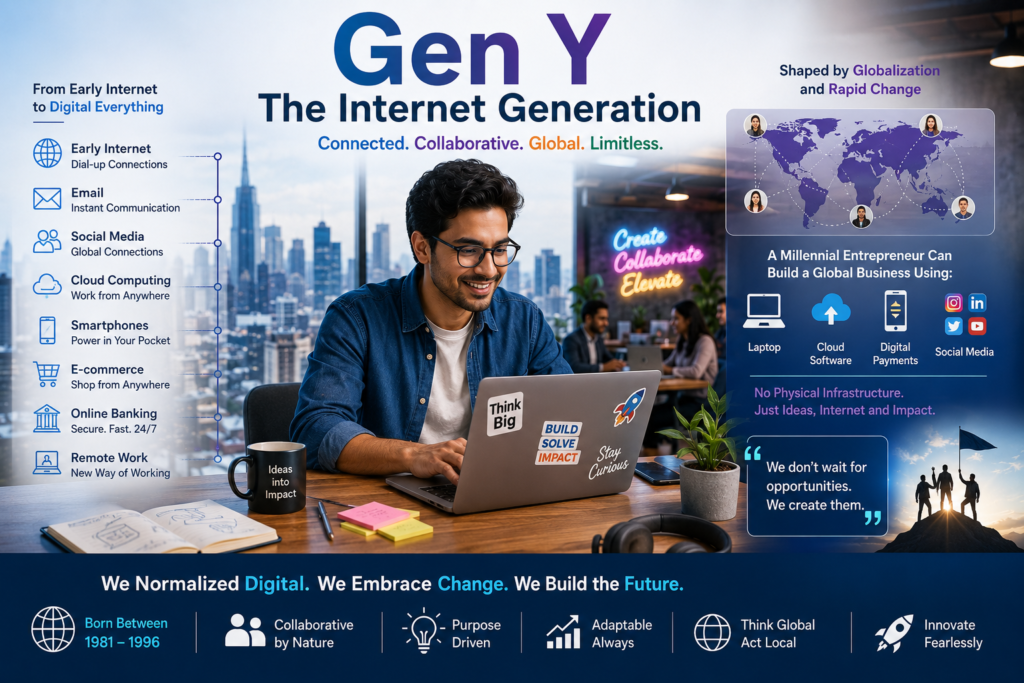
Millennials experienced the transition from the early internet to smartphones, social media, cloud computing and the platform economy.
They helped normalize email, online banking, e-commerce, digital collaboration, remote work and social networking. Their careers have also been shaped by globalization and rapid technological change.
For example, a Millennial entrepreneur can build a business using a laptop, cloud software, digital payments and social media without necessarily requiring the physical infrastructure that earlier generations needed.
Gen Z — The Always-Connected Generation
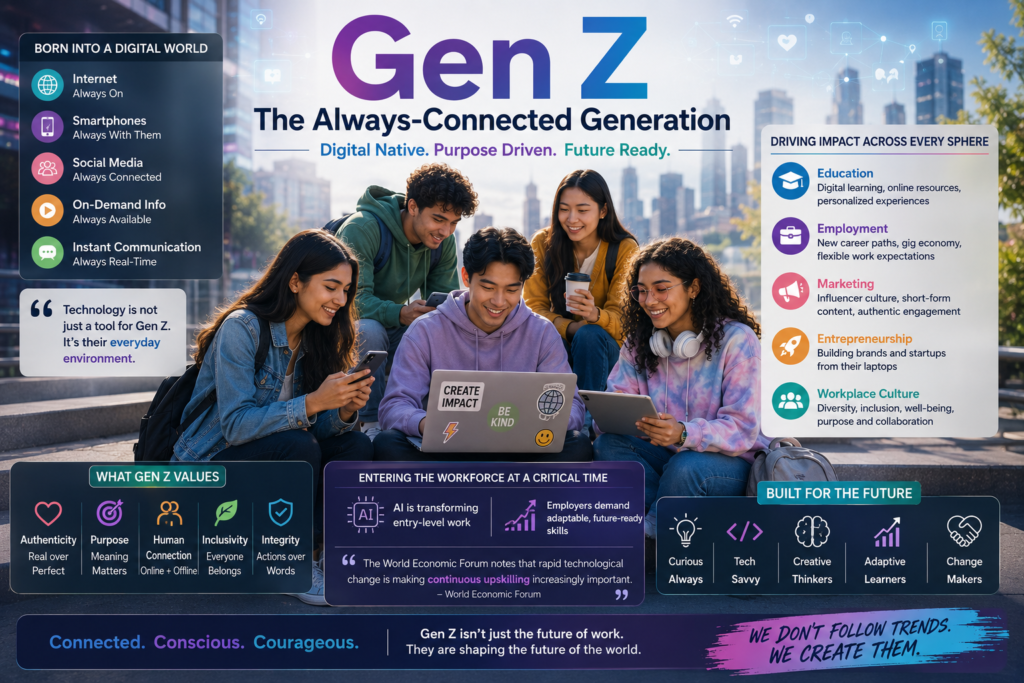
Gen Z grew up with the internet, smartphones, social media and on-demand information. Digital connectivity is not merely a tool for them—it is part of their everyday environment.
Their influence is already visible in education, employment, marketing, entrepreneurship and workplace culture. They often expect technology to be fast, intuitive and accessible, while also placing importance on authenticity, purpose and human connection.
Gen Z is also entering the workforce at a difficult moment: AI is transforming entry-level work while employers increasingly demand adaptable skills. The World Economic Forum notes that rapid technological change is making continuous upskilling increasingly important.
Gen Alpha — Growing Up With Intelligent Technology
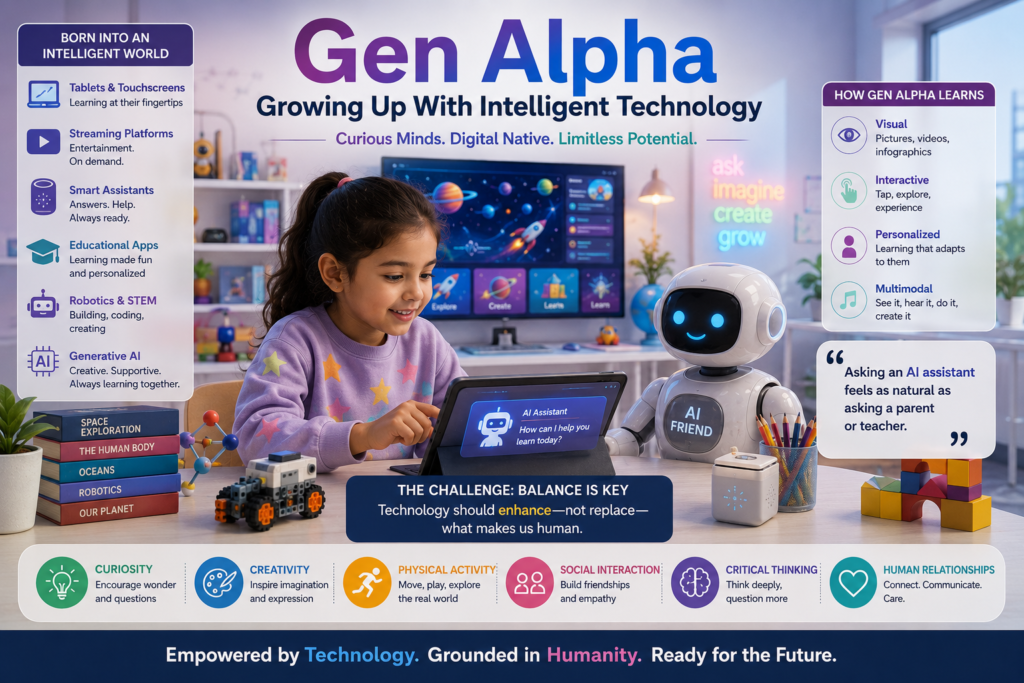
Gen Alpha has experienced tablets, streaming platforms, smart assistants, educational apps, robotics and generative AI from an early age.
For a Gen Alpha child, asking a question to an AI assistant can feel as natural as asking a parent or teacher. Learning is increasingly visual, interactive, personalized and multimodal.
The challenge is to ensure that technology enhances—not replaces—curiosity, creativity, physical activity, social interaction, critical thinking and human relationships.
Gen Beta — The AI-Native Generation
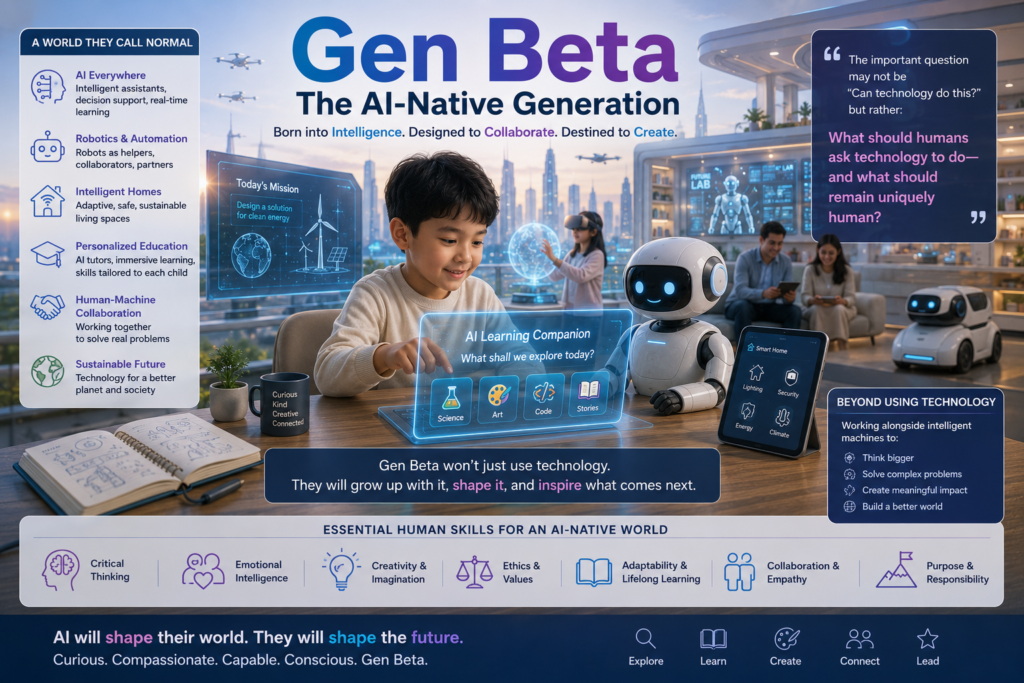
Gen Beta represents a fascinating possibility: children born into a world where AI, robotics, autonomous systems, intelligent homes, personalized education and human-machine collaboration may be ordinary parts of life.
For them, the important question may not be “Can technology do this?” but rather:
“What should humans ask technology to do—and what should remain uniquely human?”
Their education and careers may involve working alongside intelligent machines rather than simply using computers as tools.
From Gadgets to Intelligent Ecosystems
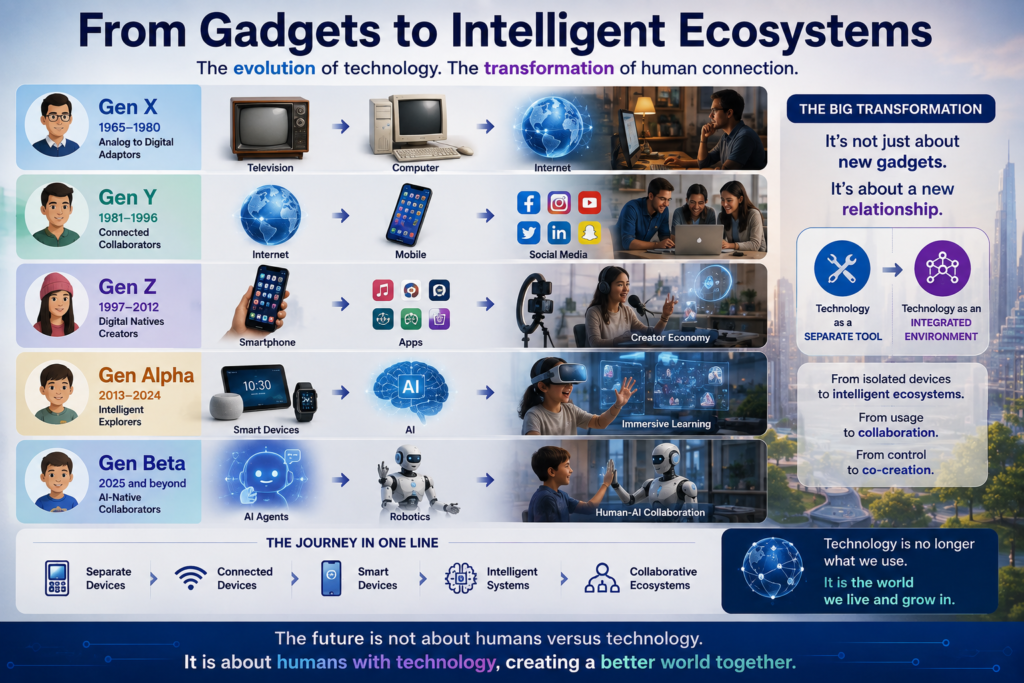
The evolution can be visualized simply:
Gen X: Television → Computer → Internet
Gen Y: Internet → Mobile → Social Media
Gen Z: Smartphone → Apps → Creator Economy
Gen Alpha: Smart Devices → AI → Immersive Learning
Gen Beta: AI Agents → Robotics → Human-AI Collaboration
The important transformation is therefore not merely the appearance of new gadgets. The relationship between humans and technology is changing.
Technology has moved from being a separate tool to becoming an integrated environment.
Global Impact
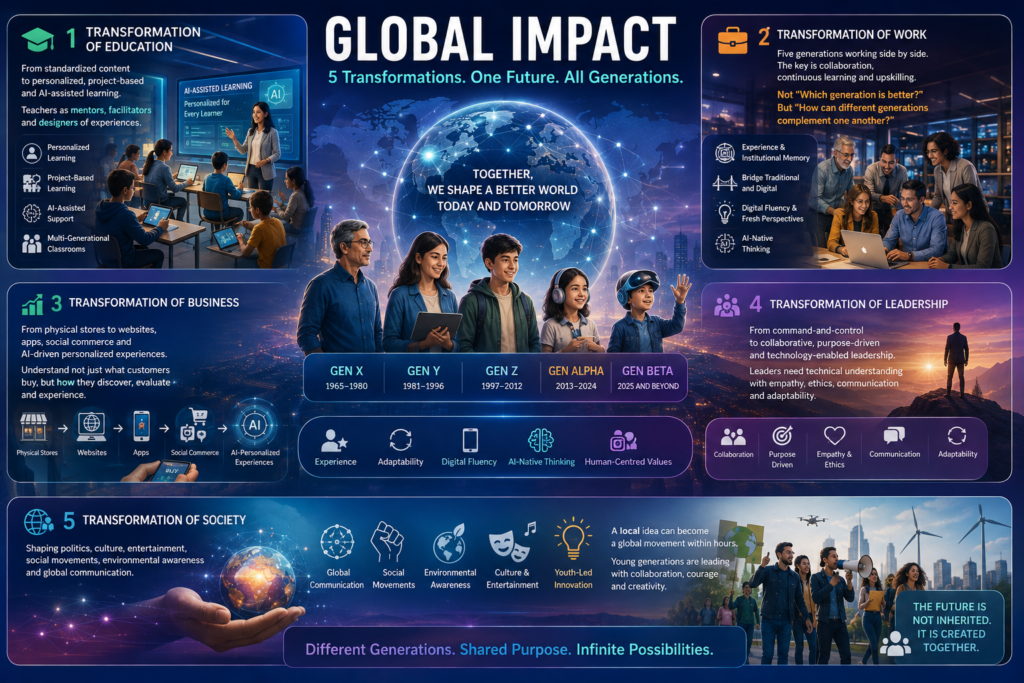
1. Transformation of Education
Education is moving from standardized content delivery toward personalized, project-based and AI-assisted learning. A teacher increasingly becomes a mentor, facilitator and designer of learning experiences.
The future classroom may contain students from multiple generations of technology experience, requiring educators to combine human mentoring with digital and AI tools.
2. Transformation of Work
Five generations can now potentially coexist in the workplace. The World Economic Forum highlights the importance of multigenerational collaboration, continuous learning and upskilling as technology reshapes employment.
The best organizations will therefore not ask “Which generation is better?”
They will ask:
“How can different generations complement one another?”
Gen X can contribute experience and institutional memory; Millennials can bridge traditional and digital practices; Gen Z can bring digital fluency and fresh perspectives; younger generations will increasingly contribute AI-native thinking.
3. Transformation of Business
Consumer behaviour has evolved from physical stores to websites, apps, social commerce and increasingly personalized AI-driven experiences.
Businesses must therefore understand not only what customers buy, but how different generations discover, evaluate and experience products and services.
4. Transformation of Leadership
Leadership is also evolving—from command-and-control models toward collaborative, purpose-driven and technology-enabled leadership.
The emerging leader must combine technical understanding with empathy, ethics, communication and adaptability.
5. Transformation of Society
Generational change is influencing politics, culture, entertainment, social movements, environmental awareness and global communication. Young people increasingly operate in a world where a local idea can become a global movement within hours.
The 2026 World Economic Forum Global Shapers discussions similarly highlight how younger generations are responding to technological change, climate concerns and uncertainty through new forms of collaboration and leadership.
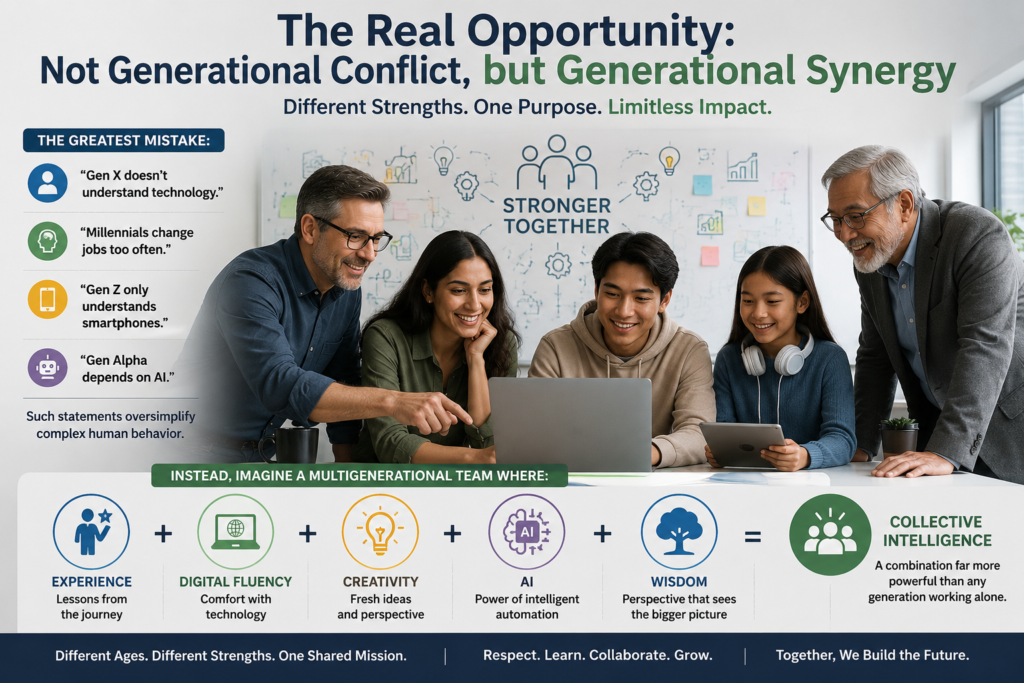
The Real Opportunity: Not Generational Conflict, but Generational Synergy
The greatest mistake would be to stereotype generations:
“Gen X doesn’t understand technology.”
“Millennials change jobs too often.”
“Gen Z only understands smartphones.”
“Gen Alpha depends on AI.”
Such statements oversimplify complex human behavior. Instead, imagine a multigenerational team where:
Experience + Digital Fluency + Creativity + AI + Wisdom = Collective Intelligence
This combination can be far more powerful than any generation working alone.
Conclusion
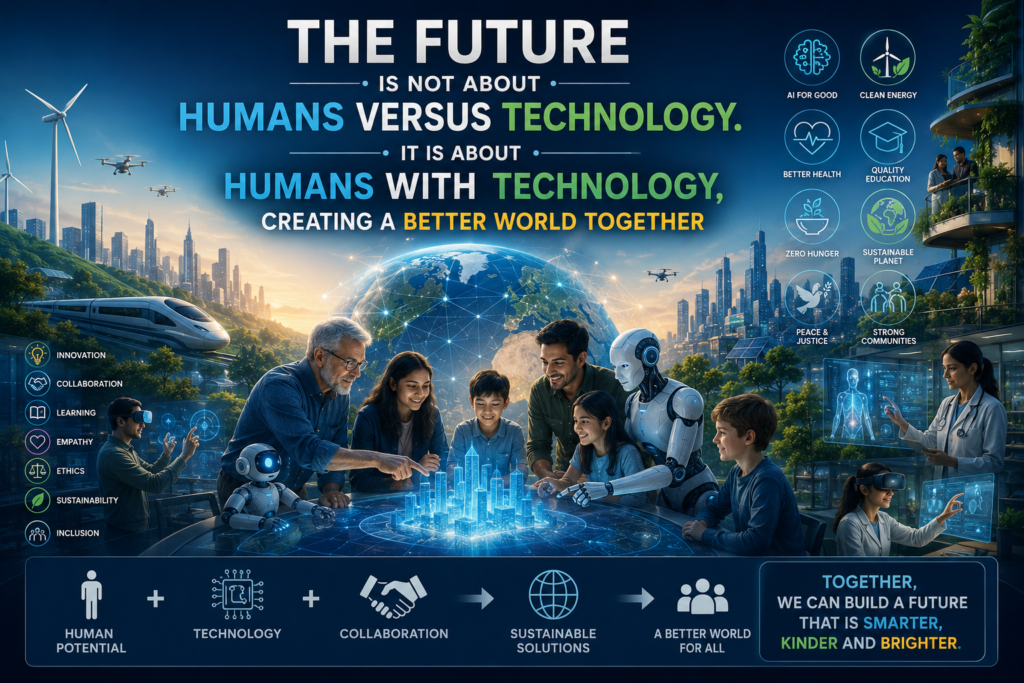
The evolution from Gen X to Gen Beta represents more than a change in age groups. It reflects humanity’s journey from an analog society to a connected society and now toward an intelligent society.
The future will not belong exclusively to Gen X, Millennials, Gen Z, Gen Alpha or Gen Beta. It will belong to people and organizations capable of learning across generations.
The essential skill of the future may therefore be neither coding nor communication alone. It will be the ability to learn, unlearn, relearn, collaborate and work intelligently with both humans and machines.
The question is no longer: “Which generation will shape the future?”
It is: “What can every generation contribute to building a better future together?”
That is where the true evolution of generations becomes the evolution of humanity itself.