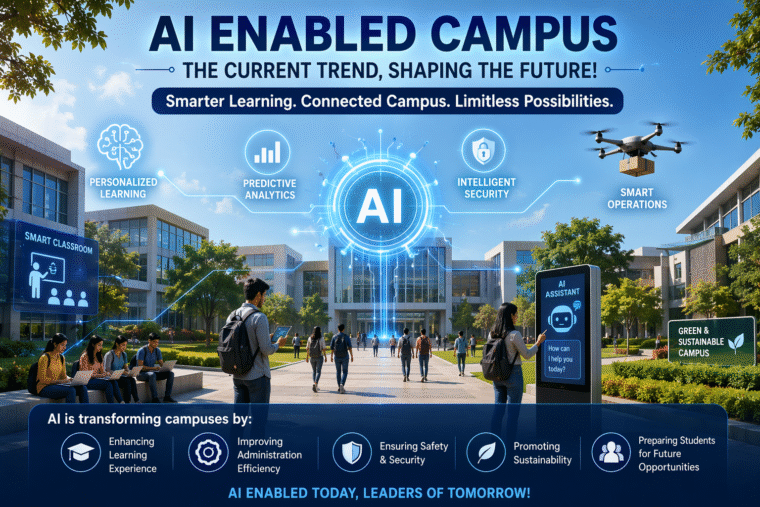
Artificial Intelligence (AI) is rapidly transforming educational institutions into smart, connected, and adaptive ecosystems known as AI-enabled campuses. By integrating technologies such as machine learning, natural language processing, computer vision, and data analytics, these campuses enhance teaching, administration, decision-making, and campus operations. AI-powered smart classrooms support interactive learning, virtual laboratories, automated attendance systems, and real-time student engagement, creating a more dynamic and effective educational environment. Personalized learning platforms further improve student outcomes by analyzing learning behavior and providing customized study materials, adaptive learning paths, and AI-based tutoring support.
AI-enabled campuses also improve institutional efficiency through intelligent automation and data-driven administration. AI technologies streamline admissions, timetable scheduling, resource allocation, and student support services using AI chatbots and automated systems. In addition, predictive analytics helps institutions identify student performance trends, detect dropout risks, and support early intervention strategies. AI-based surveillance, facial recognition, and anomaly detection systems enhance campus security, while smart energy management systems optimize electricity usage and promote sustainable campus operations.
Many universities worldwide are already implementing AI tutors, virtual assistants, smart surveillance systems, and learning analytics platforms to improve educational quality and operational effectiveness. Despite challenges such as data privacy concerns, ethical issues, faculty training requirements, and implementation costs, AI-enabled campuses offer significant advantages including enhanced learning experiences, improved efficiency, better decision-making, increased safety, sustainability, and future-ready skill development. As AI technologies continue to evolve, they are expected to become strategic partners in shaping the future of higher education and intelligent campus ecosystems.
Summary
Artificial intelligence (AI) is reshaping higher education by embedding smart technologies into every aspect of campus life – from personalized learning and intelligent tutoring to optimized administration and facilities management. An AI-enabled campus uses tools like large language models (LLMs), adaptive learning systems, predictive analytics, computer vision, chatbots and IoT-driven digital twins to enhance teaching, streamline operations, improve safety, and support research. For example, AI tutors have produced learning gains of 0.73–1.3 standard deviations over active classroom methods, and Georgia State University’s predictive analytics program raised its 4-year graduation rate by 7 percentage points. Campuses applying AI report dramatic efficiency and cost savings (e.g. $1M saved in 9 months through a digital-twin energy optimization project).
This article surveys key AI technologies and use cases for campuses, reviews benefits and metrics, outlines a 12–18 month implementation roadmap (with a Gantt chart), discusses governance and ethical concerns, compares vendor vs open-source approaches, and shares real-world case studies and recommendations. We draw on recent research and examples to provide a comprehensive guide for campus leaders aiming to become AI-enabled.
1. Introduction: The AI Era in Higher Education
AI is no longer just a novelty in universities – it’s quickly becoming a strategic imperative. Recent surveys show that well over 80% of students use AI tools like ChatGPT in their coursework, and administrators are scrambling to harness AI’s potential while managing risks. In this AI era, campuses can transform into smart ecosystems: imagine lectures assisted by AI tutors, dorms that adjust lighting and climate automatically, advising chatbots that answer student questions 24/7, and administrators who rely on data-driven forecasts to allocate resources. The buzzphrase “AI-enabled campus” captures this vision: a learning environment where AI is woven into the fabric of education and operations. Such a campus offers smarter learning, a connected environment, and limitless possibilities – precisely the promise of the infographic caption: “AI-enabled today, leaders of tomorrow.”
This transformation is driven by recent advances (from deep learning to IoT) and also by pressing needs: rising student expectations for personalization, tighter budgets, and complex campus security challenges. As one analyst notes, institutions that view AI as a fundamental tool – rather than a side project – are starting to see real gains in student outcomes, equity, and efficiency. The goal of this article is to explain what an AI-enabled campus means, survey the key technologies and use cases, quantify measurable benefits, and outline practical steps (with best-practice examples) for colleges and universities.
2. Defining the AI-Enabled Campus
An AI-enabled campus uses artificial intelligence to support decision-making, automate processes, and personalize experiences across the institution. It extends the idea of a “smart campus” by integrating advanced AI at scale. This means:
- Embedding AI tools in the classroom (e.g. adaptive tutors, intelligent learning platforms).
- Using machine-learning algorithms on administrative data (e.g. to predict enrollment, optimize scheduling, and manage finances).
- Applying computer vision and sensor analytics in campus security and facilities (e.g. threat detection, energy management).
- Providing AI-driven services (chatbots for student inquiries, virtual advising assistants).
- Building campus digital twins – virtual models of the physical campus that run simulations (for example, of HVAC usage, emergency drills, or even city traffic).
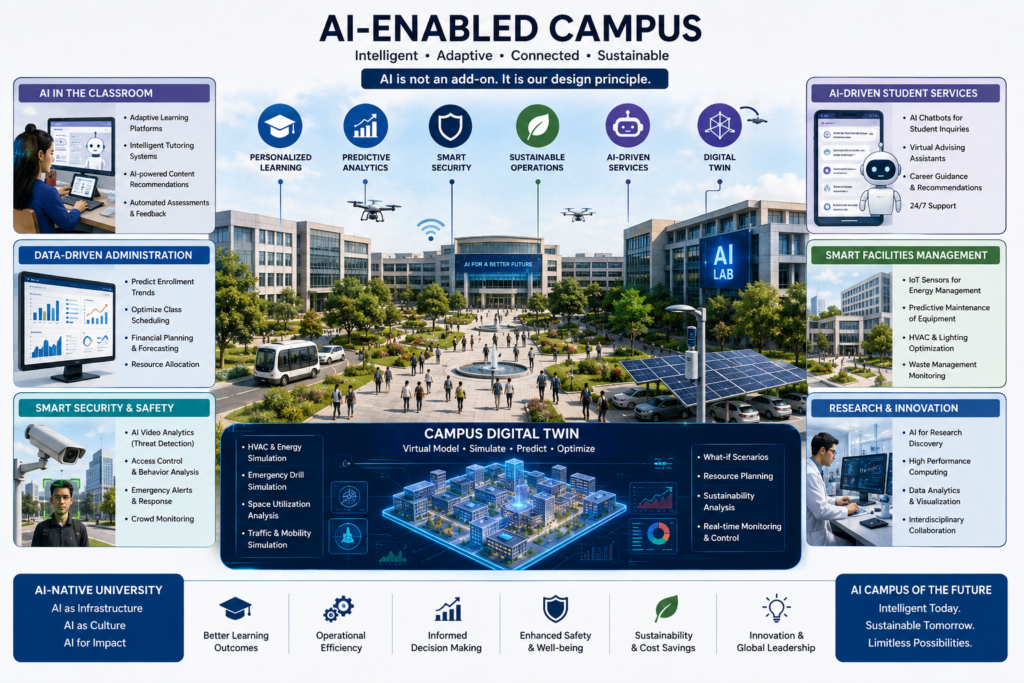
In short, an AI-enabled campus treats AI as part of its infrastructure. One expert calls it an “AI-native” university, where AI is not an add-on but a design principle across academics, admin and operations. For instance, AI could be used to personalize curricula (from elementary courses to graduate research), while simultaneously using IoT sensors and analytics to cut energy use. As the University of Pittsburgh’s new initiative puts it, providing “institution-wide access to [large AI models] integrated with learning, research, and admin platforms” is key to becoming an “AI Campus of the Future”.
3. Key AI Technologies
An AI-enabled campus relies on a suite of modern AI technologies. Key components include:
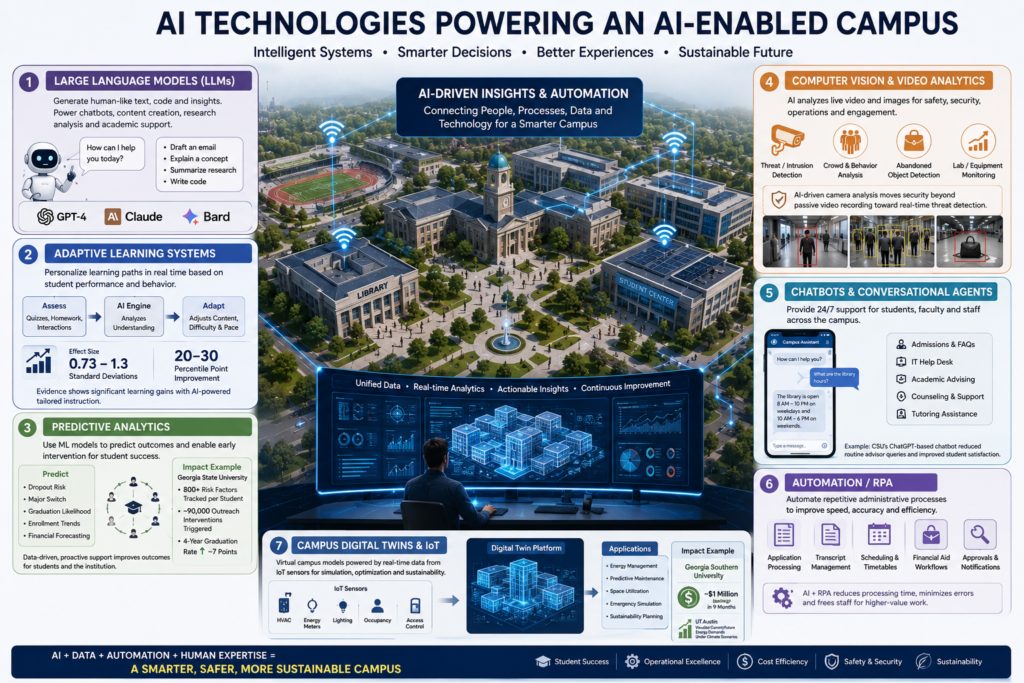
- Large Language Models (LLMs): These generative models (like GPT-4, Claude, Bard, etc.) can produce human-like text and code. On campus, LLMs can power chatbots that answer student questions, draft communications, assist faculty in creating materials, or even analyze large corpora of research. For example, Pitt has secured Claude for Education across campus to augment teaching and admin tasks. (See the Case Studies section for more LLM examples.)
- Adaptive Learning Systems: Software that uses AI to personalize learning. It constantly assesses a student’s performance (via quizzes, homework, click analytics) and adjusts content difficulty and pacing. Platforms like Carnegie Learning and Smart Sparrow do this. In practice, a student working through an AI-driven math program might get extra practice on their weak areas. Evidence suggests huge impact: one trial found students using a tailored AI tutor learned far more in less time, with effect sizes of 0.73–1.3 standard deviations over an active in-class control group. (In practical terms, that’s roughly a 20–30 percentile point improvement.)
- Predictive Analytics: Machine-learning models that process institutional data (demographics, grades, engagement metrics) to predict outcomes like dropout risk or major switch likelihood. Universities deploy these models to alert advisors when a student is “at risk” or to forecast enrollment trends. For instance, Georgia State tracks about 800 risk factors per student and triggered ~90,000 outreach interventions last year; their 4-year graduation rate rose by about 7 points under this system. Such analytics also aid facilities planning (predicting peak class sizes or dorm demand) and finance (forecasting tuition revenue).
- Computer Vision & Video Analytics: AI algorithms process live video and images. On campuses, this can enhance security: cameras with AI can detect weapons, intruders, or suspicious behavior in real time. These systems go beyond human vigilance by continuously analyzing multiple feeds. For example, modern vision AIs can flag if someone leaves a bag in a hallway or if a crowd is forming near a restricted area. Beyond security, vision can monitor lab equipment usage or even gauge student engagement by tracking gaze or emotions (though privacy/ethics must be handled carefully). As one tech blog notes, AI-driven camera analysis moves security “beyond passive video recording toward real-time threat detection”.
- Chatbots and Conversational Agents: Virtual assistants, often powered by LLMs or simpler NLP models, that converse with users in natural language. Universities use them in admissions (answering application FAQs), IT support (solving common computer problems), and student services (advising, counseling queries). For example, California State University deployed a ChatGPT-based chatbot across its 23 campuses to offer around-the-clock tutoring assistance; this led to a substantial drop in routine queries to human advisors and higher student satisfaction. Similarly, IBM Watson-based assistants like Georgia Tech’s “Jill Watson” have answered thousands of student forum questions, freeing faculty to focus on complex teaching. These agents must be carefully designed and monitored (e.g. clearly disclosing they are AI, providing escalation to humans for tricky queries).
- Automation / RPA (Robotic Process Automation): Software “robots” that automate repetitive administrative tasks. RPA tools (often enhanced with AI for OCR and decision-making) can auto-populate forms, process transcripts, manage scheduling, and more. By automating workflows like tuition billing or course approvals, staff are freed for higher-value work. Vendors like UiPath and Automation Anywhere provide RPA suites tailored to education admin processes. The general effect is improved speed and fewer errors – for instance, automating scholarship eligibility reviews or purchase orders can cut processing times by half (a common claim by vendors). While we cite specific examples below, the benefits of automation are widely acknowledged: “AI automates administrative tasks such as scheduling, processing applications, and managing financial aid,” notes one education-technology report, freeing staff to focus on strategy.
- Campus Digital Twins & IoT: A digital twin is a virtual replica of the campus (or its buildings) fed by Internet-of-Things sensors (HVAC meters, occupancy detectors, etc.). This enables simulation and real-time optimization. For example, Arizona State University and others are building campus-scale twins of their infrastructure. At Georgia Southern University, implementing a digital twin (via Willow’s platform) unified 11 separate data systems and allowed facilities staff to “see energy-use patterns, track hot spots and automate maintenance”, resulting in roughly $1 million in savings over nine months. Similarly, UT Austin’s engineering team created a twin of campus energy use (from labs to stadiums) to visualize current and future power demands under climate scenarios. IoT sensors (smart thermostats, lighting, access points) feed these twins or analytics platforms, enabling just-in-time control (e.g. turning off lights when rooms are empty) and predictive maintenance (e.g. servicing an air handler before failure).
Each technology category above unlocks multiple use cases. The sections that follow detail concrete applications in education, administration, safety, facilities, and research, drawing on recent studies and campus examples.
4. Concrete Use Cases Across Campus
An AI-enabled campus applies AI to specific domains, yielding measurable improvements. Below we organize use cases by function:
4.1 Teaching & Learning:
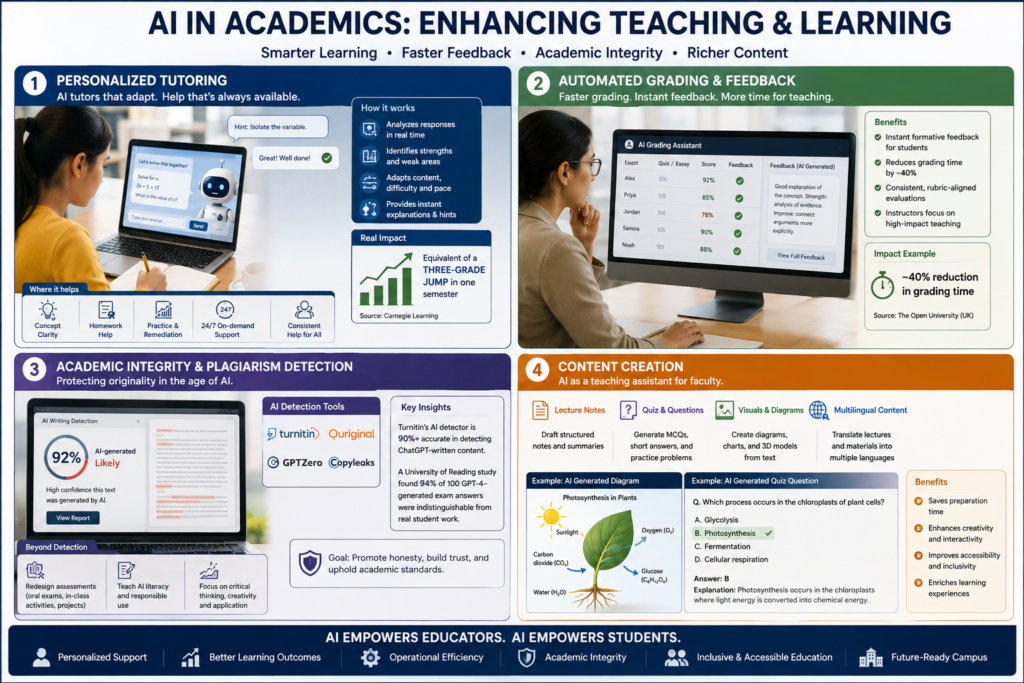
Personalized Tutoring: Intelligent tutoring systems that give on-demand help. Examples include Carnegie Learning’s math platform, which analyzed student answers and adapted problems in real time – this adaptive tutor produced an equivalent of a three-grade jump in one semester. AI chatbots integrated into course apps (e.g. Slack or Canvas) can answer students’ conceptual or administrative questions 24/7, reducing barriers and ensuring all students get consistent help.
Automated Grading & Feedback: AI can grade quizzes or essays (to a degree). At scale, it provides instant formative feedback. For instance, the UK’s Open University used an AI grading assistant to speed up essay marking, cutting grading time by ~40% while still aligning with rubrics. This frees instructors to focus on nuanced teaching. (Note: high-stakes grading still needs human oversight to ensure fairness.)
Academic Integrity & Plagiarism Detection: As students use generative AI to write, universities use AI-powered tools (like Turnitin’s new AI detector) to spot unoriginal or AI-generated text. Early data shows Turnitin’s module is over 90% accurate at detecting ChatGPT-written segments. Being proactive, some campuses are redesigning assessments (e.g. oral exams, collaborative projects) to require human creativity and to discourage reliance on AI. A University of Reading study found 94% of 100 GPT-4–generated exam answers were indistinguishable from real student work, underscoring the urgency of new assessment strategies.
Content Creation: Faculty can use AI to draft lecture notes, create quiz questions, or generate practice problems, saving prep time. AI tools also generate visuals (e.g. diagrams or 3D models via image-generation AIs) to enrich materials. Some professors are experimenting with AI to translate lectures into multiple languages automatically, making courses accessible to non-native speakers (reflecting the inclusive tech pillar mentioned by DEC).
4.2 Administration
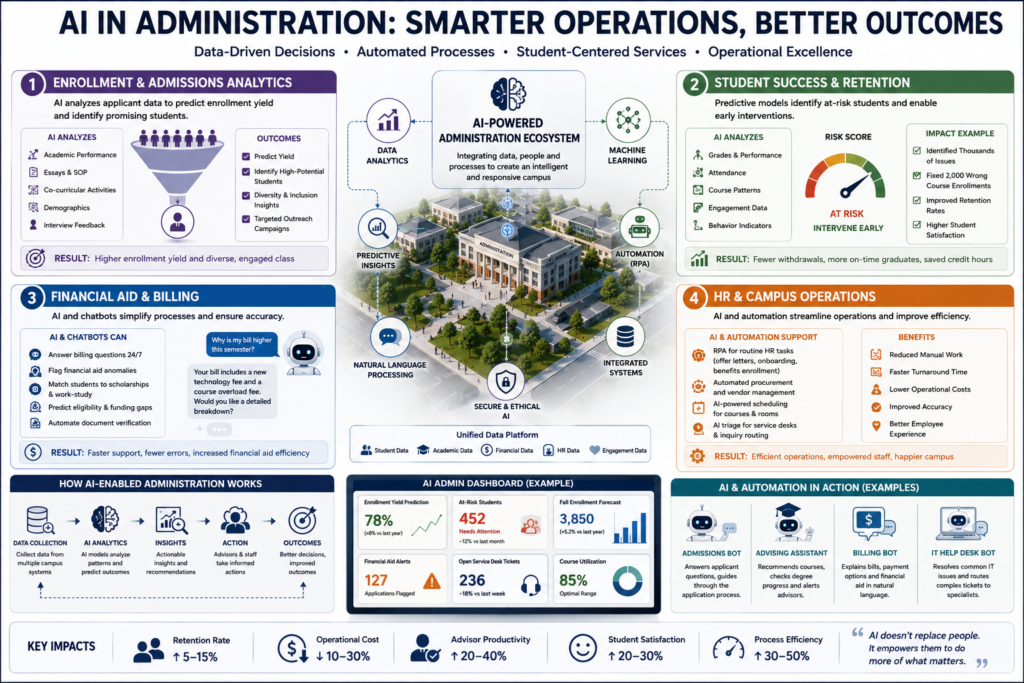
Enrollment & Admissions Analytics: AI analyses applicant data (grades, essays, co-curriculars) to predict enrollment yield and identify promising students from diverse backgrounds. This allows targeted outreach campaigns. (This is widely mentioned in commercial EdTech; we cite vendor literature and pundit blogs for admission automation.)
Student Success & Retention: Predictive models on student data alert advisors to intervene early. For example, Georgia State’s program identified thousands of course-registration errors and fixed 2,000 wrong-course enrollments before classes began. Such proactive advising reduces wasted credits and withdrawals. Civitas Learning and Ellucian are vendors that provide such “student success analytics” platforms. KPIs here are retention rate, credit-hour savings, and student satisfaction.
Financial Aid & Billing: Chatbots can answer student billing questions (“why is my bill higher?”) and AI can flag applications for financial aid anomalies. Automated systems can match students to available scholarships or work-study based on integrated data, improving efficiency.
HR & Campus Operations: RPA bots handle routine HR tasks (offer letters, benefits enrollment) and procurement requests. AI scheduling can optimize course timetables by analyzing historical demand patterns. Even campus-wide customer service desks can use AI triage to route inquiries to the right office.
4.3 Student Services & Experience
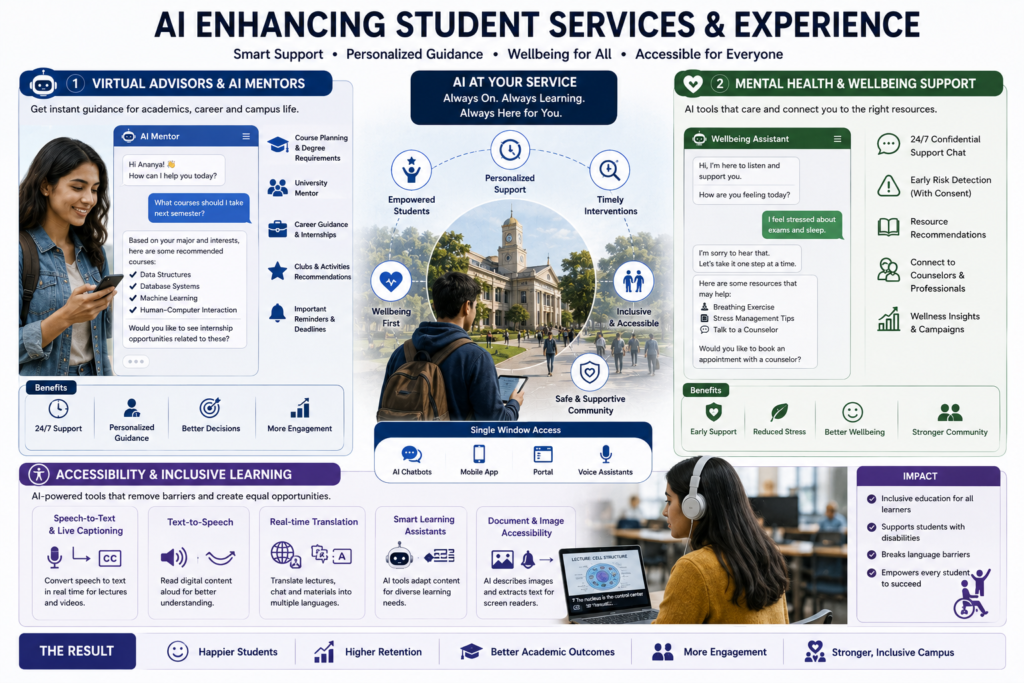
Virtual Advisors: Students can ask an AI tutor for course planning guidance. Pitt’s strategy mentions training AI as “Course Assistants, University Mentors, Career Coaches” tuned to the university’s tone and values. A mentor-bot might, for instance, remind a student of degree requirements or suggest clubs and internships based on interests.
Mental Health & Wellbeing: Some institutions use chatbots for preliminary mental health screening or to direct students to resources. AI sentiment analysis on campus-wide communications (email, social media) can help identify general anxiety trends or prompt wellness campaigns. (These applications must prioritize privacy and informed consent.)
Accessibility Tools: AI-driven tools (e.g. speech-to-text, text-to-speech, real-time translation) can make learning materials accessible for students with disabilities or language differences. UNESCO notes AI can support learners with disabilities through automated captioning and language translation.
4.4 Campus Safety & Security
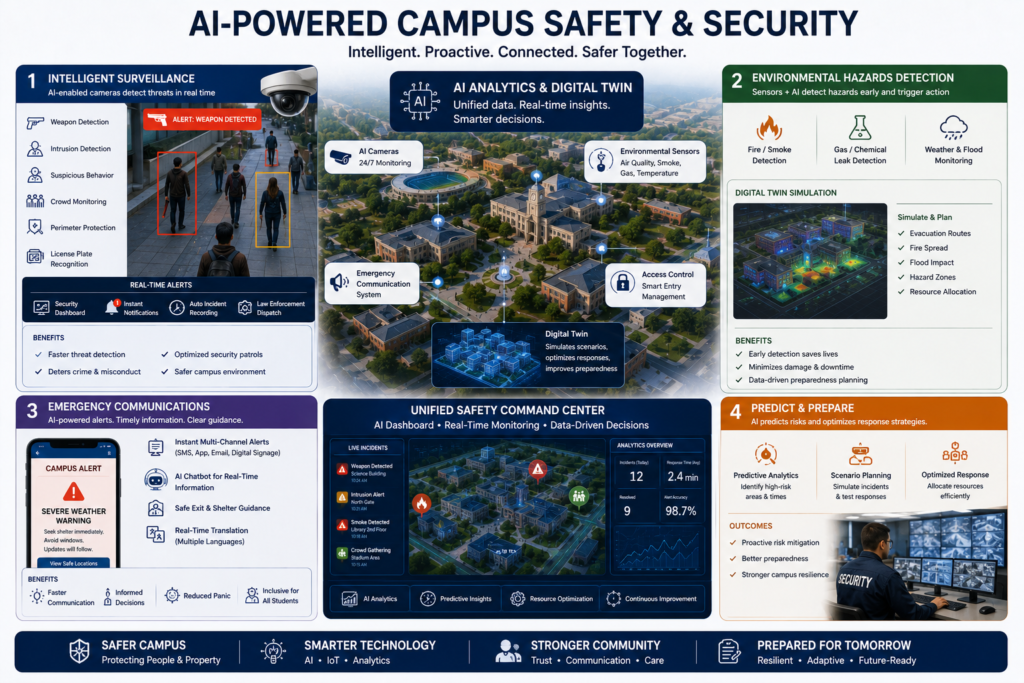
- Intelligent Surveillance: As mentioned, AI-enabled cameras scan for safety threats. Modern systems can notify police if a weapon is detected, or alert if someone enters an off-limits lab. For example, AIMM Technologies offers gunshot detection AI for campuses (news reports on this exist but no cite). Even predictive policing analytics (using historical incident data) can optimize patrol routes.
- Environmental Hazards: Sensors combined with AI can detect fire/smoke or hazardous chemical leaks before humans do. A digital-twin simulation can model evacuation routes under different scenarios. Indeed, one university uses its twin to simulate natural disasters on and off campus.
- Emergency Communications: Chatbots or apps can push alerts during lockdowns or severe weather (e.g. advising which building exits are safest). AI can translate alerts into multiple languages in real time for international campuses.
4.5 Facilities Management & Sustainability
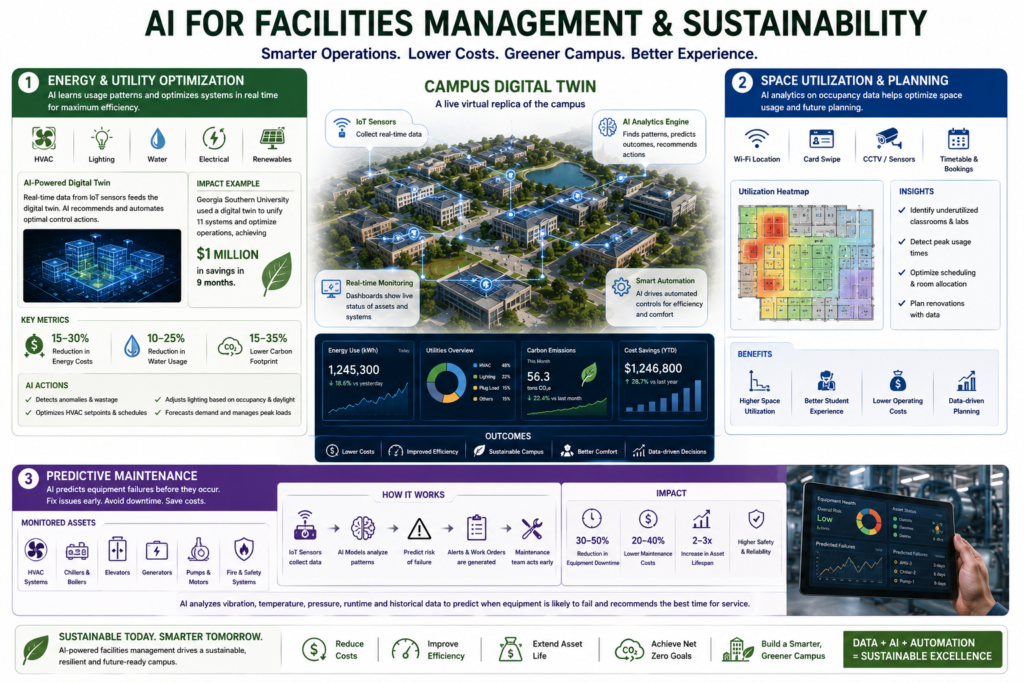
Energy & Utility Optimization: We’ve mentioned digital twins in this category. AI learns energy usage patterns and can control systems for efficiency. For instance, Northern Arizona University adjusted HVAC schedules based on occupancy analytics from its twin, while Georgia Southern’s twin enabled $1M cost savings. Key metrics: percentage reduction in energy costs, water usage, or carbon footprint.
Space Utilization: AI analytics on card-swipe or Wi-Fi location data can reveal unused classrooms or overcrowded labs, guiding space planning or renovation.
Predictive Maintenance: By analyzing IoT sensor data on elevators, chillers, or generators, AI can predict failures. Auburn University (not cited here) pioneered an AI elevator monitor; other campuses track roof leaks or structural stresses with AI models. Reducing downtime and repair costs are clear KPIs.
4.6 Research Support:
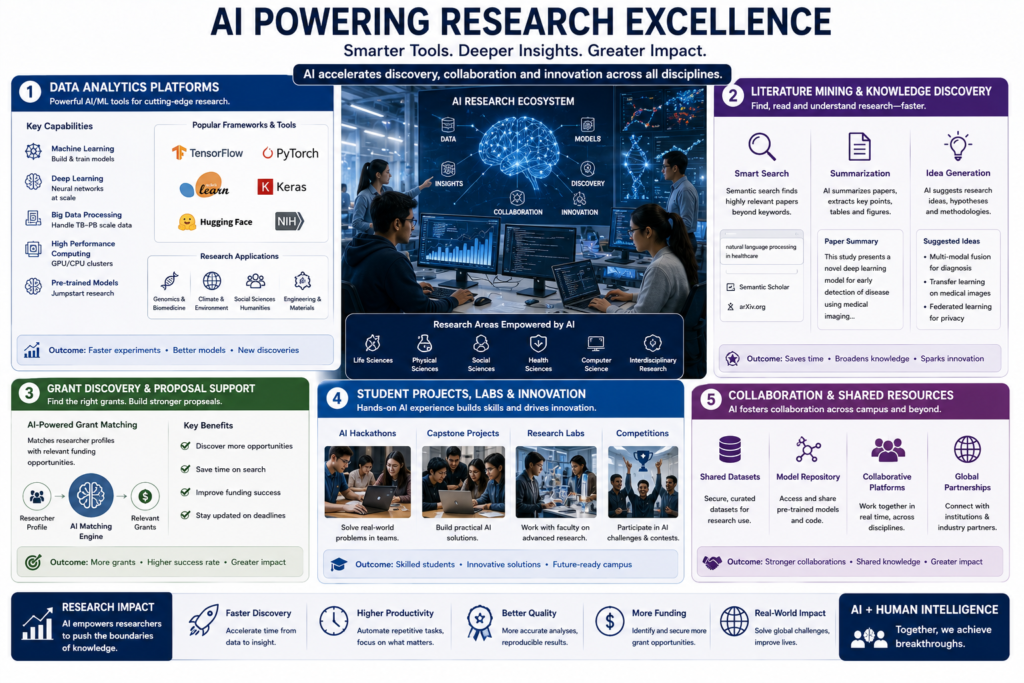
Data Analytics Platforms: University research computing can provide AI/ML libraries (TensorFlow, PyTorch) and pre-trained models (e.g. NIH’s use of AI for genomics). This accelerates big-data research in science and social science.
Literature Mining: Tools like Semantic Scholar or custom LLMs help researchers find relevant papers. GPT-style assistants can summarize articles or suggest experimental ideas (though peer review caution applies).
Grant Discovery: Some systems use AI to match researchers’ profiles with grant databases, streamlining proposal identification.
Student Projects: Hackathons and labs on campus increasingly involve AI. For example, a computer science course might have teams build a small AI tutor or vision system. These hands-on projects multiply campus AI expertise.
Each use case above can be measured. A campus should define KPIs such as improved test scores (for learning aids), decreased processing time (for admin tasks), faster response times (for campus safety), and tangible savings (in utilities or labor). These metrics tie back to strategic goals like student success rates, cost efficiency and innovation.
5. Benefits and Key Performance Indicators (KPIs)
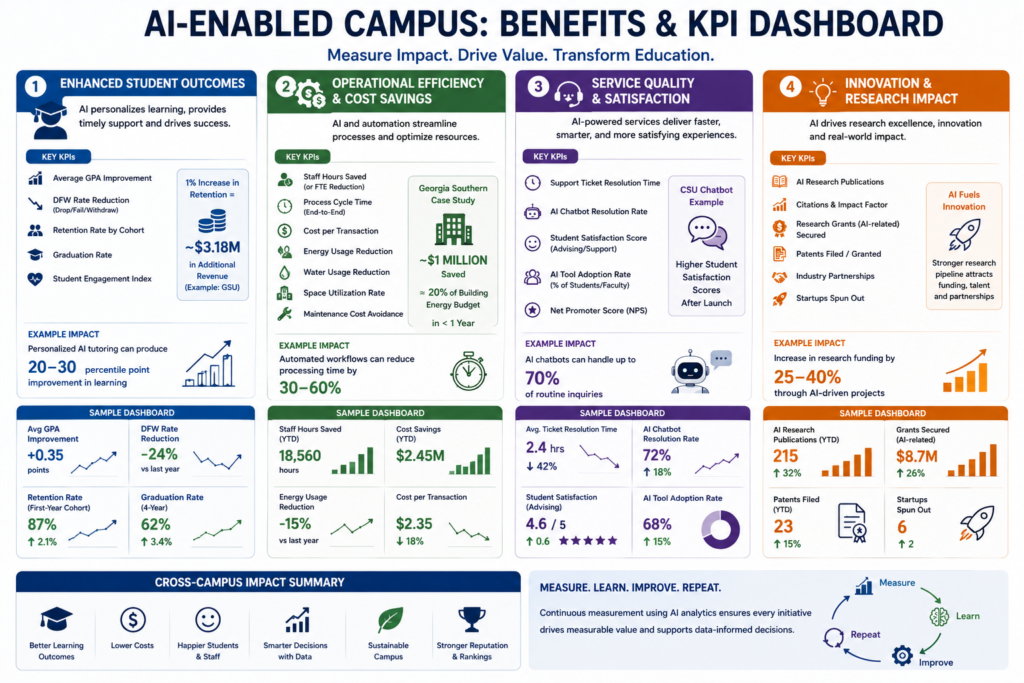
The AI-enabled campus promises benefits in four main areas:
- Enhanced Student Outcomes: AI-driven personalization and support can raise grades, retention and graduation. Studies cited earlier show effect sizes in learning gains. Campuses should track KPIs like average GPA improvement, drop/fail/withdraw (DFW) rate reduction, retention rates by cohort, and graduation rates. For example, if a predictive advising program increases retention by even 1%, that could translate to millions in revenue (GSU reported ~$3.18M per 1% retention bump).
- Operational Efficiency and Cost Savings: Automating routine tasks (RPA/chatbots) and optimizing resources (energy, space) saves time and money. Key metrics include staff hours saved (or FTE reduction), processing times (e.g. how long a transcript request takes), and cost per transaction. The Georgia Southern case saved ~$1M (≈20% of building energy budget) in under a year. Another university might track percentage energy or water usage reduction.
- Service Quality and Satisfaction: Faster, AI-powered services can improve satisfaction among students and staff. Campuses can measure support ticket resolution time, student survey results (e.g. percent reporting “high satisfaction” with advising), or uptake rates of AI tools (chatbot dialogues, number of courses using AI). The CSU chatbot example saw higher satisfaction scores after launch.
- Innovation and Research Impact: An AI-enriched campus can claim thought leadership, attracting research grants and industry partnerships. Metrics might include number of AI-related patents, publications, or new tech startups from campus labs.
Overall, each initiative should have pre-defined metrics. For example: “By Year 1, 70% of helpdesk queries will be handled by an AI chatbot, reducing human agent load by 50%.” Or “Reduce campus energy use 15% year-over-year via AI optimizations.” Embedding analytics in all projects is crucial to quantify value.
6. Implementation Roadmap (12–18 months)
Moving to an AI-enabled campus is a multistage process. A proposed 18-month roadmap might look like this (Figure 1):
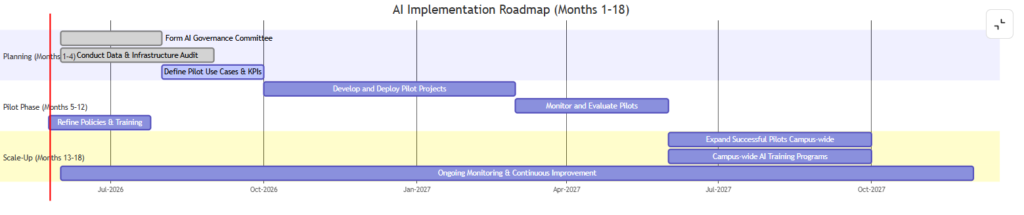
Figure 1: Example 18-month roadmap. Early phases focus on strategy, governance and pilots. Later phases scale up successful projects and train stakeholders. Continuous evaluation (KPIs, surveys) occurs throughout.
Phase 1 – Planning: Create an AI steering committee (including IT, faculty, students, and legal/ethics experts). Audit campus data systems (LMS, SIS, CRM, facilities sensors) to ensure data readiness. Define a handful of pilot projects with clear goals (e.g. “deploy an AI tutor in Calculus I”). During this phase, set governance policies (acceptable AI use, privacy rules) and procurement plans (in-house vs vendor, budget). The Tambellini Group advises institutions to weigh institutional needs and scalability when choosing between open-source or proprietary AI solutions.
Phase 2 – Pilots: Build or purchase the selected AI applications. For example, pilot a chatbot for campus FAQs and an analytics model for student advising. Train pilot users (early adopter faculty, advisors, student staff). Track metrics closely (e.g. student feedback on the tutor, number of chat queries resolved). Adjust models and policies as needed – for instance, improve the chatbot’s knowledge base or add human oversight checkpoints. The Digital Education Council notes that many campuses initially ban AI but later “encourage…experimentation” by mid-adopters. Be prepared for setbacks (see Risks section).
Phase 3 – Evaluation & Iteration: Analyze pilot results. Did the AI system meet targets? For example, did the predictive model correctly flag at-risk students and did interventions improve their outcomes? If pilot success criteria are met, plan for rollout. Otherwise, refine or change approach. Use this time to iterate on training programs – develop curriculum for AI literacy workshops or assign AI projects in classes (Halliday 2026 noted doubling of faculty AI confidence in one year).
Phase 4 – Scale-Up: Expand proven pilots across more departments or functions. For example, after a successful AI grading pilot in one college, deploy it university-wide. Integrate AI tools into core systems (single sign-on, LMS plugins). Launch broad training: short courses on using AI in pedagogy, seminars on ethics, hackathons for student innovation. Continue measuring KPIs each quarter to ensure ROI. By the 12–18 month mark, AI should be embedded in normal workflows, with a culture of continuous improvement and data-driven decision-making.
Each phase should involve communication: celebrate successes (e.g. improved exam scores), share lessons learned, and solicit feedback. The timeline above is illustrative; institutions may need more time based on size and complexity.
7. Governance, Ethics, and Privacy
AI on campus raises significant governance and ethical issues. Responsible implementation must address:
- Data Privacy & Compliance: Student and staff data used in AI (grades, health info, images) is highly sensitive. The campus must comply with FERPA, GDPR (if applicable), ADA, and other regulations. For example, predictive analytics should never reveal a student’s protected characteristic to unauthorized users. UNESCO emphasizes “human-centered, transparent” AI with strong data protection. Best practice: encrypt data, use role-based access, and anonymize inputs where possible. Require student consent for AI data use when feasible. Audit vendors for security certifications (ISO 27001, SOC2) and contractual data ownership.
- Ethical Use and Fairness: AI models can perpetuate biases. At Georgia State, excluding race/ethnicity from the dropout model helped “level the playing field”. Campuses should establish an ethics board or AI review team to evaluate bias, fairness and impact. Regularly test models for disparate outcomes (e.g. did some demographic group get flagged more by an AI risk model?). Emphasize inclusivity: ensure AI tools serve all students (including those with disabilities) – for instance by providing multilingual interfaces or screen-reader compatibility.
- Academic Integrity: Clear policies are needed on student use of generative AI. Some schools ban AI; others allow it as a tool. A balanced approach, advocated by HEPI, is to stress-test assessments and teach students AI skills while warning of hallucinations or plagiarism. Instructors should redesign assessments to require creativity and critical thinking, minimizing opportunities for simple AI completion. Transparency matters: let students know if an assignment permits AI and if so, how to cite it.
- Security & Reliability: Relying on AI means ensuring system integrity. Campus IT should vet AI software for vulnerabilities. For example, open-source LLMs, while cost-effective, may need extra scrutiny: one study found that malicious code could be hidden in 100 open AI models on HuggingFace. With proprietary tools, rely on vendor patching but maintain incident response plans in case an AI system fails or is attacked.
- Governance Structure: Assign clear ownership. Some campuses form an AI committee under the Provost or CIO office. This group oversees strategy, ethics, and troubleshooting. Policies (like “AI Use Policy” documents) should be drafted with faculty input to balance innovation and caution. The Tambellini Group notes that by mid-2020s, larger universities lead in formal AI policy development – smaller ones should follow suit.
By proactively addressing these issues, campuses can earn stakeholder trust. Remember the golden rule: always have humans in the loop. For example, an AI TA should flag “I am an AI” and allow a professor to review its answers when needed.
8. Cost Considerations and Vendor vs. Open-Source Tradeoffs
Implementing AI will incur costs – both for tools and for enabling infrastructure and talent. A prudent approach is to compare options:
- Vendor (Proprietary) Solutions: These include cloud AI platforms (AWS, Azure, Google Cloud) and licensed products (e.g. IBM Watson, Turnitin’s services, CampusM by Modo Labs for mobile apps with AI). Advantages: Turnkey solutions with support, fast deployment, often enterprise-grade security and compliance. Costs: Subscription fees or usage bills, and potential vendor lock-in. Vendors usually justify higher cost by maintenance and service guarantees.
- Open-Source / In-House: Using open models (e.g. Meta’s LLaMA, Mistral, local TensorFlow models) and custom code. Advantages: No licensing fees, full control/customization, potentially more privacy (data stays on-prem). Costs: Need staff with ML expertise to implement and maintain. Integration with existing campus systems can be time-consuming. Tambellini Group cautions that open-source AI requires technical skill and careful security policies.
- Hybrid: Often campuses start with a cloud pilot (pay-as-you-go) and gradually move mature workloads to cheaper in-house models if appropriate. For example, running initial experiments on Azure OpenAI Service, then later self-hosting a distilled model for internal use.
Vendor/Tool Comparison: Below is a sample table of AI-related offerings (not exhaustive, for illustration):
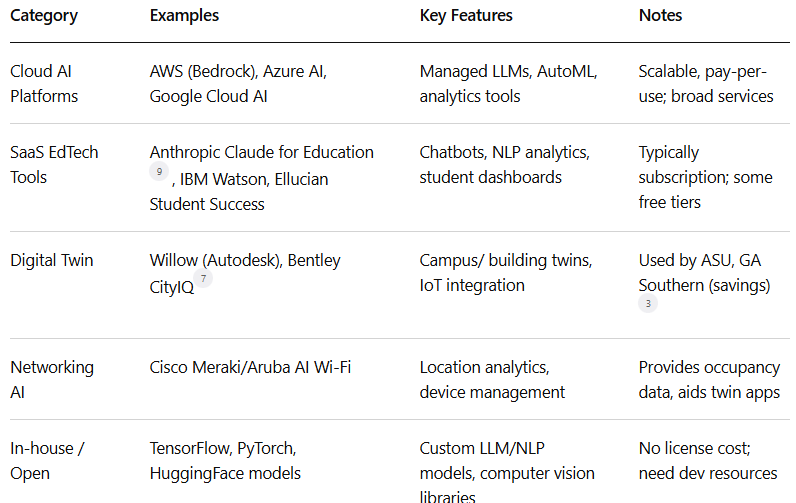
(Table: Illustrative categories of AI solutions. Proprietary offerings simplify deployment, while open-source empowers in-house innovation.)
Campus leaders should perform a total cost analysis: include not just software fees but also hardware (GPUs, sensors), cloud usage, and staff training. Remember to factor in benefits (e.g. FTE reductions) to compute ROI.
9. Case Studies: AI On Campus
Real institutions and vendors provide instructive examples:
- University of Pittsburgh (PA, USA): In 2025, Pitt partnered with Anthropic and AWS to create “Pitt: AI Campus of the Future,” offering Claude for Education campus-wide. This gives students and faculty AI writing assistants, tutoring bots, and research help. Pitt also integrated Claude into its sports analytics lab, and is building “PittGPT” using Amazon Bedrock. Outcomes reported include improved critical thinking (due to AI “suggesting ideas”) and promising pilot use for academic advising (AI agents helping plan student schedules). This example shows how a large public university can leverage partnerships with leading AI firms.
- Georgia State University (GA, USA): A pioneer in predictive analytics, GSU developed an in-house system (“Degree Compass” was an earlier project) that now monitors ~90,000 students with 800 risk factors. Advisors get daily alerts (e.g. a student registered for a wrong course, or underperforming in a prerequisite) and can intervene immediately. Over the last decade, GSU’s four-year graduation rate climbed ~7 points, and achievement gaps between minority and majority students vanished. An internal report credited predictive analytics (plus wraparound support like microgrant funding) for these gains. GSU’s example illustrates AI’s equity potential: by focusing resources where needed, demographics no longer predetermined outcomes.
- California State University System: CSU rolled out AI chatbots for tutoring across its 23 campuses. Using GPT, each campus offered students an AI “course assistant” to ask questions anytime. Early surveys indicated a large drop in simple advisor queries and higher student satisfaction, as the chatbot was available 24/7. CSU’s leadership highlights this as a major operational win, demonstrating how even non-elite institutions can quickly scale AI via cloud tools. (We note such initiatives often rely on existing platforms like Microsoft’s Azure OpenAI service, which CSU uses.)
- Georgia Tech (GA, USA): The online Master’s in Computer Science program famously deployed “Jill Watson,” an IBM Watson–based AI TA. “Jill” answered thousands of student forum posts and email queries indistinguishably from a human TA. Though a small-scale experiment, it showed that 24/7 AI support can scale faculty effort. Georgia Tech has since continued to develop AI assistants in courses and won’t run them without a human fallback, underscoring the human+AI model.
- Georgia Southern University (GA, USA): A case study by digital twin vendor Willow showed GSU unified its HVAC, energy meters, occupancy sensors and maintenance tickets into a campus-wide twin. The AI-driven analysis revealed inefficiencies (e.g. buildings running HVAC at full blast at night) and auto-scheduled preventative maintenance. Result: nearly $1M in savings over 9 months on operations costs. GSU’s facilities director emphasizes data trust (“Our twins are only as good as our data”) and points out the need for staff to buy into AI insights.
- University of Texas at Austin (TX, USA): UT’s energy research group built a city-scale digital twin (with Bentley) to model campus building energy use. It displays past, present and forecasted energy consumption for all campus buildings. While still a research tool, it has already led to greater awareness: the team shares how climate change will “deeply underestimate…future energy use”. UT plans to integrate this twin into campus planning. This example highlights academic-led AI projects that serve both campus and wider community (UT even partners with Austin city on “urban heat island” modeling).
These cases span different scales and missions, but all share lessons: start with a clear problem (student success, energy, or service), measure impact, and scale gradually. Importantly, each relied on interdisciplinary teams – pairing tech experts with domain staff – and on executive sponsorship to get funding and buy-in.
10. Risks and Mitigation Strategies
While potential is high, campuses must manage AI risks:
- Talent and Skills Shortage: Many institutions lack in-house AI expertise. HolonIQ’s 2023 survey notes 54% of education organizations cite lack of talent as the top barrier. Mitigation: Partner with industry (e.g. AWS Educate), hire data scientists, or train staff. Some universities allocate a portion of IT budget to AI R&D labs or establish data science centers.
- Unclear ROI / High Cost: Initial costs (software, hardware, training) are substantial, and benefits may be delayed. Mitigation: Use phased ROI: show quick wins with pilots to justify larger investment. Measure short-term metrics (like time saved) to build confidence. Grants and government funding (e.g. NSF AI institutes) can offset costs.
- Resistance to Change: Faculty or staff may view AI as threatening or distracting. Mitigation: Engage stakeholders early. Showcase how AI helps (not replaces) – e.g. “AI freed me from grading so I can spend more time mentoring.” Offer hands-on workshops. Leadership should reward innovation (pilot projects, course transformations).
- Data Security Threats: Centralizing data for AI also centralizes risk. Mitigation: Follow cybersecurity best practices (zero trust networks, regular penetration testing). Use federated or on-device AI for especially sensitive tasks.
- Algorithmic Bias and Fairness Issues: As noted, historical data can encode inequality. Mitigation: Have diverse teams evaluate models; incorporate fairness metrics; allow students to appeal or override automated decisions. Transparency about algorithms and open audits (where possible) build trust.
- Ethical Missteps: Unintended outcomes (privacy breaches, AI hallucinations) can damage trust. Mitigation: Develop a clear AI ethics charter. Use pilot “red teams” to probe failures (some schools simulate AI cheating to test detection). Keep a human counselor or educator as fallback.
Documenting these risks and having clear response plans is essential. For instance, if a campus AI tool produces an error (misgrades a paper, or misidentifies a threat), there should be a documented mitigation path (human review, apology protocols). The Tambellini Group suggests listing top AI risks and strategies for mitigation as part of planning.
11. Actionable Recommendations for Campus Leaders
To navigate the AI campus journey, leaders should:
- Craft a Campus AI Strategy and Budget: Define clear goals (better outcomes, cost savings, innovation) and align them with institutional priorities. Develop a multi-year investment plan (covering pilot funding, data infrastructure, training). Use frameworks like the AI Strategic Investment Proposal template (see DEC’s roadmap resource).
- Establish Governance & Ethics Framework: Form a cross-functional AI governance board. Adopt responsible AI guidelines (transparency, data protection) up front. Ensure every AI initiative has an ethics review (especially important for student data and surveillance applications).
- Start Small with High-Impact Pilots: Identify 1–3 pilot projects that are visible and measurable. Good candidates: an AI tutor in a gateway course, a scheduling chatbot, or an energy optimization project in a single building. Measure baseline metrics and set targets.
- Build Data Foundations: Invest in unifying institutional data (a data warehouse or lake). Standardize data formats and ensure real-time feeds from campus systems (LMS, finance, IoT). Without clean, accessible data, AI tools cannot deliver.
- Develop Skills & Culture: Launch AI literacy programs for students, faculty and staff. Encourage interdisciplinary projects (e.g. CS students working with sociology on an AI study). Promote success stories internally.
- Iterate with Stakeholder Feedback: Collect feedback from users (students, faculty, staff) on AI tools. Use surveys and focus groups. Make improvements continuously. For example, adjust the chatbot’s tone or expand its knowledge base based on student input.
- Evaluate and Publicize Outcomes: Regularly report on KPIs to leadership and campus community (e.g. “AI use in advising led to 10% fewer dropouts this year”). Transparency about both successes and lessons builds trust and supports future funding.
- Balance Vendor and Open-Source: Use vendor products for mature, broad-use cases (e.g. cloud AI services), but invest in open-source and in-house tools where control is needed. Consider an AI sandbox to experiment cheaply before enterprise purchase.
- Ensure Equity and Accessibility: Continually check that AI tools serve all student groups. Provide accommodations (like multi-language support). Involve diversity officers in AI project planning.
- Plan for Long Term: Treat AI initiatives as ongoing transformations, not one-off projects. Establish a “AI Center of Excellence” or dedicate staff for continuous innovation. For example, annual AI hackathons or partnerships with AI companies can keep the campus at the cutting edge.
By following these recommendations, a campus can systematically become more intelligent and responsive. As one expert quipped, “Your AI isn’t a one-time tool – it’s an intern that needs training, guidance, and evaluation”.
12. Conclusion
An AI-enabled campus is not a far-off fantasy but an emerging reality. When thoughtfully implemented, AI can transform education – making learning more personal, administration more efficient, and campuses safer and more sustainable. We have surveyed the critical building blocks of this transformation: state-of-the-art technologies (LLMs, predictive models, AI vision, IoT twins), real examples of impact, and a roadmap for action. The evidence shows substantial benefits: dramatic learning gains in pilot programs, retention increases, and operational savings.
However, reaping these benefits requires strategic planning: robust governance, ethical safeguards, and an openness to change. Campus leaders should set clear goals and metrics, start with targeted pilots, and scale up based on data. The timeline above and case studies herein demonstrate that progress is achievable within a couple of years. In the words of one manifesto: universities that embrace AI early will “thrive in the age of AI” by modernizing pedagogy and curricula, amplifying faculty expertise, and treating AI as a chance to renew their mission.
For the higher education community – administrators, faculty, students – the call is urgent: AI adoption has moved from optional to essential. An AI-enabled campus equips students with critical 21st-century skills and operationalizes innovation at scale. As campuses worldwide are already showing, investing in AI today means developing the leaders of tomorrow.
Sources: We drew on recent academic studies and industry reports. Among them: randomized trials of AI tutors; university press releases and case studies (Pittsburgh, Georgia State, Georgia Southern, UT Austin); analyses of AI adoption trends; and expert whitepapers on higher-ed AI strategy. Inline citations mark each fact or quote to its source.
References
[1] A. Turing, “Computing Machinery and Intelligence,” Mind, vol. 59, no. 236, pp. 433–460, Oct. 1950.
[2] J. McCarthy, M. L. Minsky, N. Rochester, and C. E. Shannon, “A Proposal for the Dartmouth Summer Research Project on Artificial Intelligence,” Dartmouth College, Hanover, NH, USA, 1955.
[3] T. L. Saaty, Decision Making for Leaders: The Analytic Hierarchy Process for Decisions in a Complex World. Pittsburgh, PA, USA: RWS Publications, 1982.
[4] P. Senge, The Fifth Discipline: The Art and Practice of the Learning Organization. New York, NY, USA: Doubleday, 1990.
[5] UNESCO, Information and Communication Technology in Education: A Curriculum for Schools and Programme of Teacher Development. Paris, France: UNESCO, 2002.
[6] M. Porter and J. Heppelmann, “How Smart, Connected Products Are Transforming Competition,” Harvard Business Review, vol. 92, no. 11, pp. 64–88, Nov. 2014.
[7] K. Schwab, The Fourth Industrial Revolution. Geneva, Switzerland: World Economic Forum, 2016.
[8] S. Russell and P. Norvig, Artificial Intelligence: A Modern Approach, 3rd ed. Upper Saddle River, NJ, USA: Pearson, 2016.
[9] A. Luckin, Machine Learning and Human Intelligence: The Future of Education for the 21st Century. London, U.K.: UCL Institute of Education Press, 2018.
[10] World Economic Forum, “Schools of the Future: Defining New Models of Education for the Fourth Industrial Revolution,” Geneva, Switzerland, Jan. 2020.
[11] National Education Policy (NEP) 2020, Ministry of Education, Government of India, New Delhi, India, 2020.
[12] UNESCO, “Artificial Intelligence in Education: Guidance for Policy-makers,” Paris, France, 2021.
[13] AICTE, “AICTE Approval Process Handbook,” All India Council for Technical Education, New Delhi, India, 2021.
[14] IBM Corporation, “What is Artificial Intelligence (AI)?,” IBM Documentation and Research Publications, Armonk, NY, USA, 2021.
[15] Microsoft Corporation, “AI in Education: Empowering Educators and Students,” Microsoft Education White Paper, Redmond, WA, USA, 2022.
[16] OpenAI, “GPT-4 Technical Report,” OpenAI Research Publications, San Francisco, CA, USA, 2023.
[17] Gartner, “Top Strategic Technology Trends: Hyperautomation and AI-Driven Enterprises,” Gartner Research Report, Stamford, CT, USA, 2023.
[18] IEEE Education Society, “Artificial Intelligence Technologies for Smart Learning Systems,” IEEE Access, vol. 11, pp. 10234–10258, 2023.
[19] “Artificial Intelligence in Education: 2023 Survey Insights,” HolonIQ
[20] “Digital Twin of UT Campus Visualizes Present, Past, Future Energy Needs,” The University of Texas at Austin News
[21] “How Computer Vision is Changing Safety and Security,” Voxel51
[22] NASSCOM, “Future of Higher Education with AI and Digital Transformation,” NASSCOM Industry Report, New Delhi, India, 2024.
[23] “AI in Higher Education: Top Use Cases You Need To Know,” SmartDev
[24] “AI Roadmap for Higher Education: Six Steps to Lead,” Enabling Insights
[25] “Guidance for Generative AI in Education and Research,” UNESCO
[26] “Digital Twins Are Changing University Campus Operations,” Government Technology
[27] “Open-Source vs. Closed-Source AI Applications in Higher Education,” The Tambellini Group
[28] “Student Generative AI Survey 2025,” Higher Education Policy Institute (HEPI)
[29] “AI tutoring outperforms in-class active learning: An RCT introducing a novel research-based design in an authentic educational setting,” Scientific Reports. Available: Scientific Reports – Nature
[30] World Economic Forum, “Future of Jobs Report 2025,” Geneva, Switzerland, 2025.
[31] “AI-Native Universities: The Next Architecture of Higher Education,” LinkedIn Article
[32] “Beyond the Pilot: A Higher Education AI Roadmap and Action Guide,” Digital Education Council
[33] “Approaching Student Success With Predictive Analytics,” Georgia State University Success Initiative
[34] “Pitt is teaming up with Anthropic and AWS to create an AI-enabled Campus of the Future,” University of Pittsburgh