A Journey from Buddha’s Wisdom to Understanding the Human Mind

Proposed Theme:
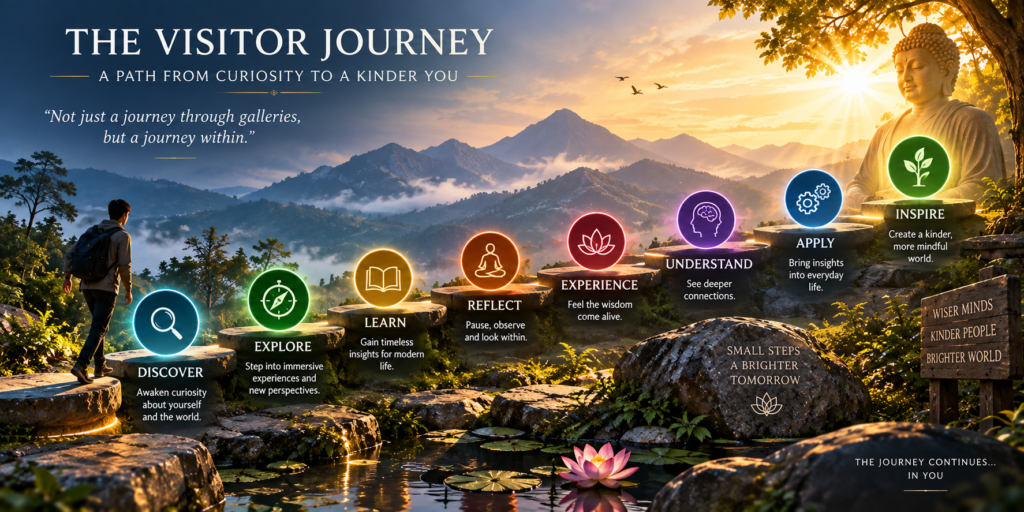
Conceptual Visitor Journey :
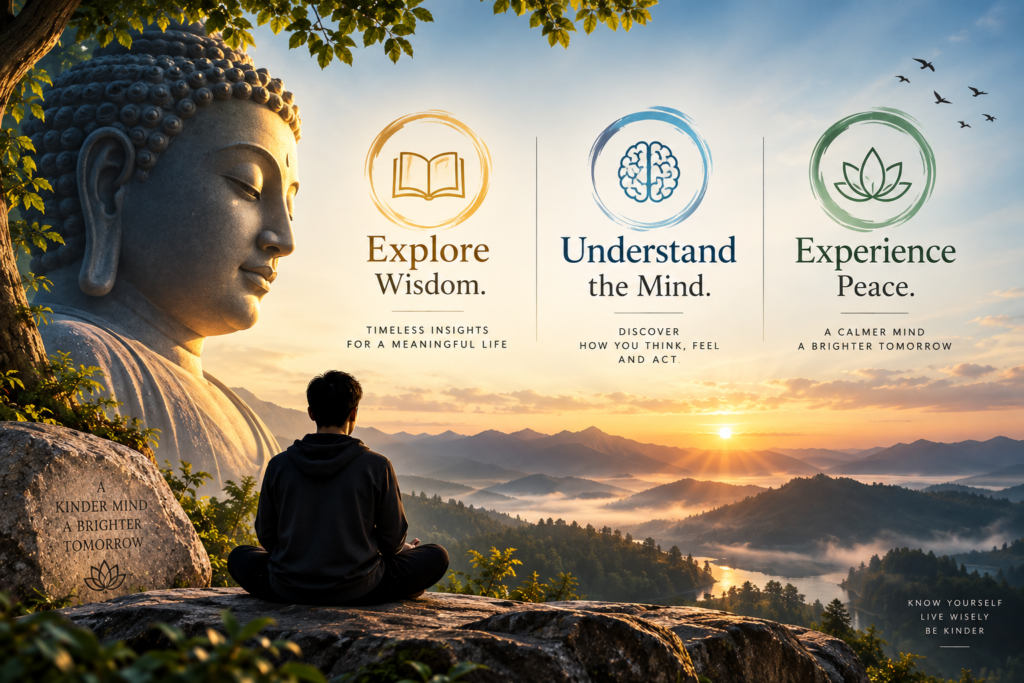
1. INTRODUCTION
The proposed Buddha Museum is conceptualized as an experiential, educational and contemplative museum dedicated to presenting the life, teachings, philosophy, cultural heritage and continuing relevance of Buddha.
The museum is envisioned not simply as a building containing statues, artifacts, paintings and historical information, but as a journey of discovery into the human mind.
Buddha’s teachings have traditionally addressed fundamental questions concerning human experience, suffering, attachment, awareness, ethical conduct, compassion, wisdom and the possibility of inner transformation. These questions continue to have relevance in contemporary life.
The proposed museum therefore seeks to create a bridge between Buddha’s historical and philosophical heritage and the contemporary visitor’s search for knowledge, meaning, awareness and peaceful living.
The conceptual design combines:
Buddhist Heritage + Philosophy + Human Mind + Mindfulness + Art + Culture + Science + Contemporary Knowledge + Experiential Learning + Reflection
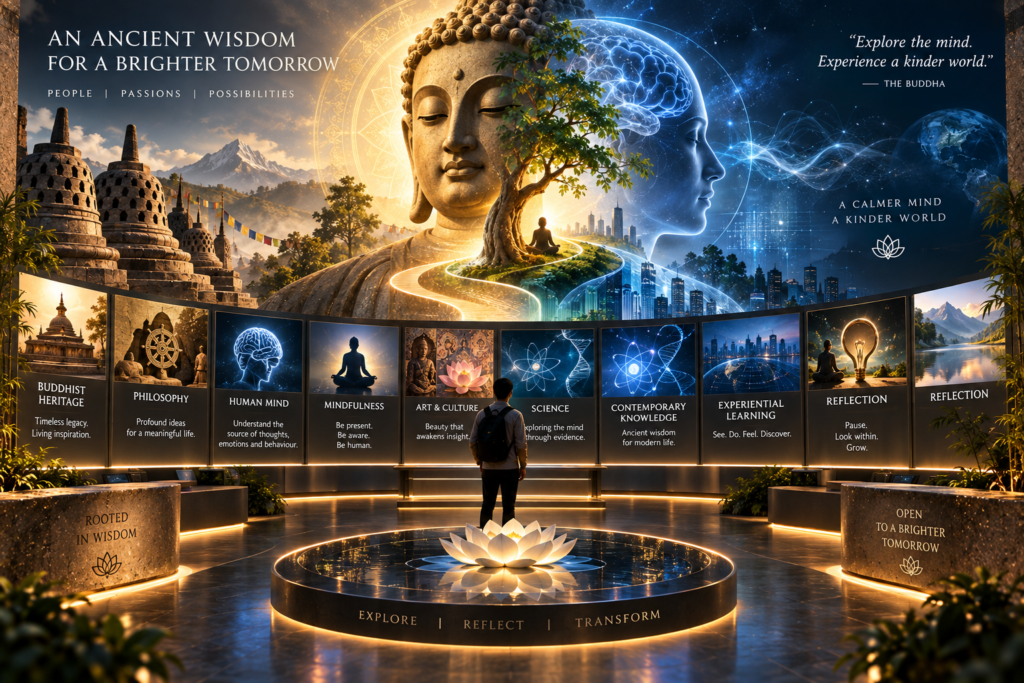
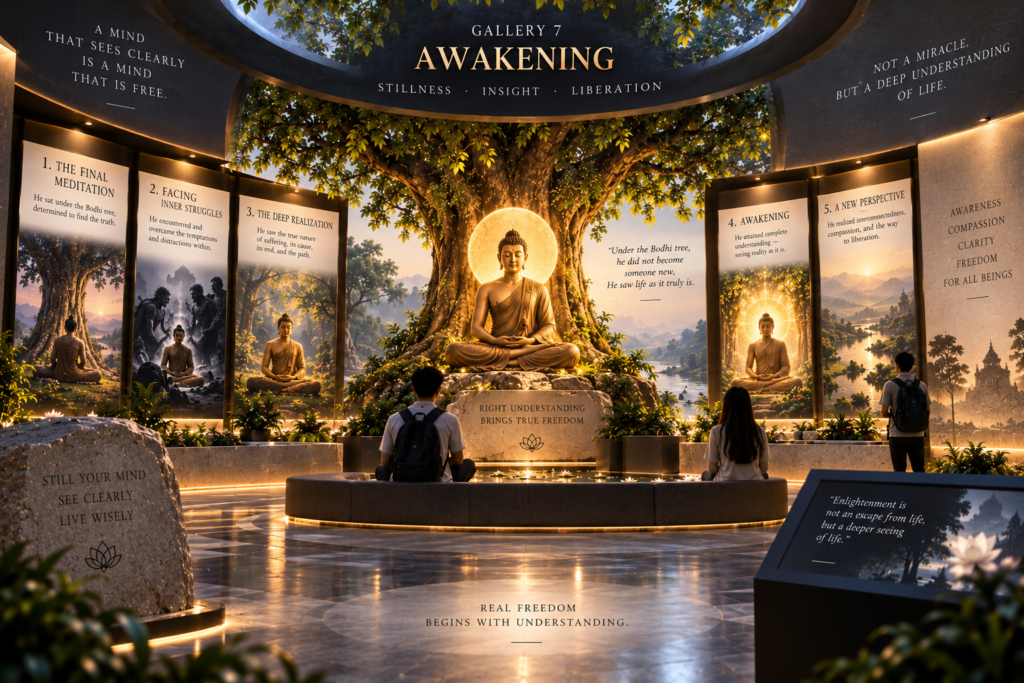
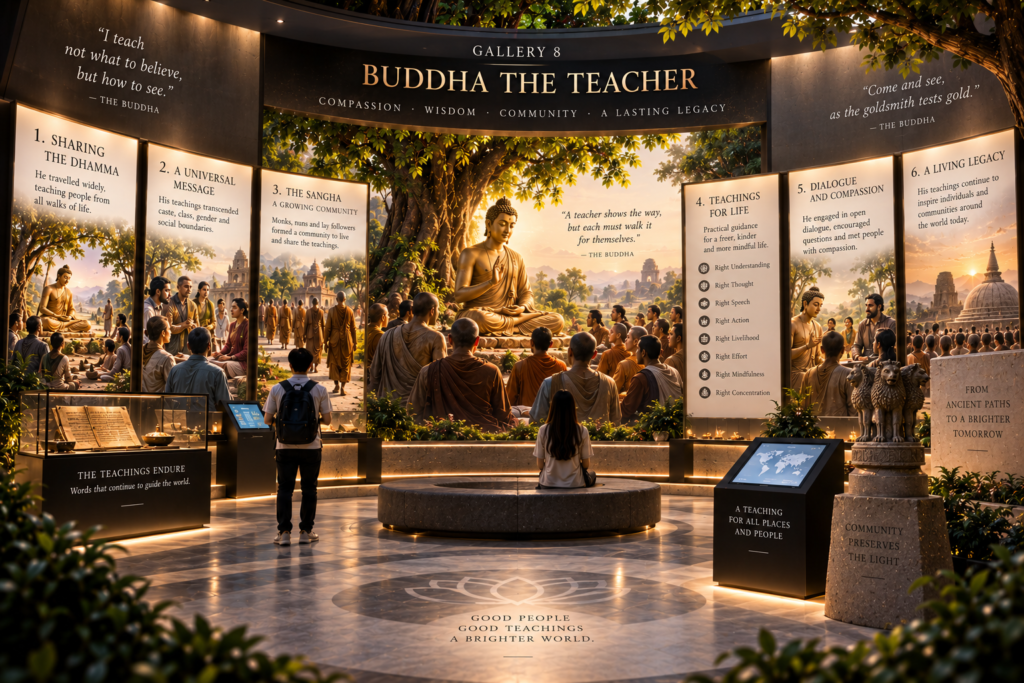
The museum is intended to be accessible to people of different ages, cultures, nationalities, religions and philosophical backgrounds.
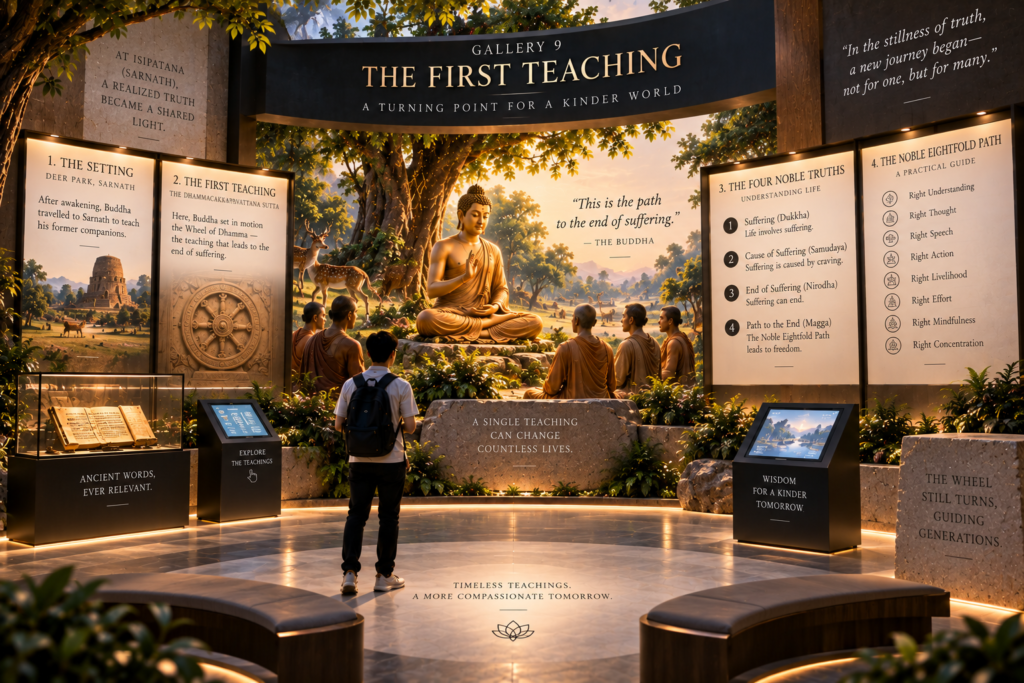
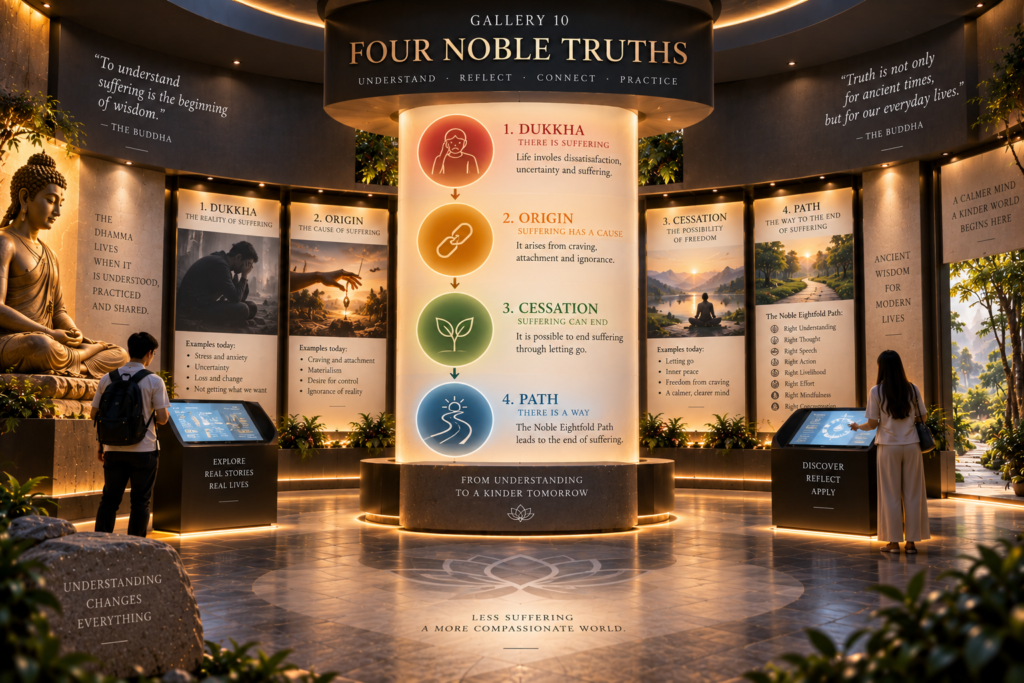
2. PROJECT CONCEPT
The central concept of the museum is:
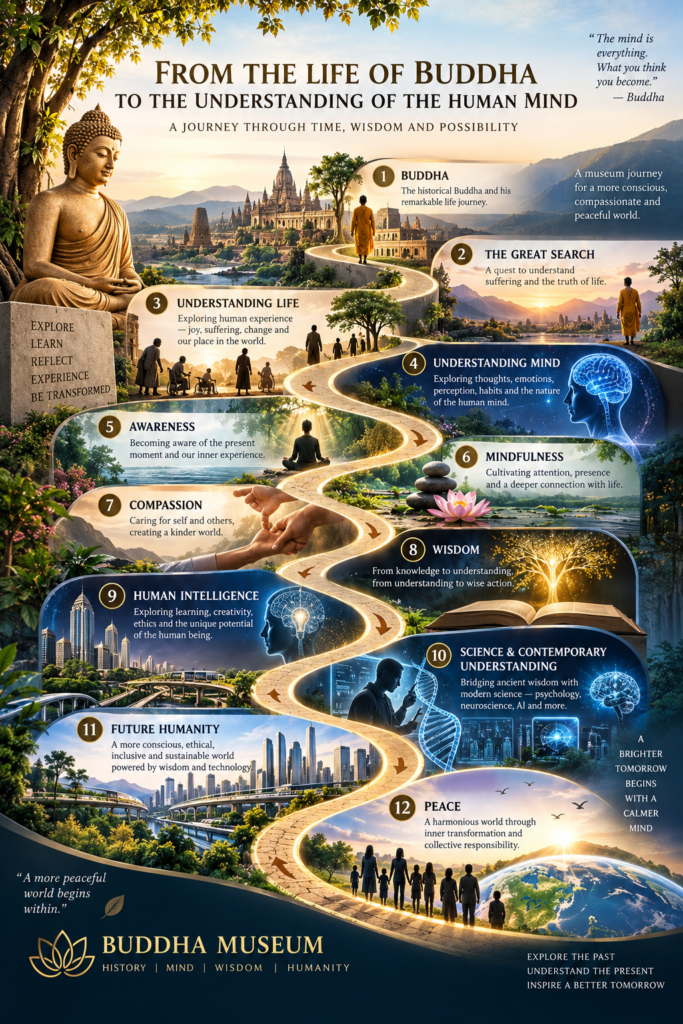
The museum therefore moves from history to philosophy, philosophy to mind, mind to awareness, awareness to wisdom, and wisdom toward peaceful human living.
3. VISION
To create an inspiring and inclusive museum that preserves and presents Buddha’s life, teachings, wisdom and cultural heritage while encouraging visitors to explore the human mind, develop awareness, reflect on life and discover pathways toward compassion, wisdom and peaceful coexistence.
4. MISSION
The conceptual mission of the Buddha Museum is to:
- Present the life and journey of Buddha.
- Introduce visitors to fundamental Buddhist teachings.
- Preserve and interpret Buddhist cultural heritage.
- Encourage understanding of the human mind.
- Create meaningful experiences of awareness and mindfulness.
- Present compassion, ethics and wisdom as important dimensions of human life.
- Use contemporary museum technologies to make learning accessible.
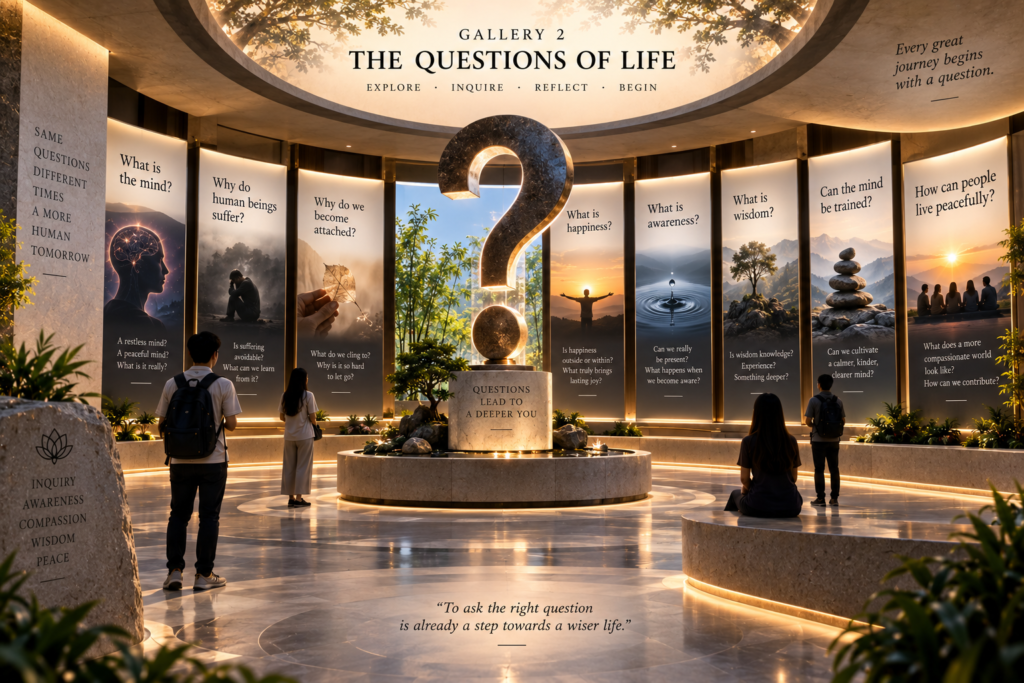
- Encourage curiosity, questioning and reflection.
- Connect historical wisdom with contemporary human challenges.
- Create an environment conducive to learning, contemplation and peaceful reflection.
5. CORE DESIGN PRINCIPLES
The conceptual design should be guided by the following principles.
Authenticity : The museum should represent Buddha’s life, teachings and Buddhist traditions responsibly and with appropriate historical and cultural context.
Inclusivity: The museum should be accessible to visitors regardless of religious or cultural background. It should function as a place of learning and exploration, not require visitors to hold a particular belief.
Experiential Learning: Visitors should not merely read information. They should: See → Hear → Touch → Explore → Experience → Reflect where appropriate.
Contemplation: The museum should contain quiet spaces where visitors can pause and reflect.
Simplicity: The design should communicate calmness and clarity rather than excessive visual complexity.
Curiosity: Exhibitions should encourage questions rather than simply provide conclusions.
Human-Centred Design: The museum experience should be designed around the visitor’s physical, intellectual, emotional and contemplative journey.
6. CONCEPTUAL DESIGN PHILOSOPHY
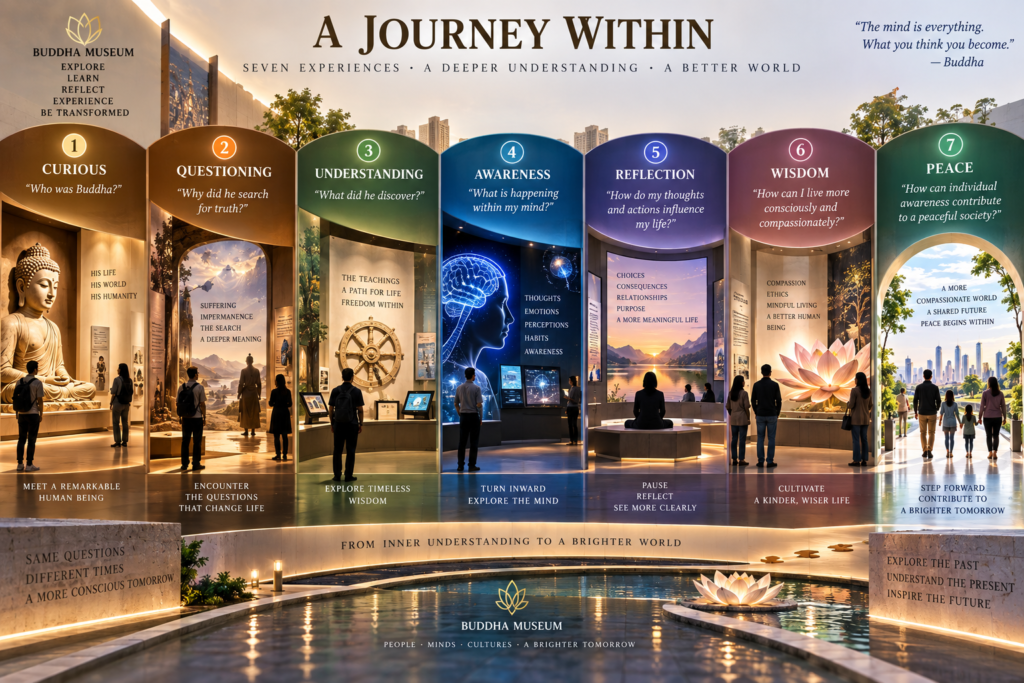
The museum can be understood as a transition through seven experiential states:
- 1. CURIOUS : “Who was Buddha?”
- 2. QUESTIONING: “Why did he search for truth?”
- 3. UNDERSTANDING: “What did he discover?”
- 4. AWARENESS: “What is happening within my mind?”
- 5. REFLECTION: “How do my thoughts and actions influence my life?”
- 6. WISDOM: “How can I live more consciously and compassionately?”
- 7. PEACE: “How can individual awareness contribute to a peaceful society?”
This progression should influence both the exhibition design and architectural movement.
8. OVERALL MUSEUM EXPERIENCE
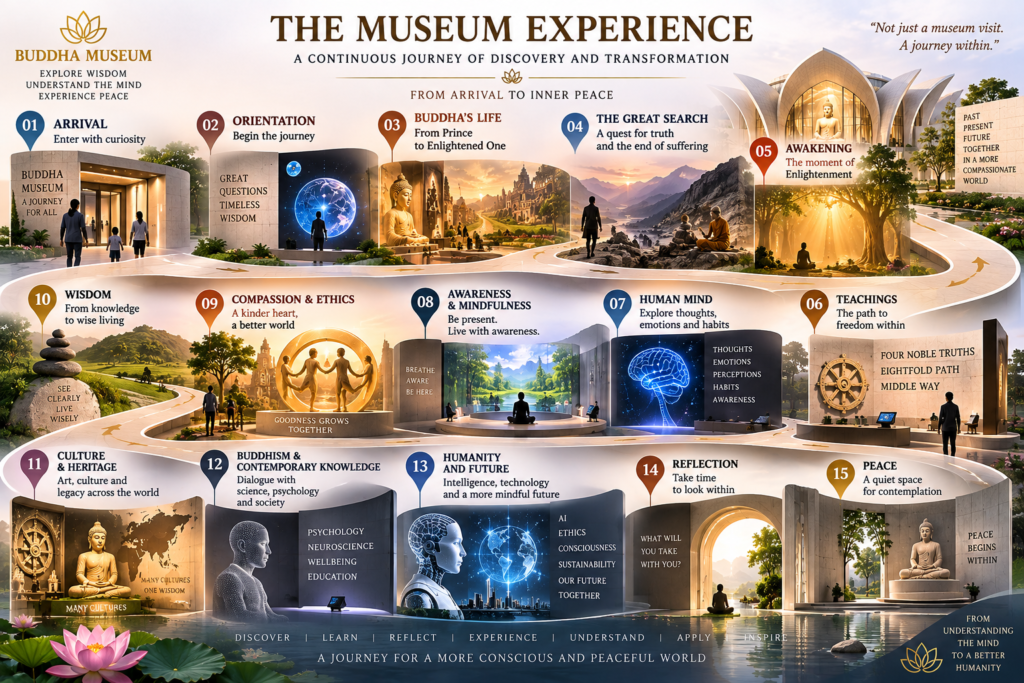
The proposed museum should be designed as a continuous narrative journey rather than a collection of unrelated galleries.
The visitor experience may follow:
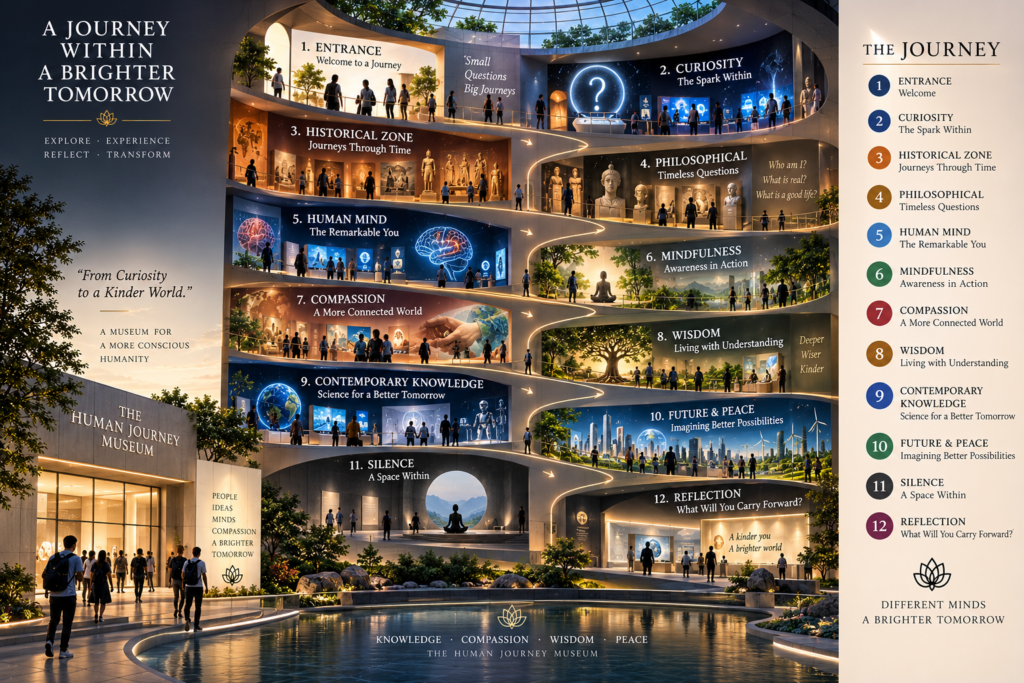
Arrival -> Orientation-> Buddha’s Life-> The Great Search -> Awakening->Teachings-> Human Mind -> Awareness & Mindfulness -> Compassion & Ethics-> Wisdom-> Culture & Heritage -> Buddha teachings and Contemporary Knowledge -> Humanity and Future -> Reflection-> Peace. The visitor finally arrives at a quiet contemplative space.
8. PROPOSED MUSEUM ZONING
The museum can conceptually be organized into ten major zones.
ZONE 1 — WELCOME & ORIENTATION
ZONE 2 — LIFE OF BUDDHA
ZONE 3 — TEACHINGS & PHILOSOPHY
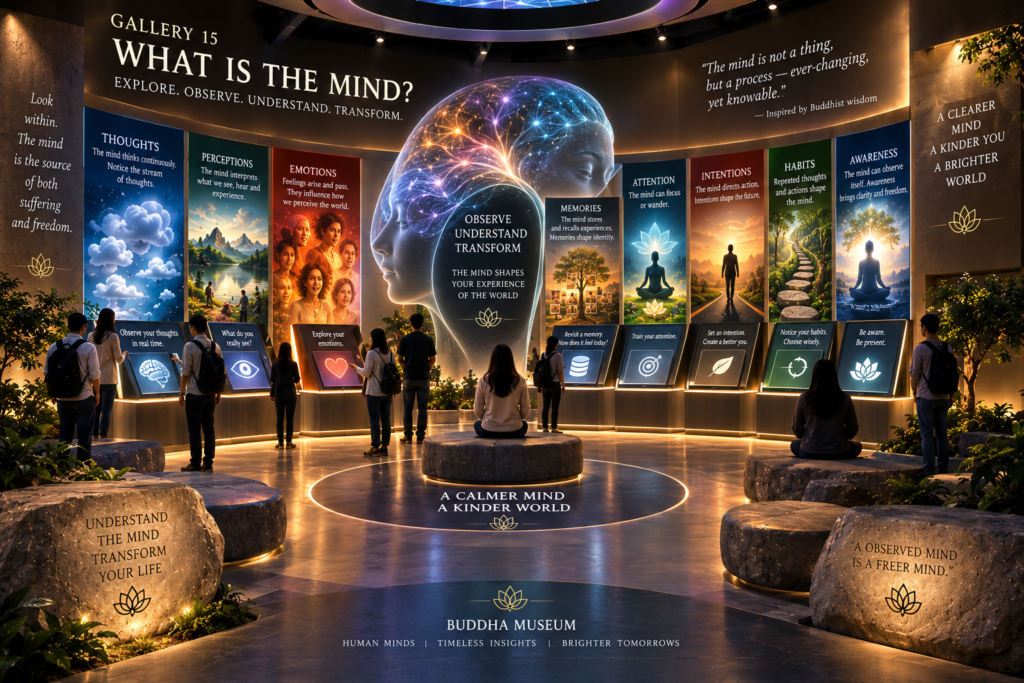
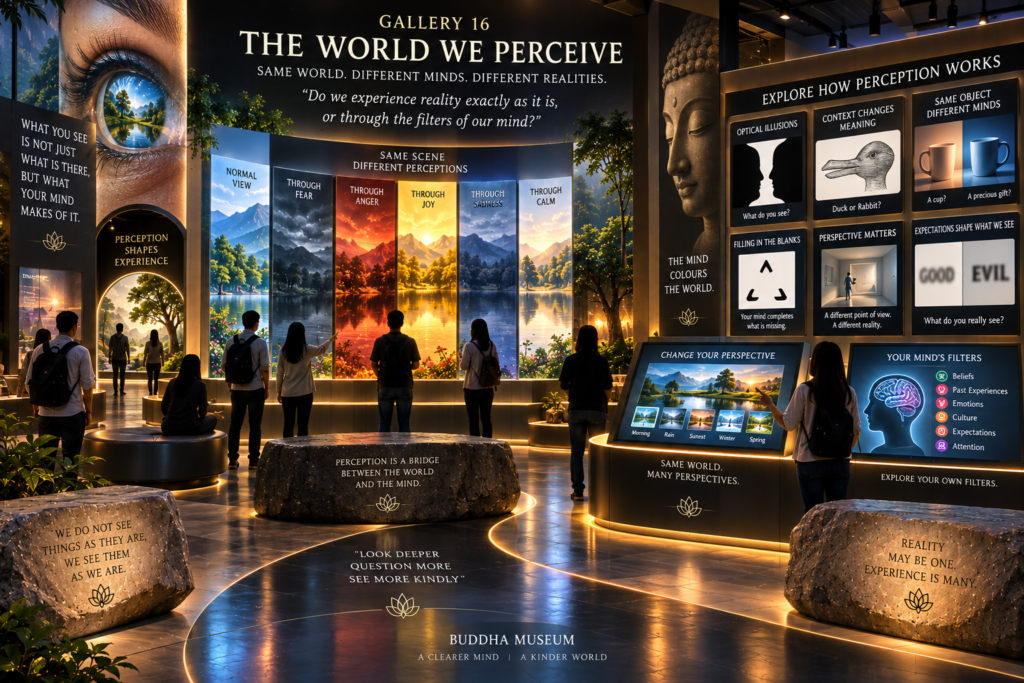
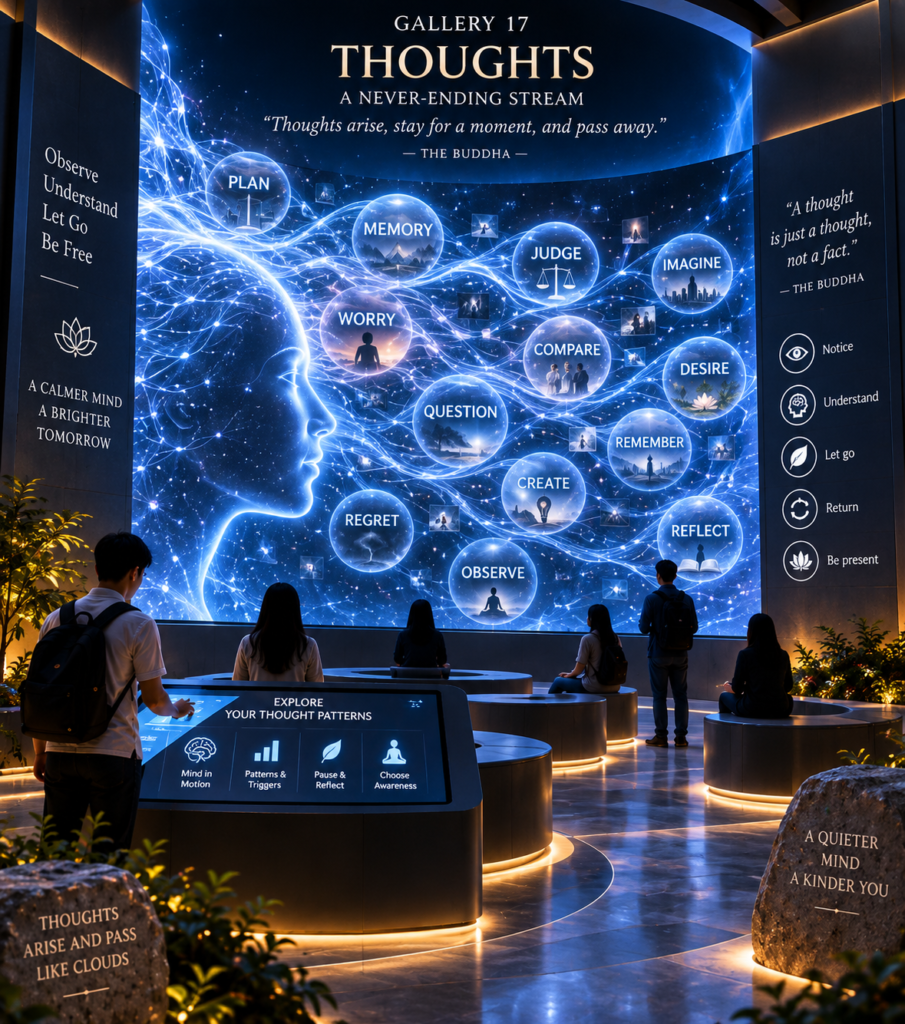
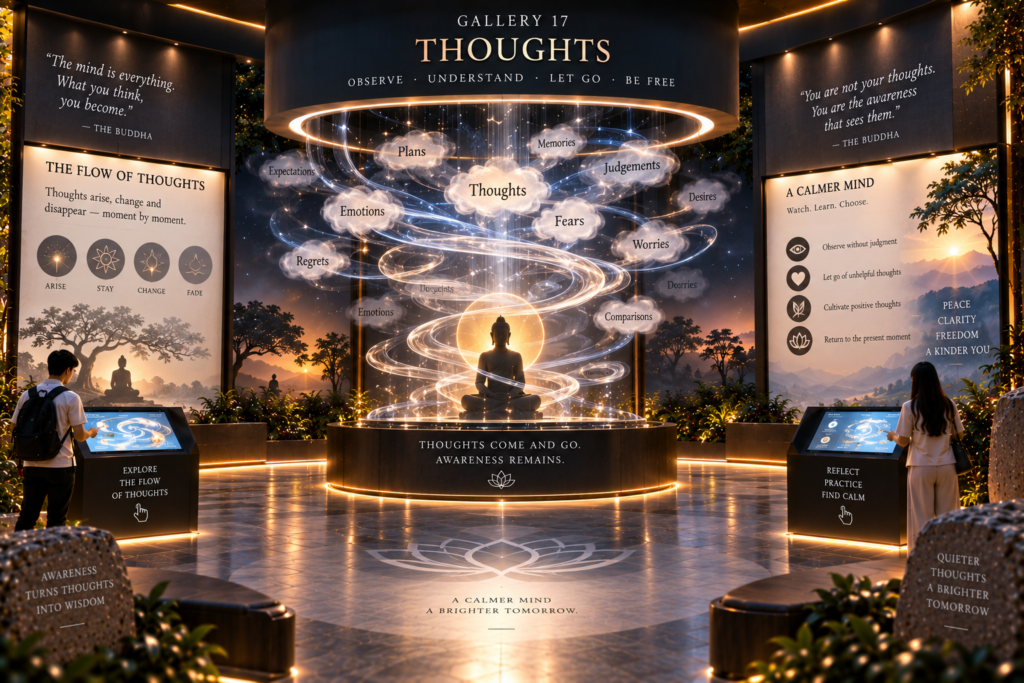
ZONE 4 — THE HUMAN MIND
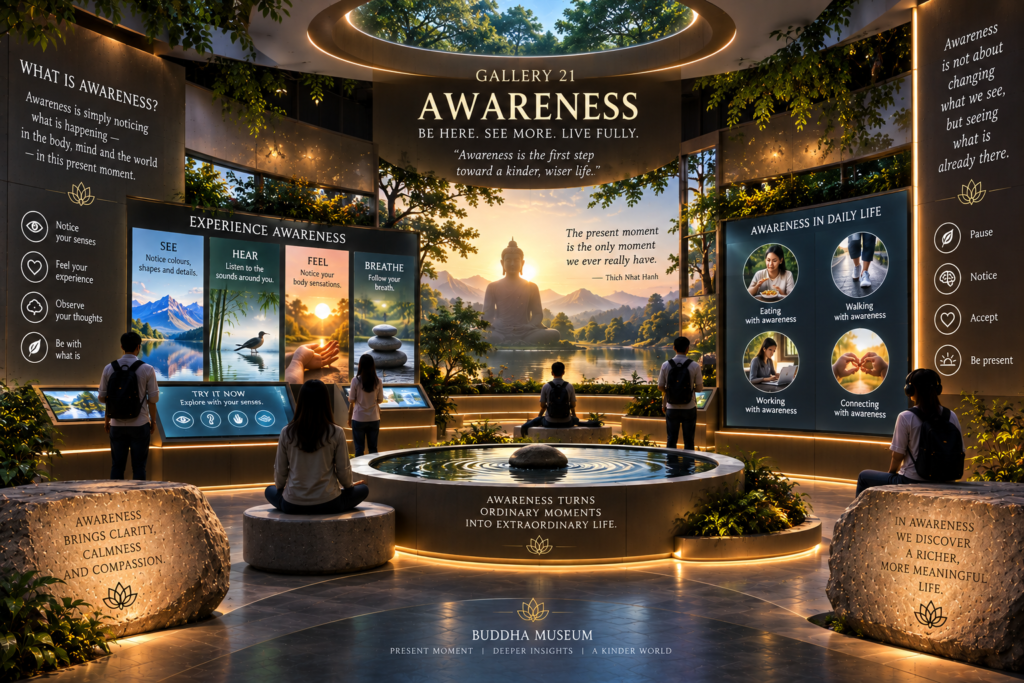
ZONE 5 — AWARENESS, MINDFULNESS & MEDITATION
ZONE 6 — COMPASSION, ETHICS & WISDOM
ZONE 7 — BUDDHIST ART, CULTURE & HERITAGE
ZONE 8 — BUDDHA AND CONTEMPORARY KNOWLEDGE
ZONE 9 — HUMANITY, FUTURE & PEACE
ZONE 10 — REFLECTION & PERSONAL JOURNEY
These zones can contain multiple galleries and interactive experiences.
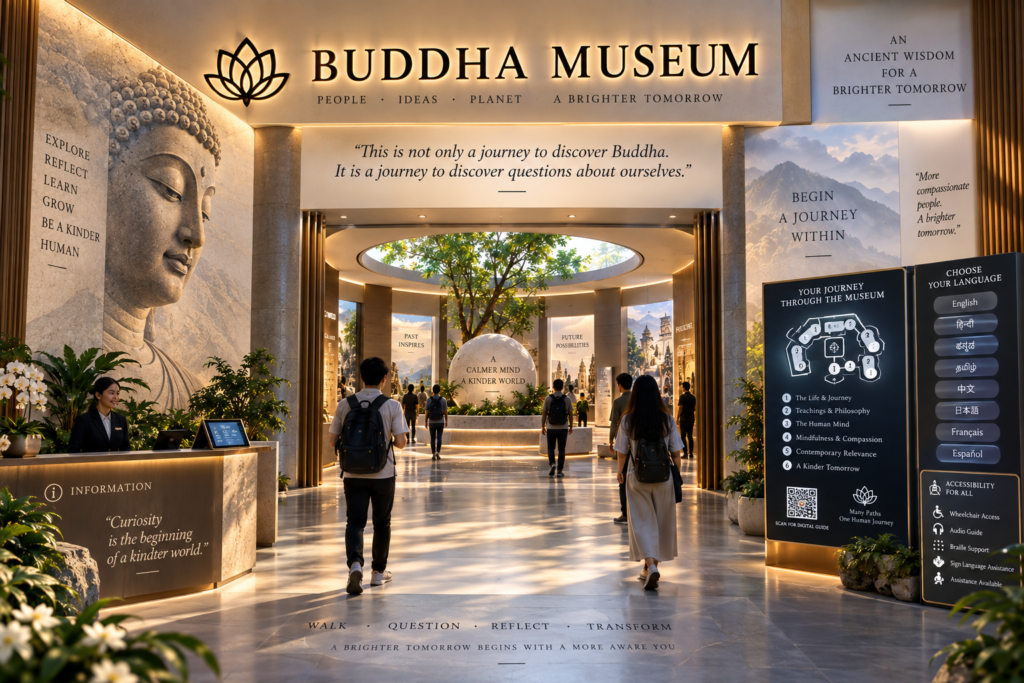
9. ZONE 1 — WELCOME & ORIENTATION
10. ZONE 2 — LIFE OF BUDDHA
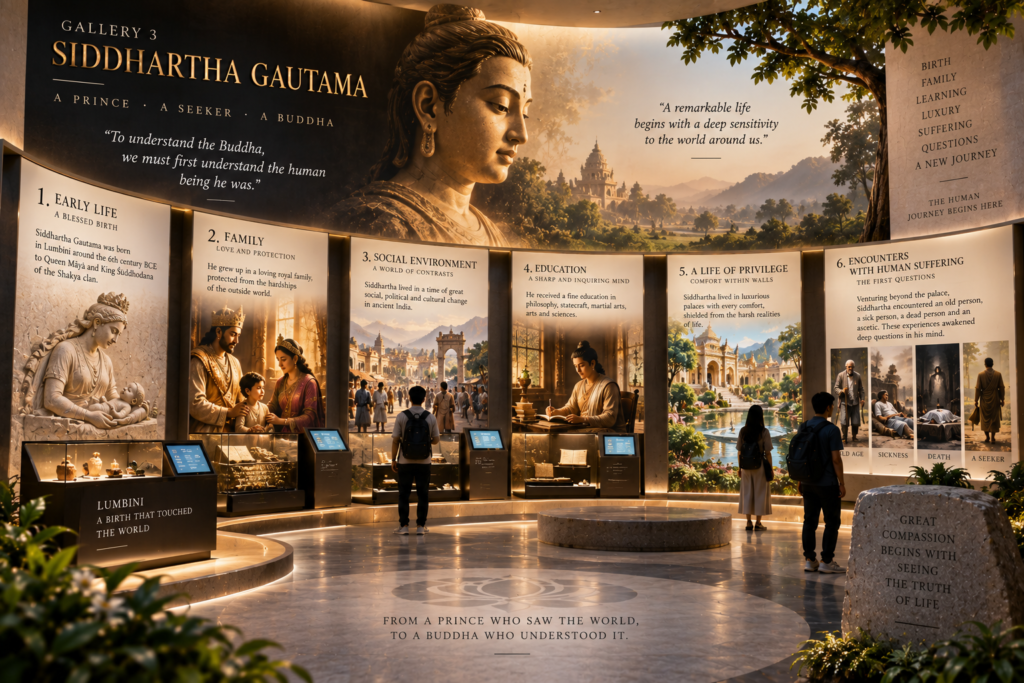
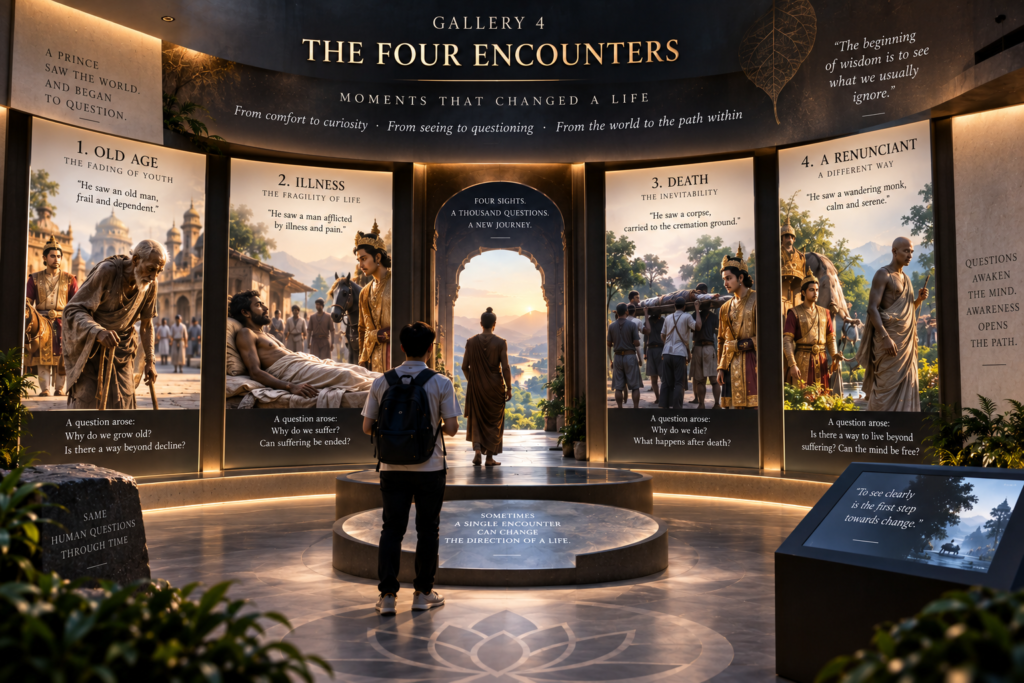
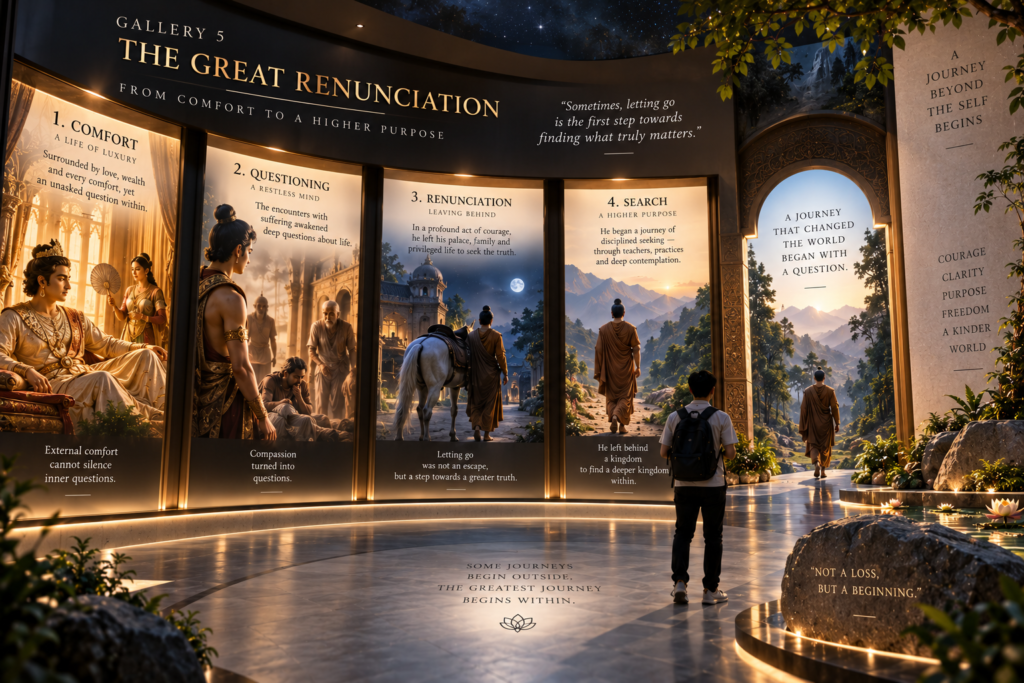
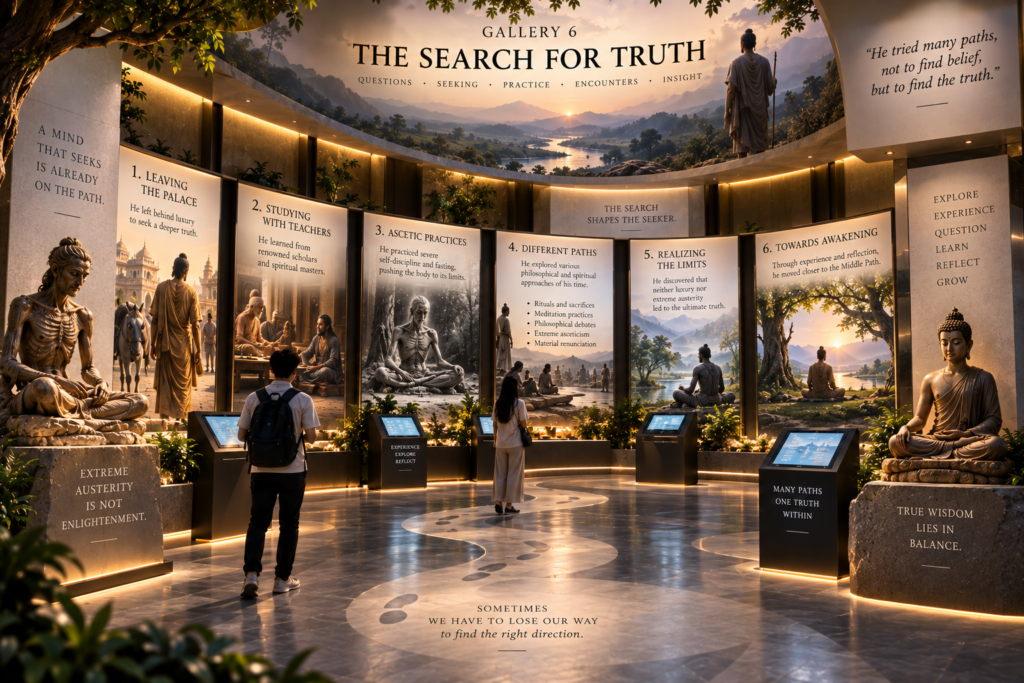
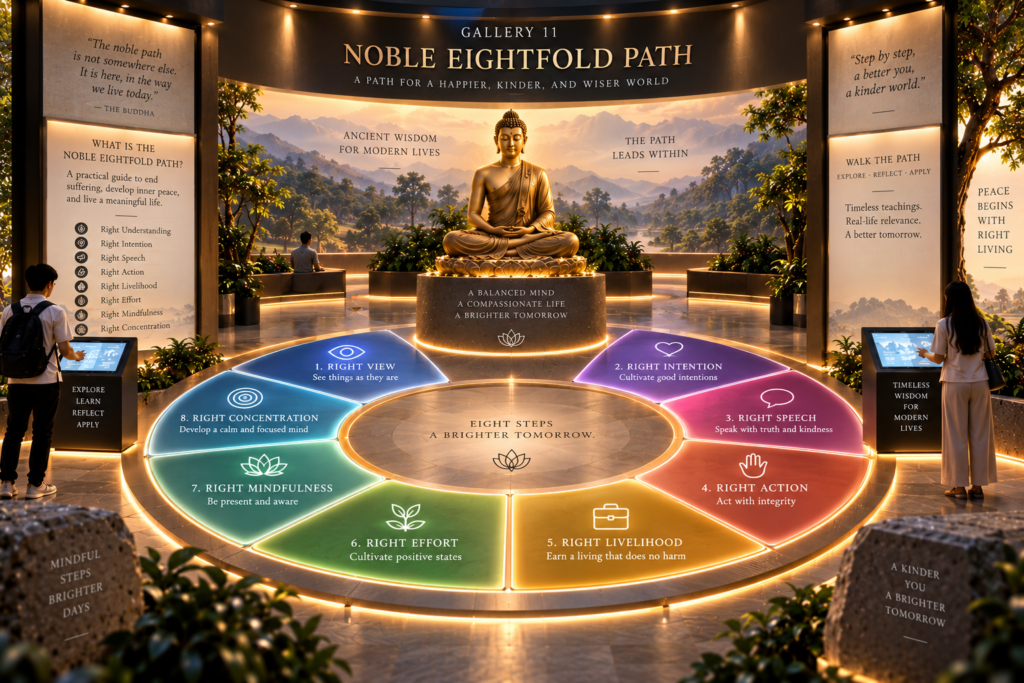
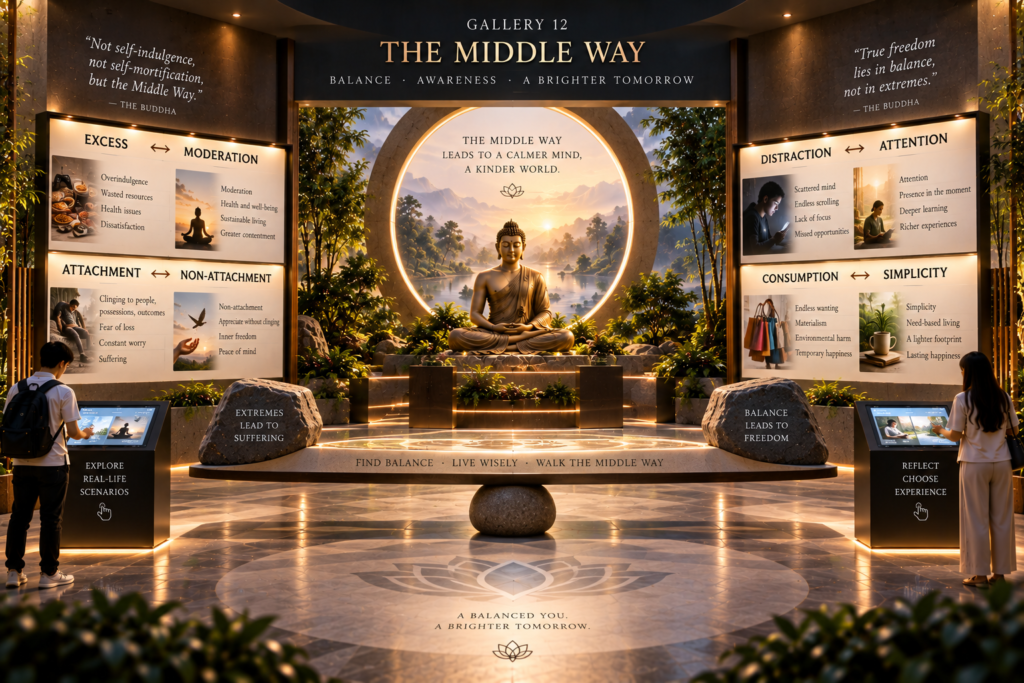
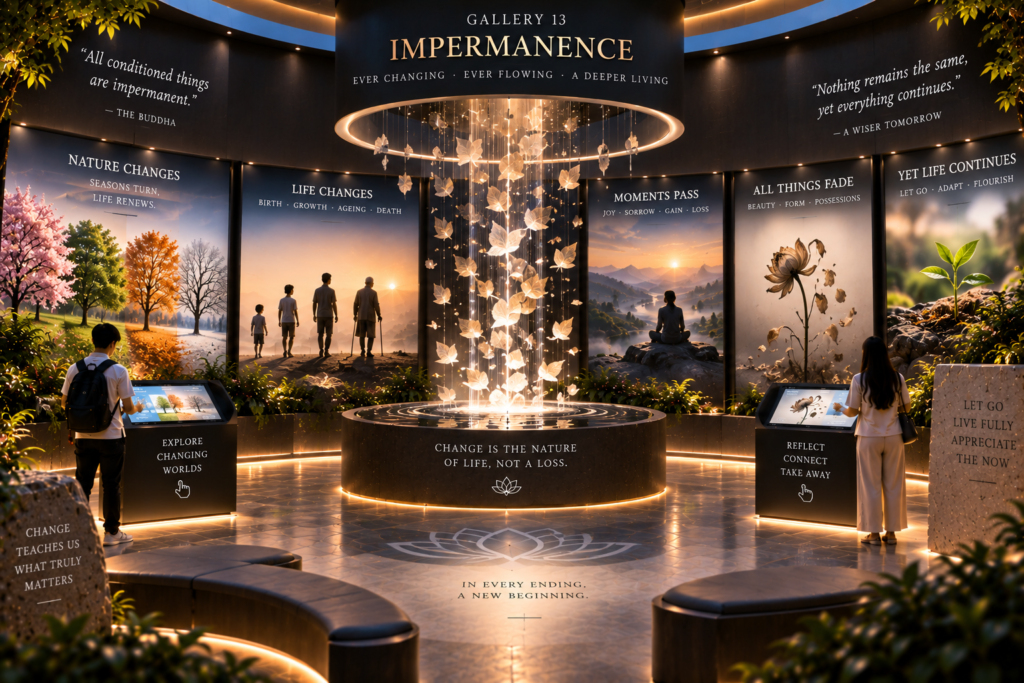
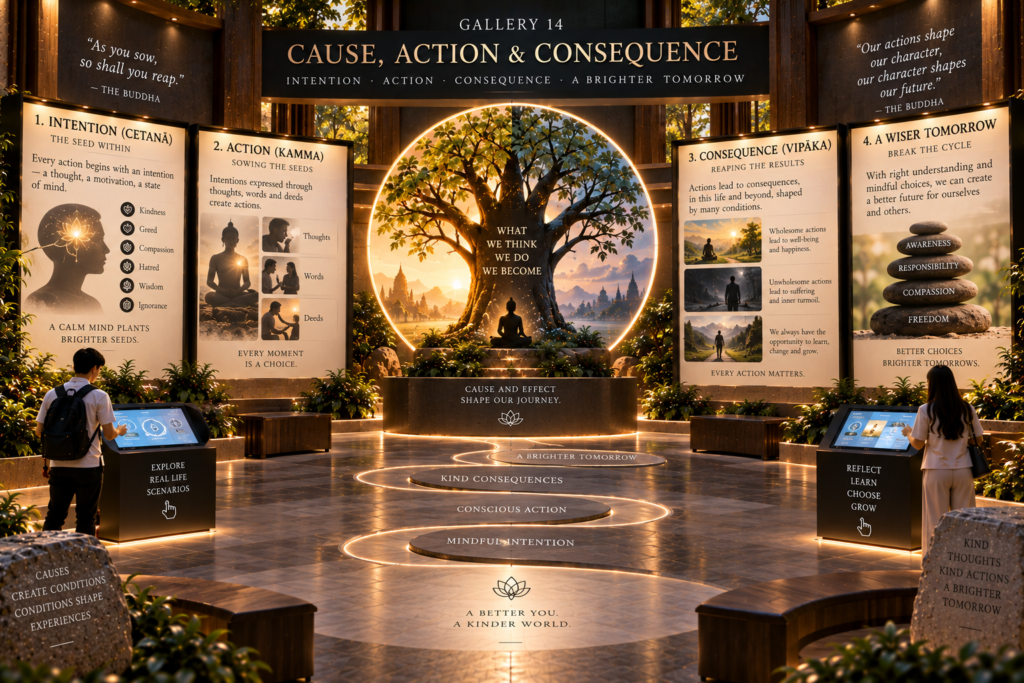
11. ZONE 3 — TEACHINGS & PHILOSOPHY
12. ZONE 4 — THE HUMAN MIND
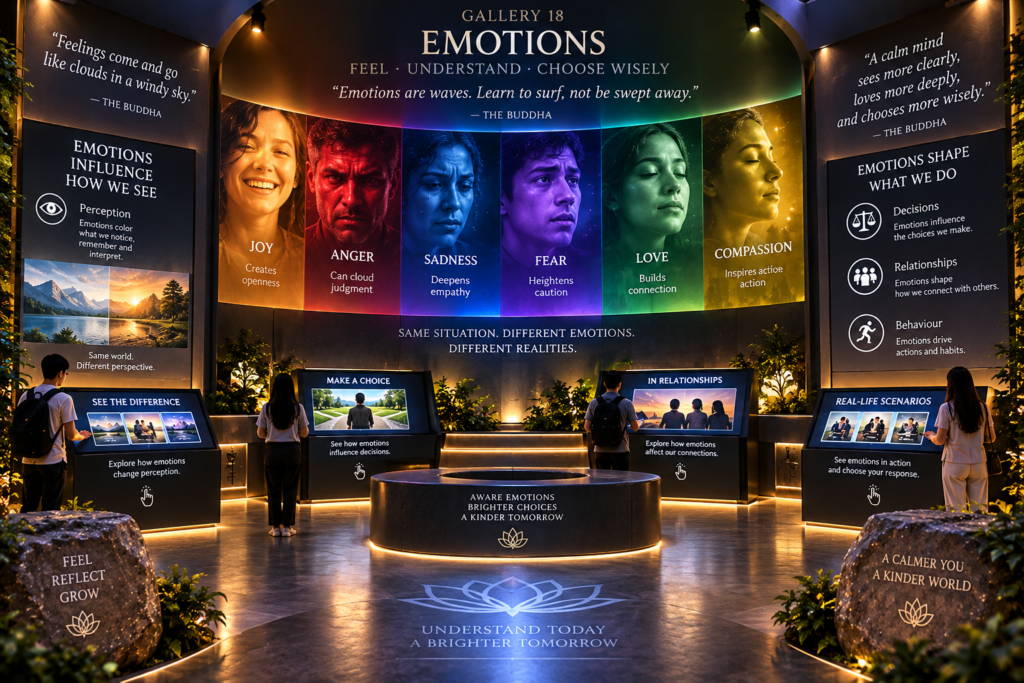
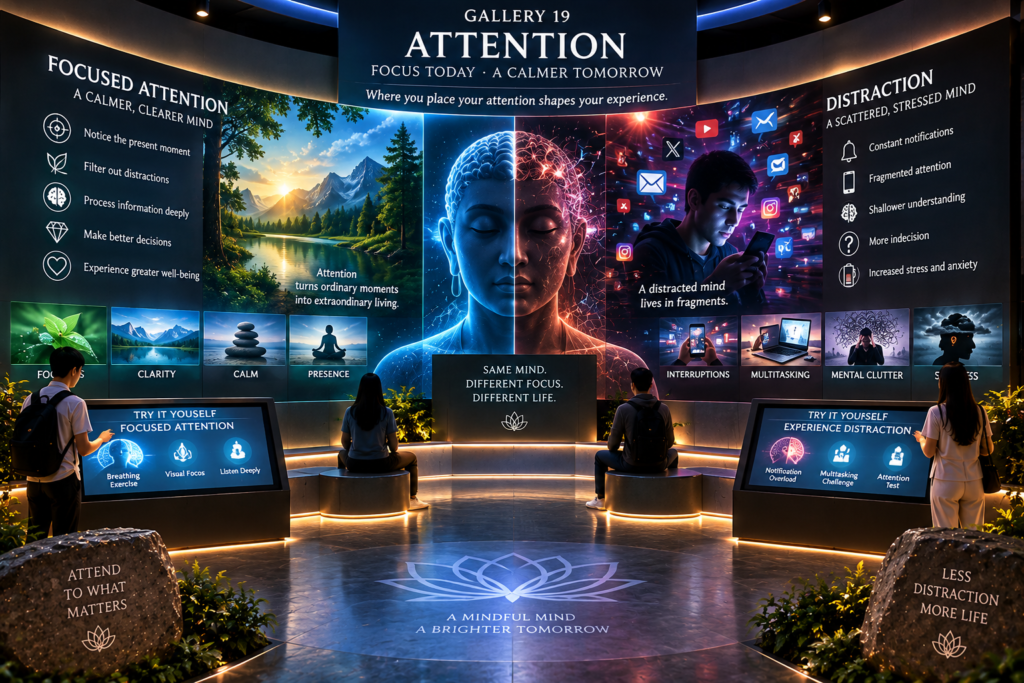
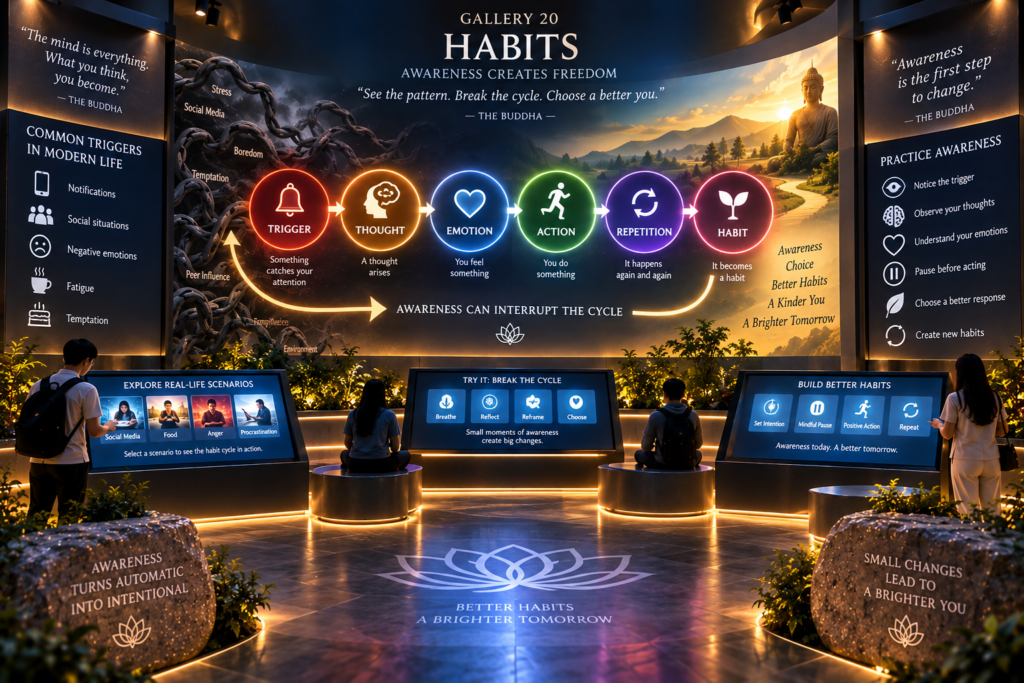
13. ZONE 5 — AWARENESS, MINDFULNESS & MEDITATION
Gallery 21: The visitor is introduced to the concept of becoming aware of present experience.
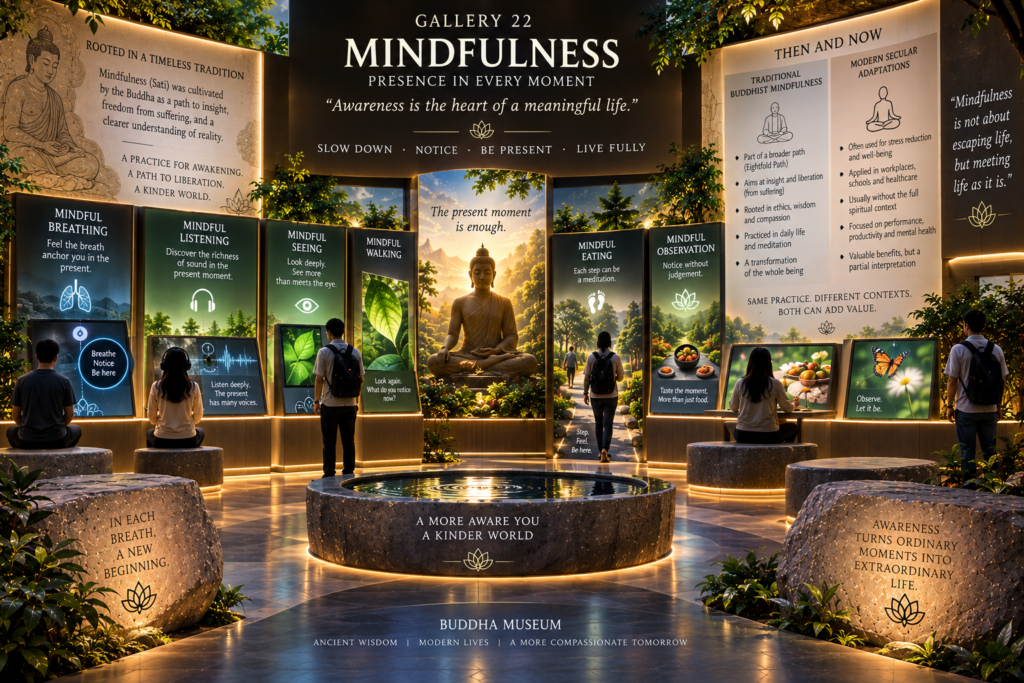
Gallery 22 : Interactive experiences may include:
- mindful breathing;
- mindful listening;
- mindful seeing;
- mindful walking;
- mindful eating;
- mindful observation.
The museum should distinguish historical Buddhist mindfulness practices from modern secular adaptations.
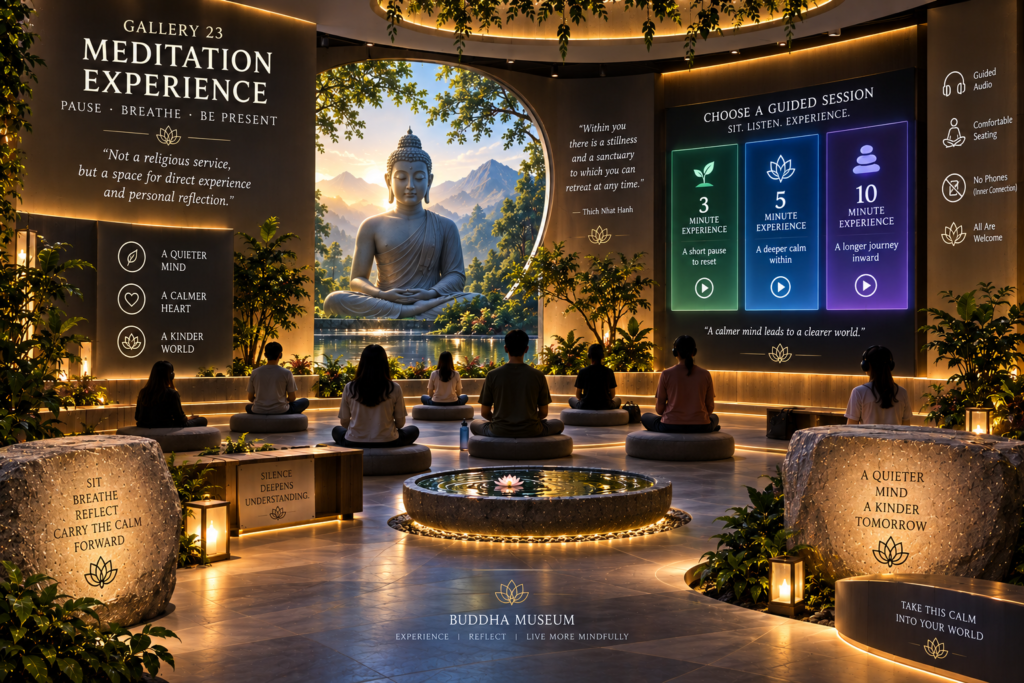
Gallery 23: A dedicated quiet room provides visitors with short guided contemplative experiences.
Possible sessions:
3-minute experience
5-minute experience
10-minute experience
The objective is not to turn the museum into a religious service but to provide an opportunity for direct experience and reflection.
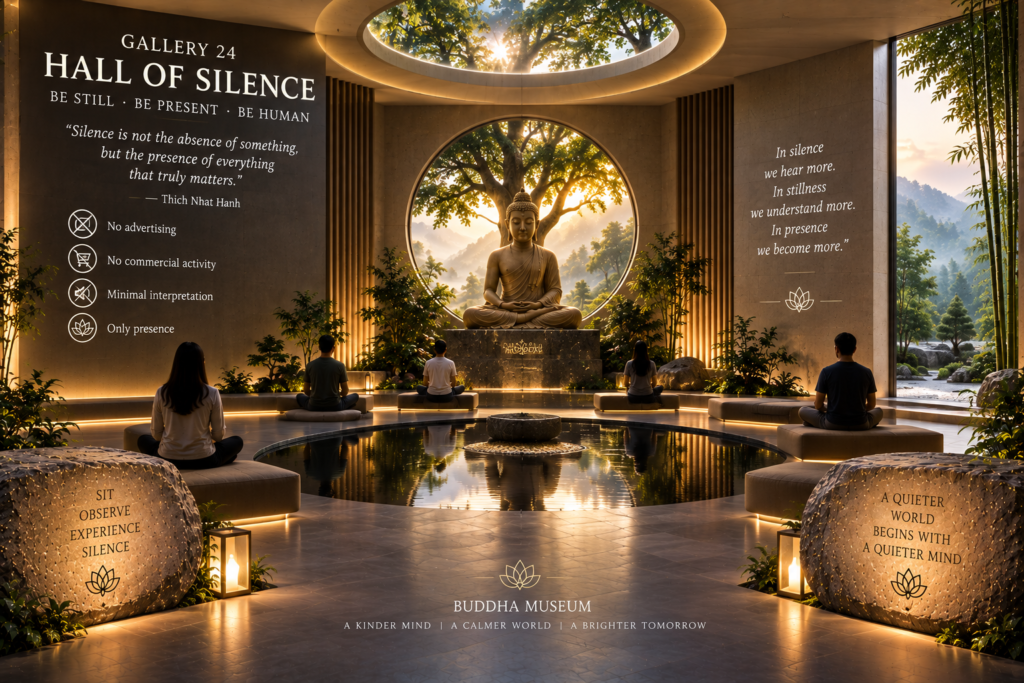
Gallery 24: A technology-free contemplative space can become one of the museum’s signature features.
No advertising.
No commercial activity.
Minimal interpretation.
Visitors simply sit, observe and experience silence.
14 ZONE 6 — COMPASSION, ETHICS & WISDOM
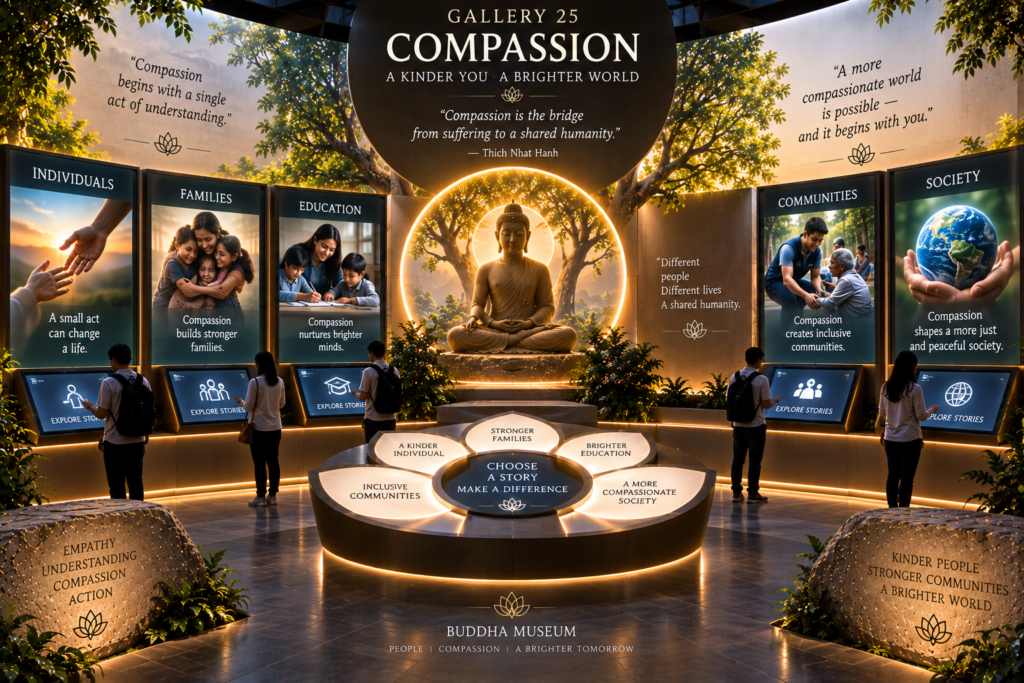
Gallery 25: Compassion
Interactive stories demonstrate how compassion can influence:
- individuals;
- families;
- education;
- communities;
- society.
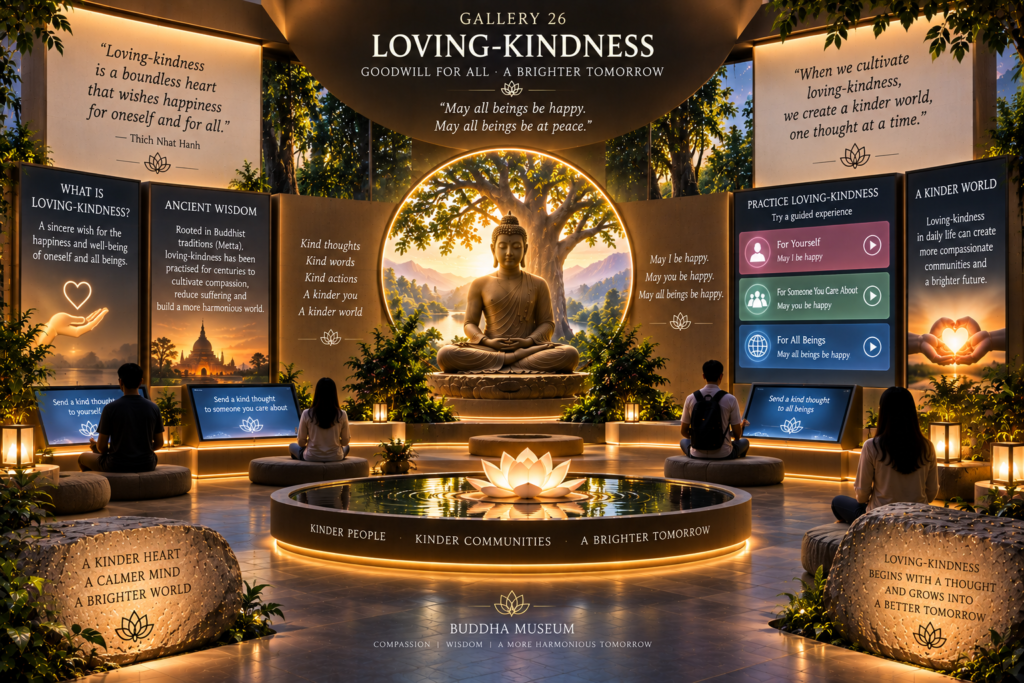
Gallery 26: Loving-Kindness
A contemplative installation introduces practices and traditions associated with goodwill and loving-kindness.
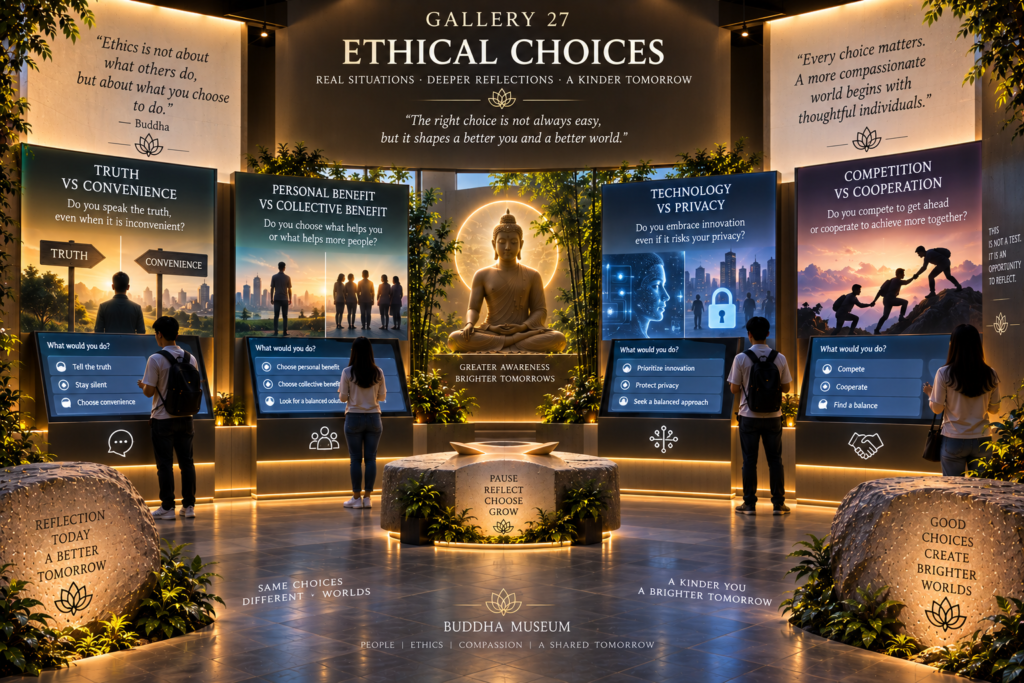
Gallery 27: Ethical Choices
Visitors encounter real-life ethical situations.
For example:
- truth versus convenience;
- personal benefit versus collective benefit;
- technology versus privacy;
- competition versus cooperation.
The purpose is to encourage reflection rather than judge visitors.
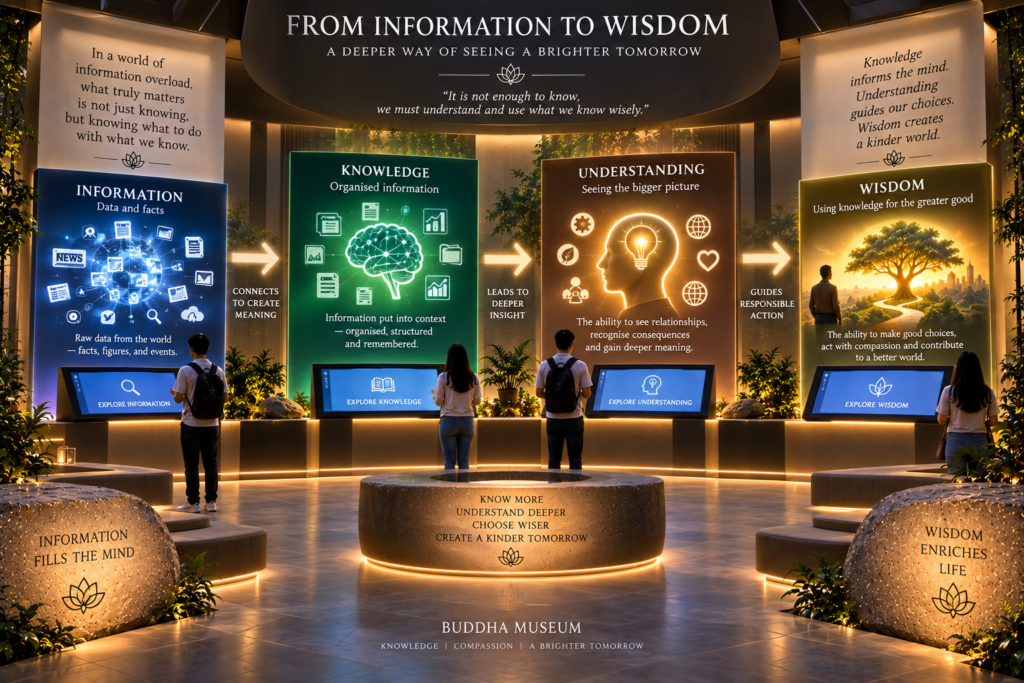
Gallery 28: Wisdom
A central conceptual installation explores:
Information → Knowledge → Understanding → Wisdom
The visitor is encouraged to consider the difference between simply knowing something and understanding how to use knowledge responsibly.
15 ZONE 7 — BUDDHIST ART, CULTURE & HERITAGE
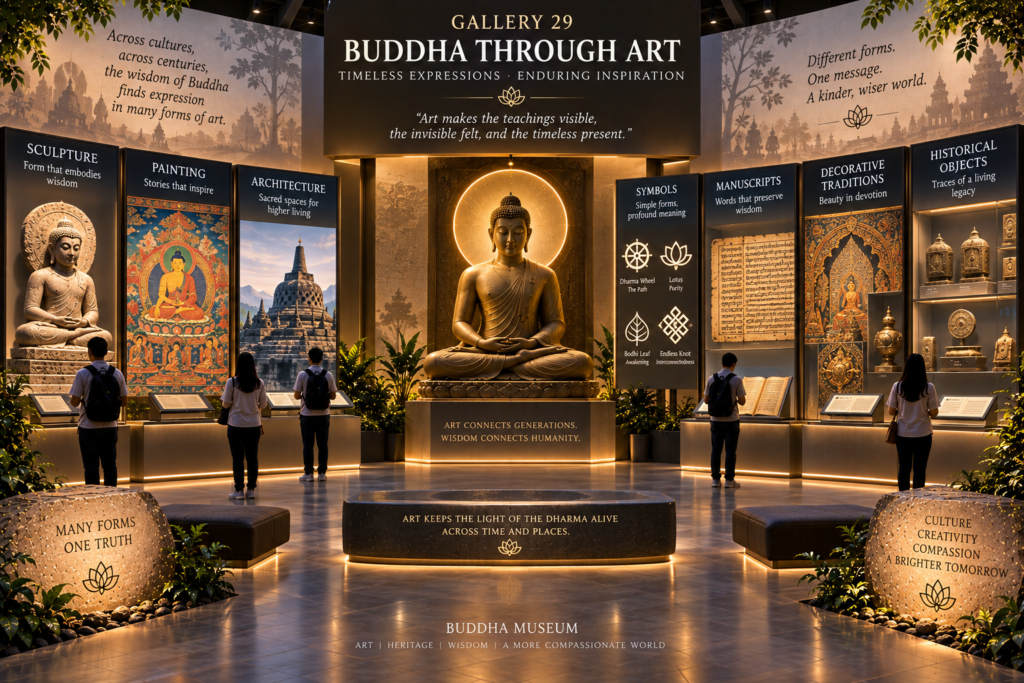
Gallery 29: Buddha Through Art
Display and interpretation of:
- sculpture;
- painting;
- architecture;
- symbols;
- manuscripts;
- decorative traditions;
- historical objects.
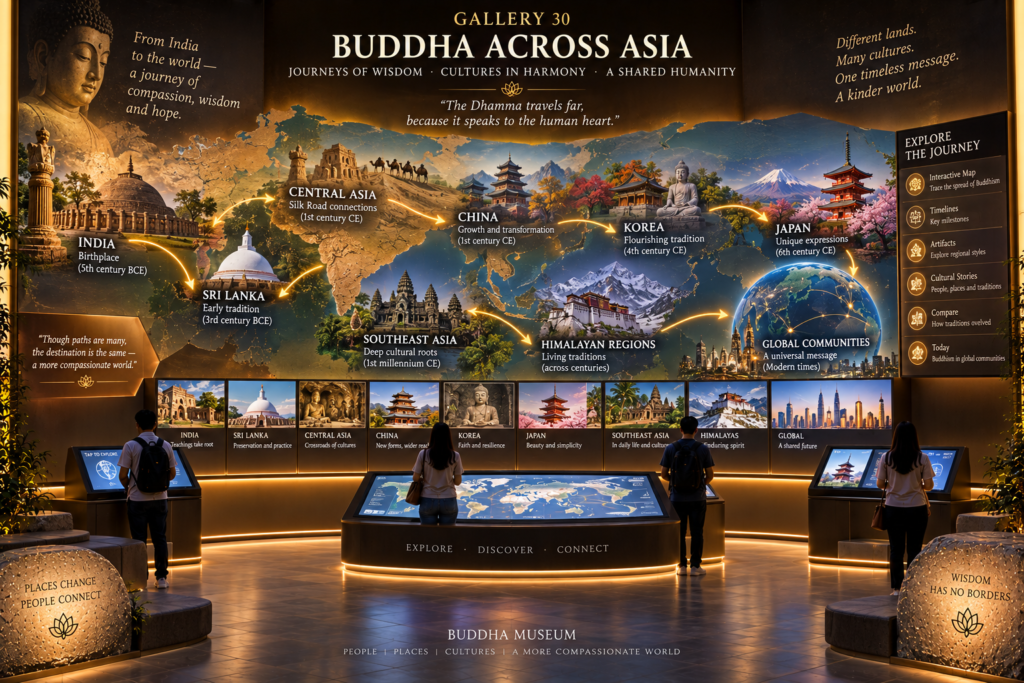
Gallery 30: Buddha Across Asia
An interactive geographical map illustrates the historical spread and cultural development of Buddhism.
Possible regions:
India → Sri Lanka → Central Asia → China → Korea → Japan → Southeast Asia → Himalayan regions → Global communities
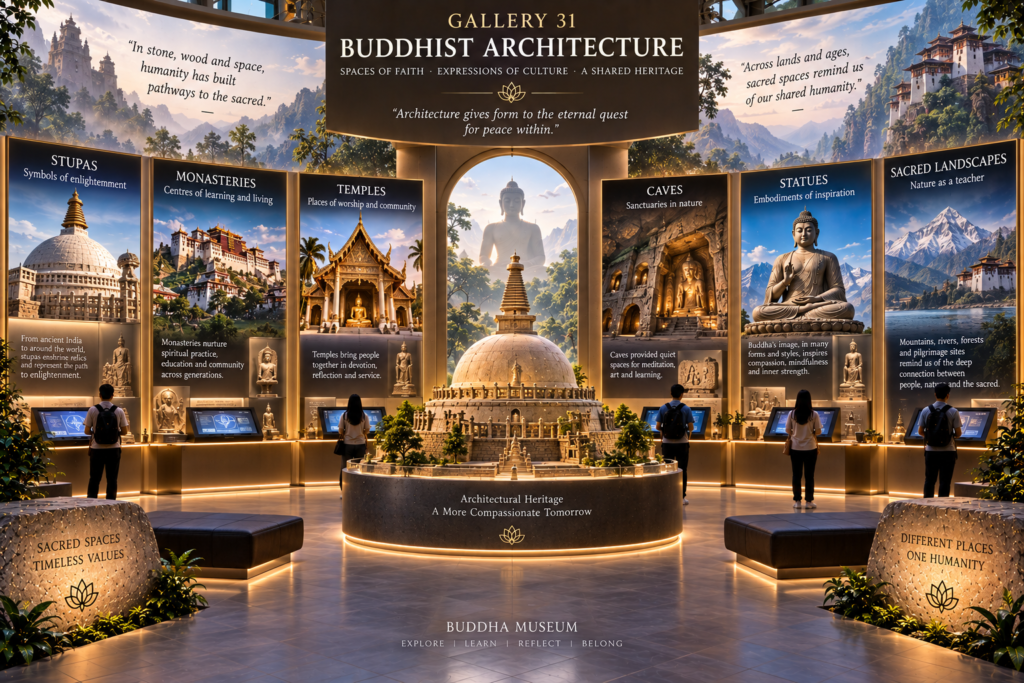
Gallery 31: Buddhist Architecture
Visitors explore:
- stupas;
- monasteries;
- temples;
- caves;
- statues;
- sacred landscapes.
Gallery 32: Buddhist Literature
Introduce major textual traditions and the development of Buddhist literature.
Digital interfaces can allow visitors to explore translations and historical context.

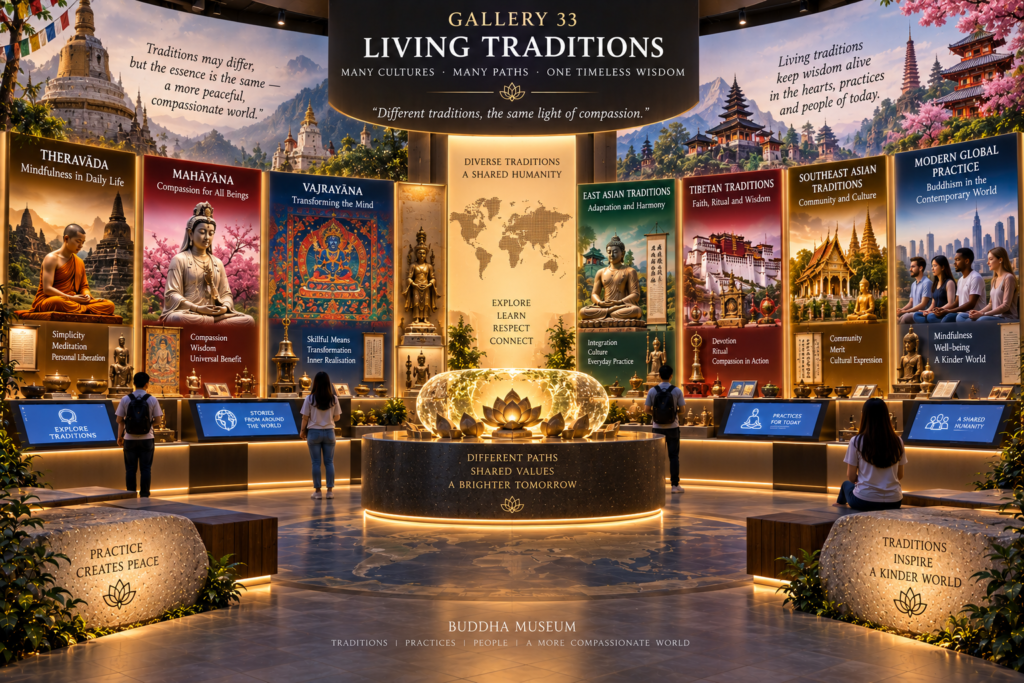
Gallery 33: Living Traditions
The museum should communicate that Buddhism has developed diverse traditions and practices across cultures.
16. ZONE 8 — BUDDHA AND CONTEMPORARY KNOWLEDGE
This zone should be academically careful and explicitly distinguish Buddhist teachings from modern scientific claims.
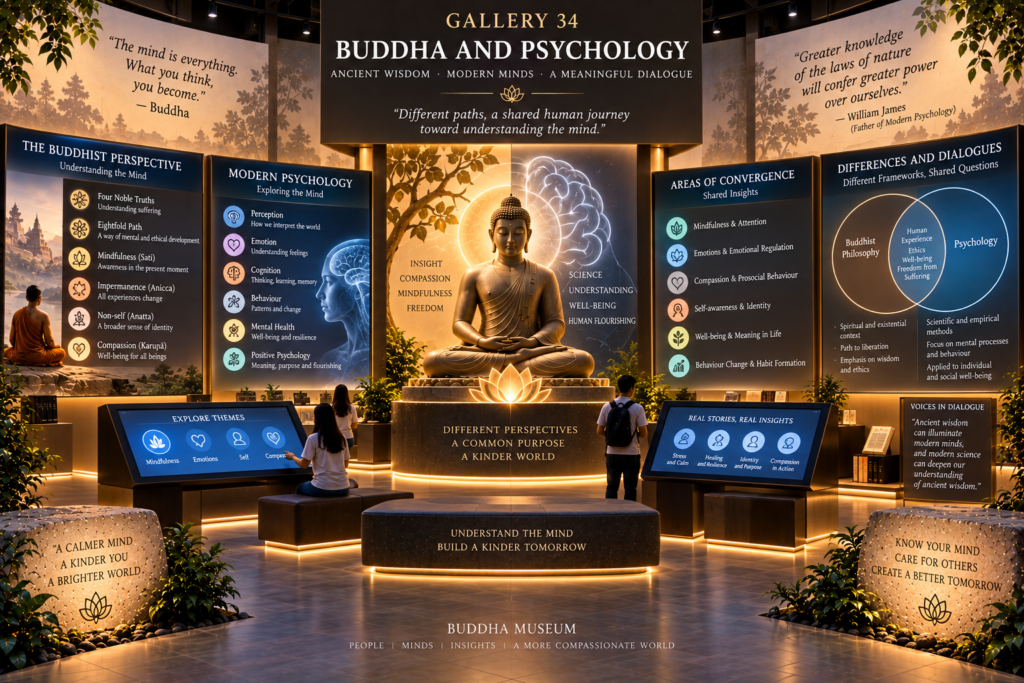
Gallery 34: Buddha and Psychology
Explore similarities, differences and possible dialogues between Buddhist philosophical traditions and psychology.
Gallery 35: Mind and Brain
Introduce contemporary scientific understanding of:
- brain function;
- perception;
- attention;
- memory;
- learning;
- emotion;
- neuroplasticity.

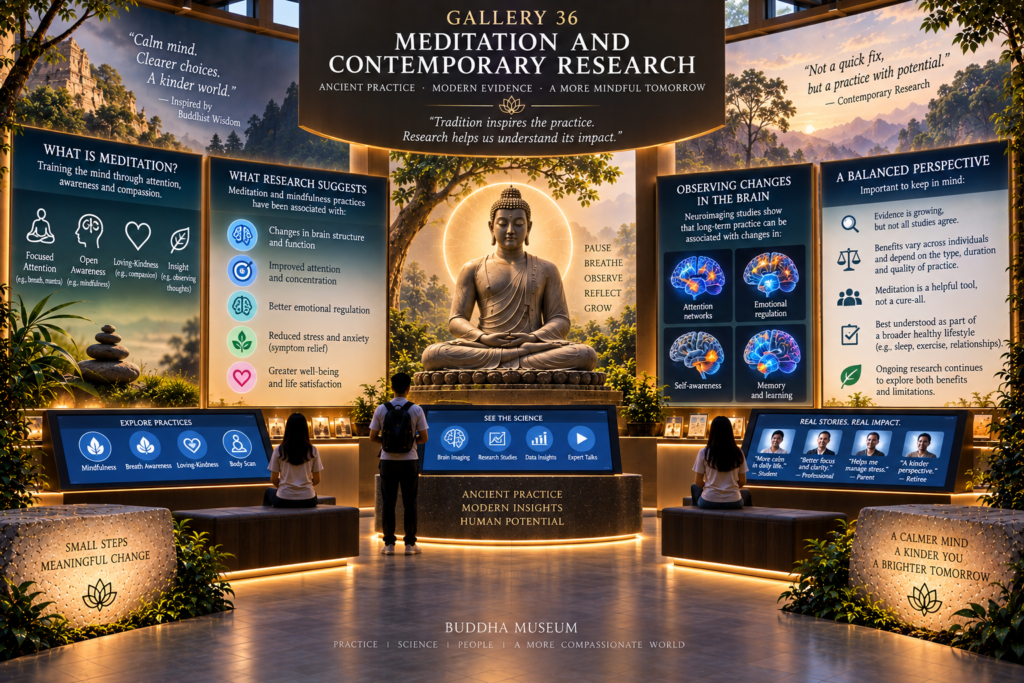
Gallery 36: Meditation and Contemporary Research
Present evidence-informed research concerning meditation and mindfulness while avoiding exaggerated or universal claims.
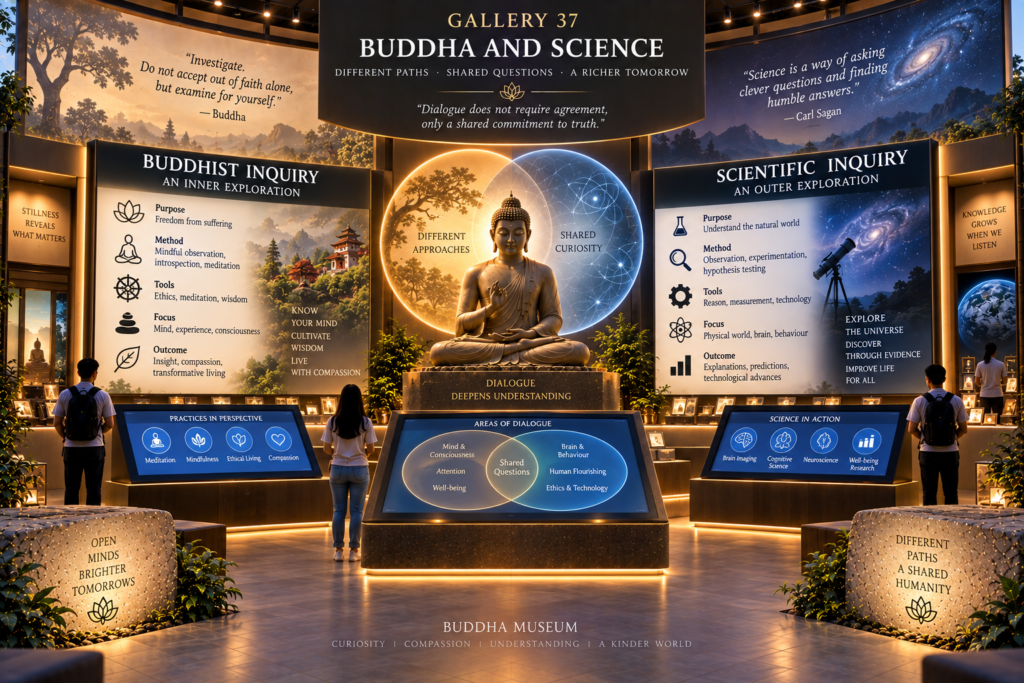
Gallery 37: Buddha and Science
Rather than presenting Buddhism as equivalent to science, the gallery can explore:
Buddhist inquiry
and
scientific inquiry
as different approaches that can sometimes engage in productive dialogue.
17. ZONE 9 — HUMANITY, FUTURE & PEACE
This zone expands the museum’s focus from the individual to humanity.
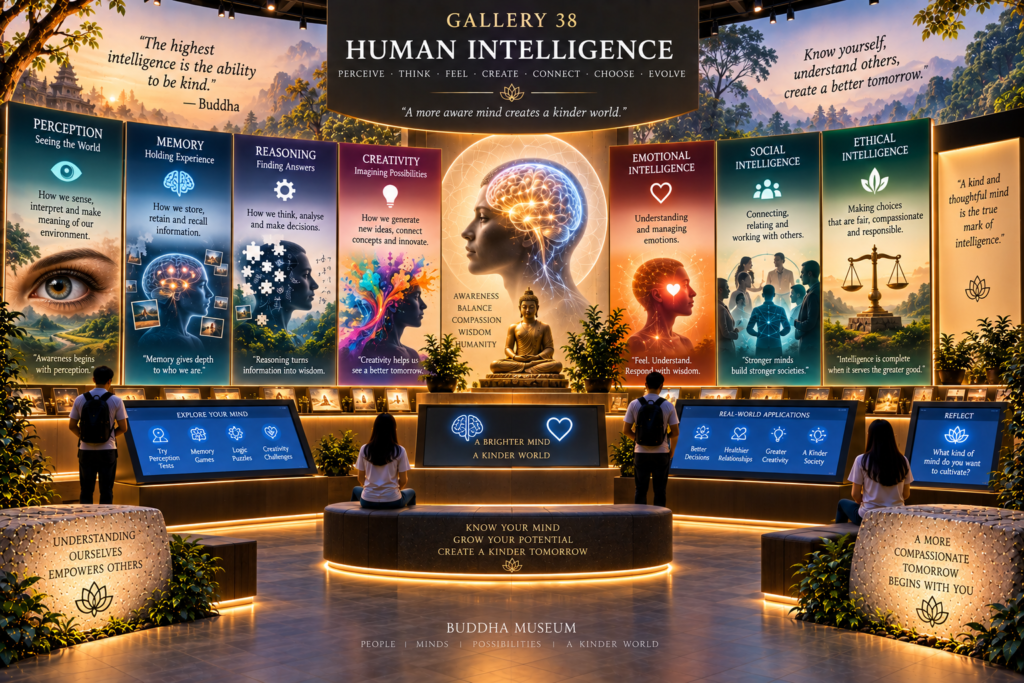
Gallery 38: Human Intelligence
Visitors explore:
- perception;
- memory;
- reasoning;
- creativity;
- emotional intelligence;
- social intelligence;
- ethical intelligence.
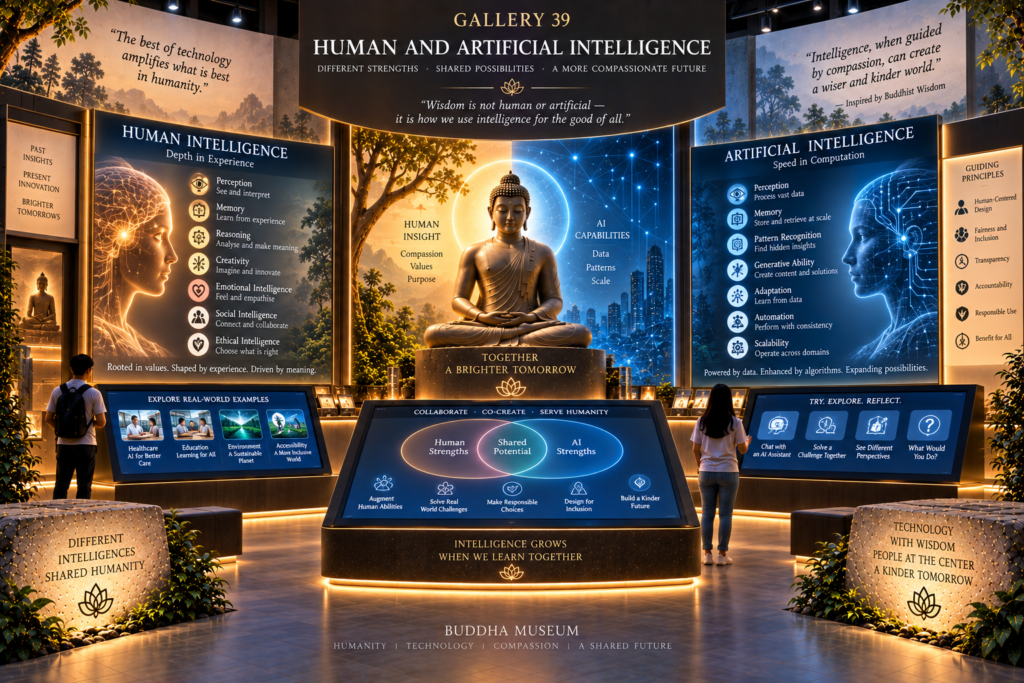
Gallery 39: Human and Artificial Intelligence
An interactive installation explores:
Human Intelligence + Artificial Intelligence
The focus is on collaboration, responsibility and ethical use.
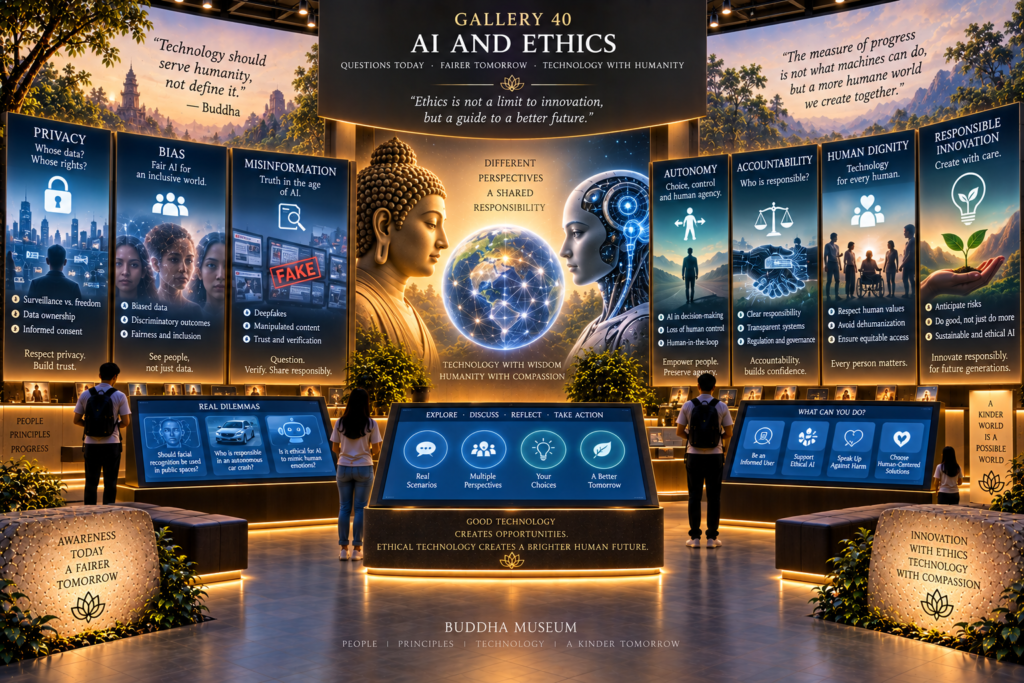
Gallery 40: AI and Ethics
Visitors encounter questions involving:
- privacy;
- bias;
- misinformation;
- autonomy;
- accountability;
- human dignity;
- responsible innovation.
Gallery 41: Consciousness
The museum can introduce philosophical and scientific perspectives on:
- awareness;
- subjective experience;
- self;
- consciousness;
- perception.
Different perspectives should be presented without claiming that one unresolved theory is established fact.

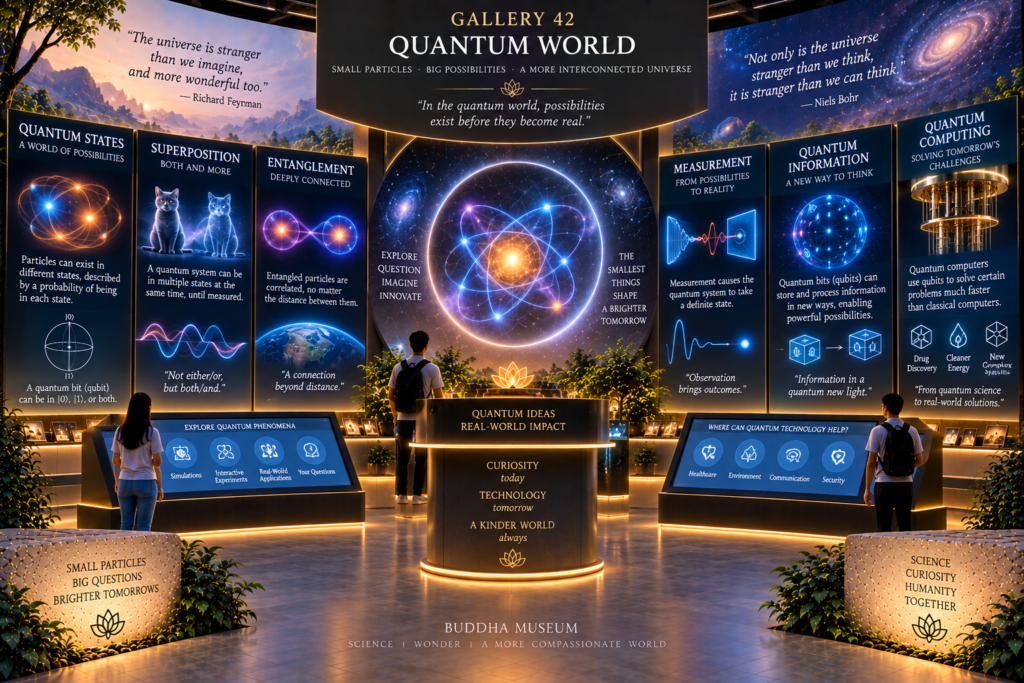
Gallery 42: Quantum World
An introductory exhibition can explain:
- quantum states;
- superposition;
- entanglement;
- measurement;
- quantum information;
- quantum computing.
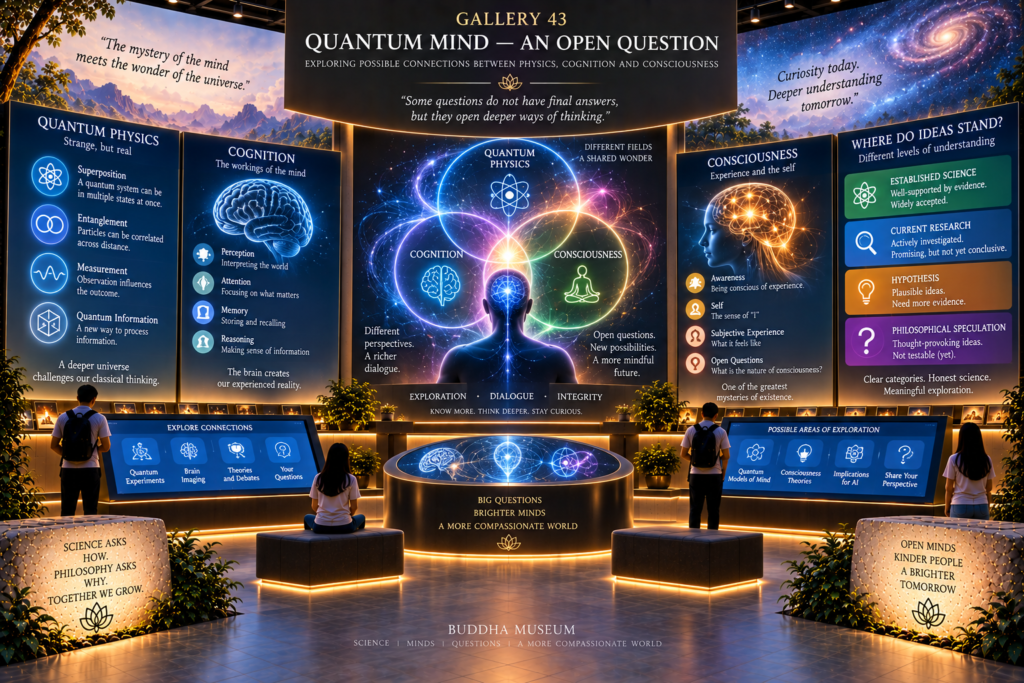
Gallery 43: Quantum Mind — An Open Question
A carefully designed exhibit may explore questions concerning possible relationships between:
Quantum Physics ↔ Cognition ↔ Consciousness
However, the exhibit should clearly distinguish:
Established Science
from
Current Research
from
Hypothesis
from
Philosophical Speculation
This protects the museum’s academic integrity.
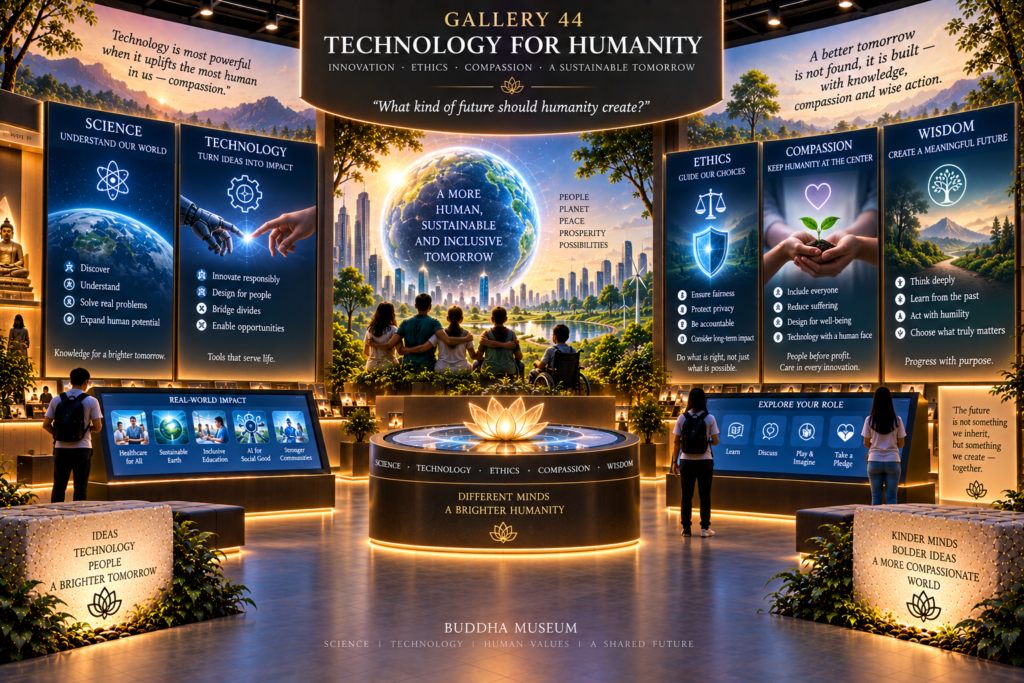
Gallery 44: Technology for Humanity
The central question becomes: “What kind of future should humanity create?”
Visitors explore the relationship between:
Science + Technology + Ethics + Compassion + Wisdom
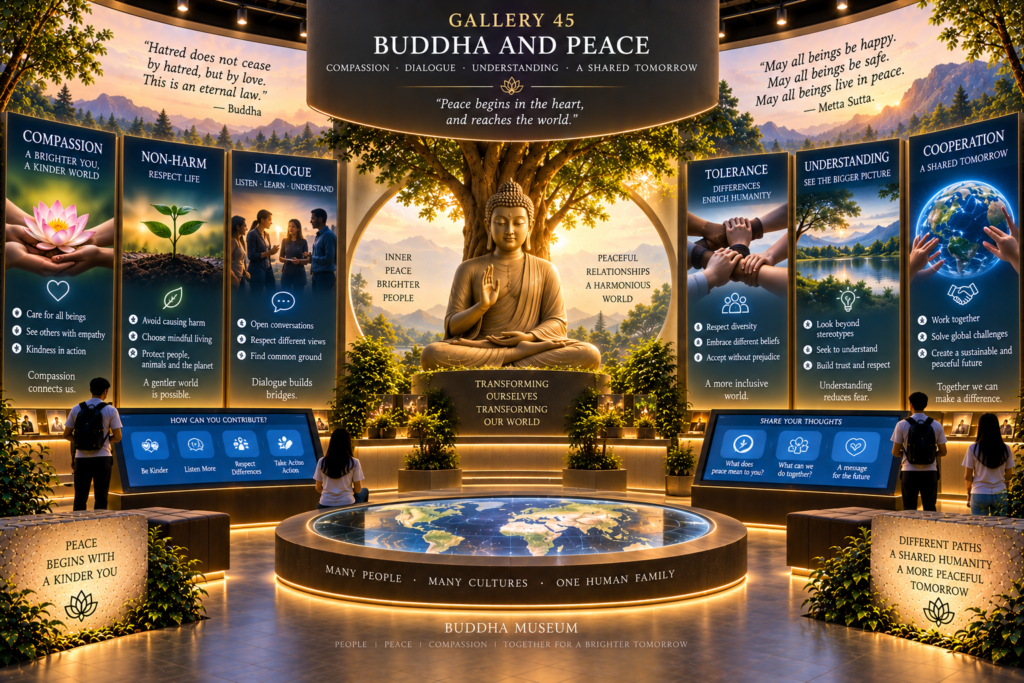
Gallery 45: Buddha and Peace
The final thematic gallery connects individual transformation with peaceful human relationships.
Possible themes:
- compassion;
- non-harm;
- dialogue;
- tolerance;
- understanding;
- cooperation;
- peaceful coexistence.
18. ZONE 10 — REFLECTION & PERSONAL JOURNEY
The museum should not end with another information panel.
It should end with reflection.
Gallery 46: What Did You Discover?
Visitors can select or record:
- an idea;
- a question;
- an insight;
- a personal reflection.

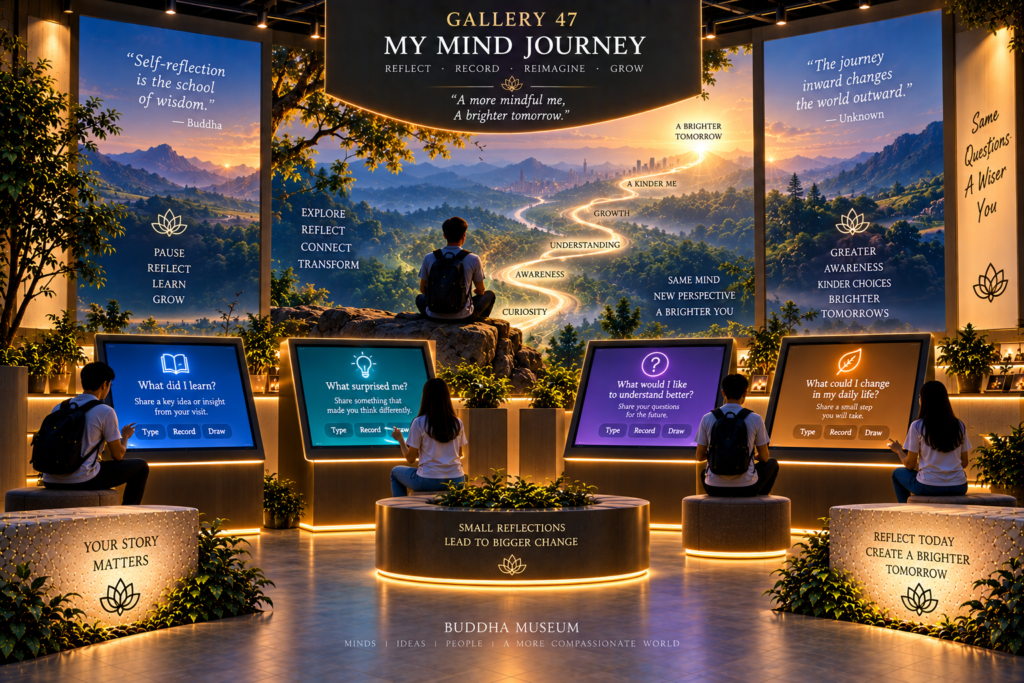
Gallery 47: My Mind Journey
A digital installation can allow visitors to record a personal takeaway.
Possible prompts:
What did I learn?
What surprised me?
What would I like to understand better?
What could I change in my daily life?
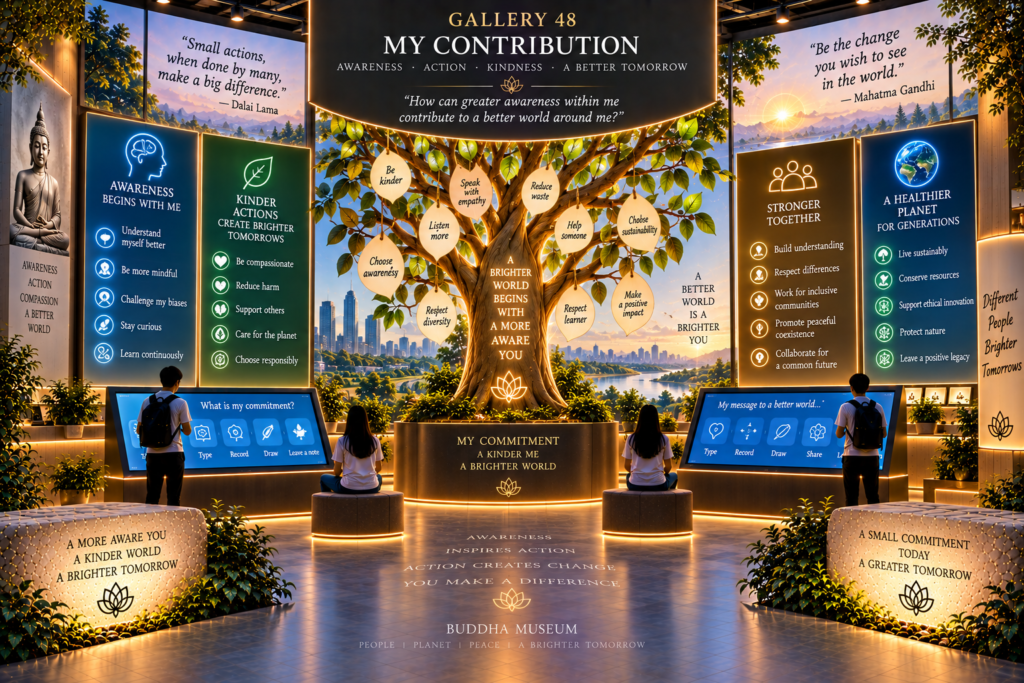
Gallery 48: My Contribution
The final question: “How can greater awareness within me contribute to a better world around me?”
Visitors may leave with a personal commitment.
19. ARCHITECTURAL CONCEPT
The architecture should express the museum’s central philosophy without becoming overly symbolic or decorative.
A possible architectural language can draw inspiration from:
- lotus;
- circular movement;
- natural light;
- water;
- gardens;
- pathways;
- balance;
- simplicity;
- openness;
- silence.
The building should communicate calmness, dignity and intellectual curiosity.
20 CONCEPTUAL SPATIAL JOURNEY
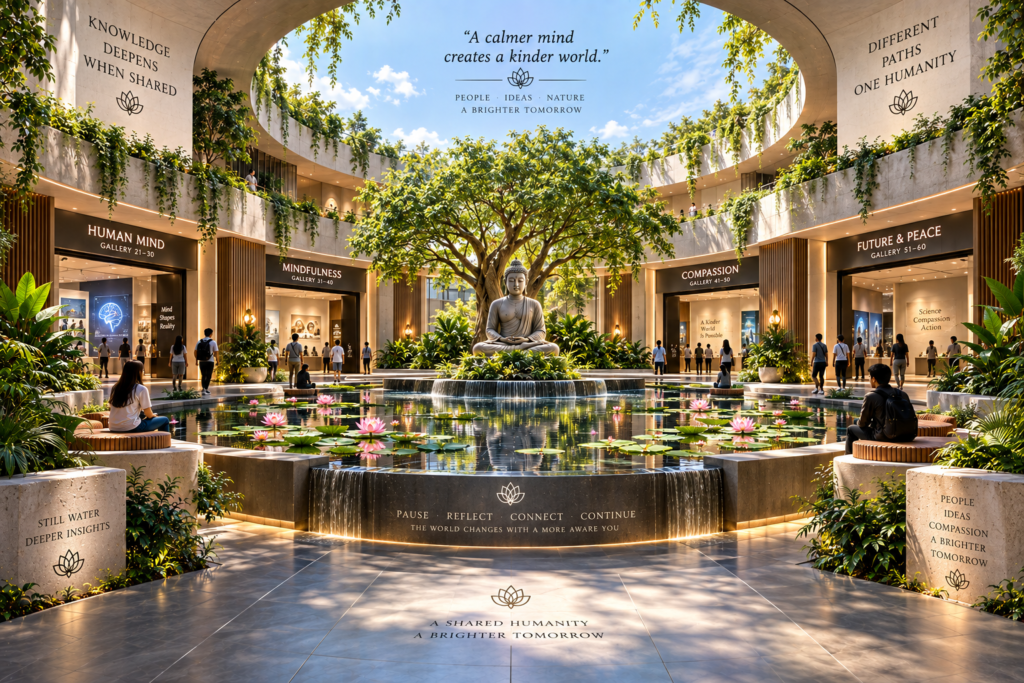
22. CENTRAL COURTYARD
A central courtyard can serve as the symbolic heart of the museum.
Possible elements:
- water;
- lotus pond;
- trees;
- sculpture;
- open sky;
- contemplative seating.
The courtyard can act as a transition between exhibition zones.
23. WATER AS A DESIGN ELEMENT
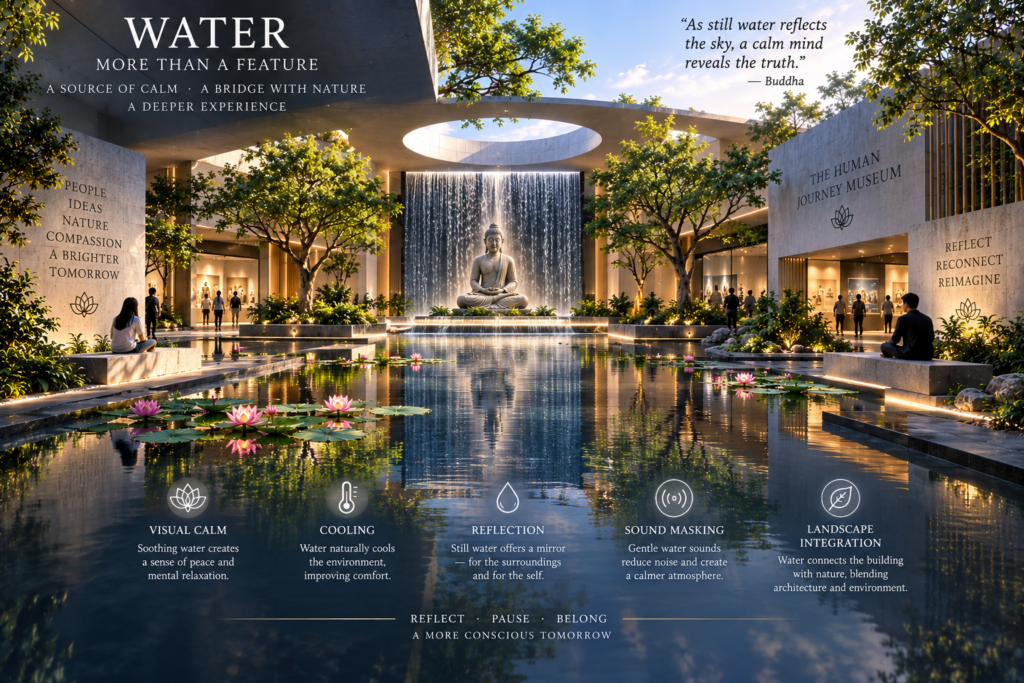
Water may be used symbolically and architecturally.
It can provide:
- visual calm;
- cooling;
- reflection;
- sound masking;
- landscape integration.
Reflective pools can create a transition from the busy external environment to the contemplative museum environment.
24. LIGHTING DESIGN
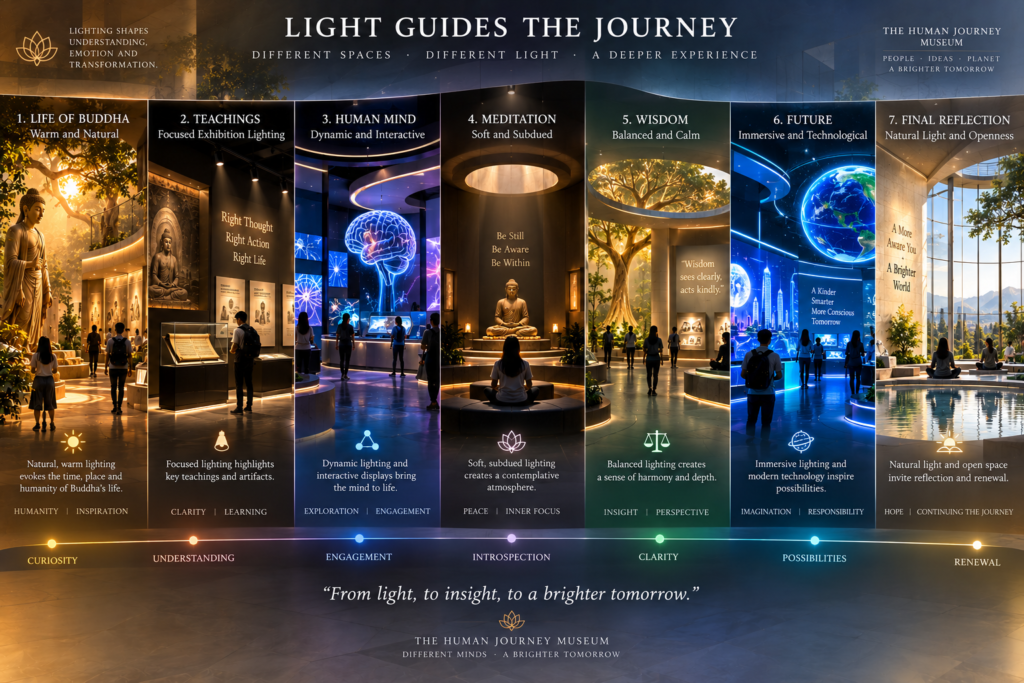
Lighting should change according to the narrative.
Life of Buddha
Warm and natural.
Teachings
Focused exhibition lighting.
Human Mind
Dynamic and interactive.
Meditation
Soft and subdued.
Wisdom
Balanced and calm.
Future
Immersive and technological.
Final Reflection
Natural light and openness.
This creates an emotional progression through the museum.
25. SOUND DESIGN
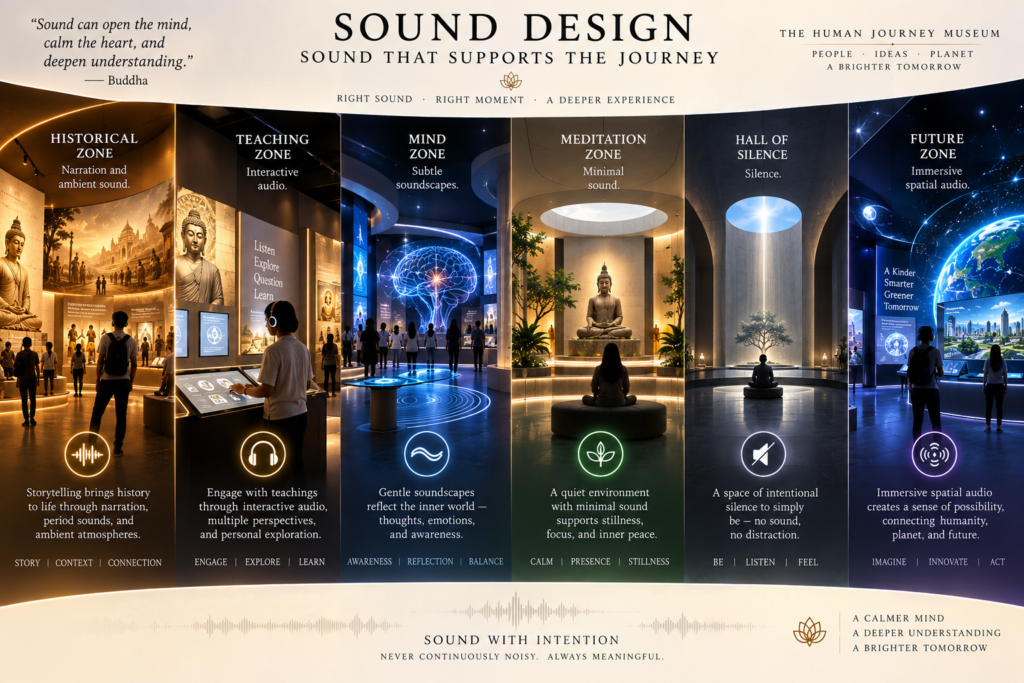
Sound should be carefully controlled.
Possible environments:
Historical Zone
Narration and ambient sound.
Teaching Zone
Interactive audio.
Mind Zone
Subtle soundscapes.
Meditation Zone
Minimal sound.
Hall of Silence
Silence.
Future Zone
Immersive spatial audio.
The museum should never become continuously noisy.
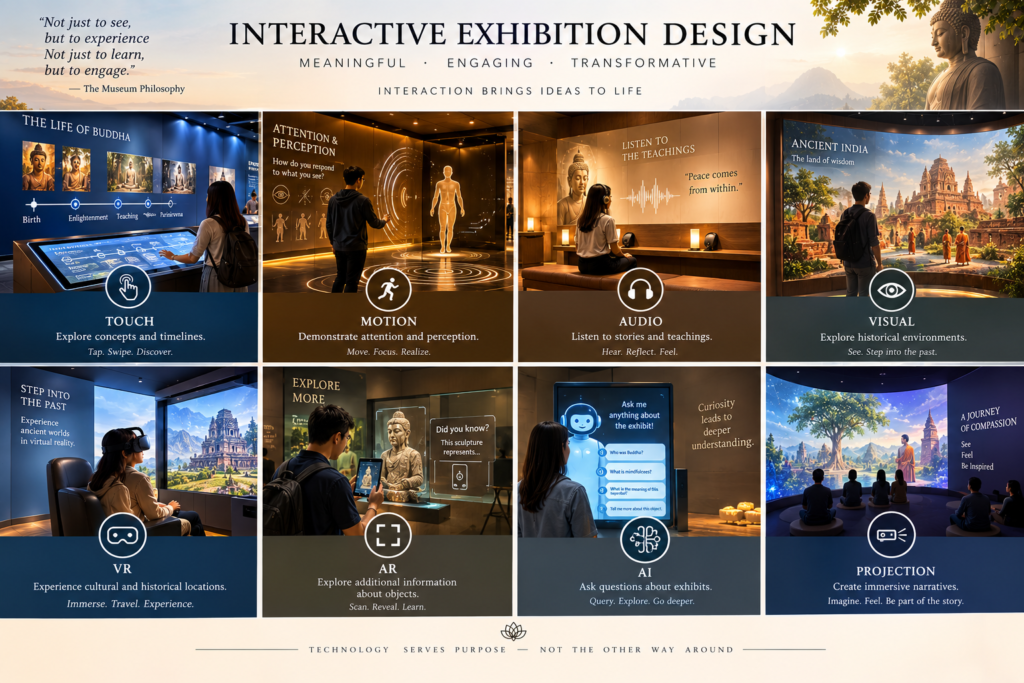
26. INTERACTIVE EXHIBITION DESIGN
Interactive exhibits should be purposeful rather than technology for its own sake.
Possible interaction types:
Touch
Explore concepts and timelines.
Motion
Demonstrate attention and perception.
Audio
Listen to stories and teachings.
Visual
Explore historical environments.
VR
Experience cultural and historical locations.
AR
Explore additional information about objects.
AI
Ask questions about exhibits.
Projection
Create immersive narratives.
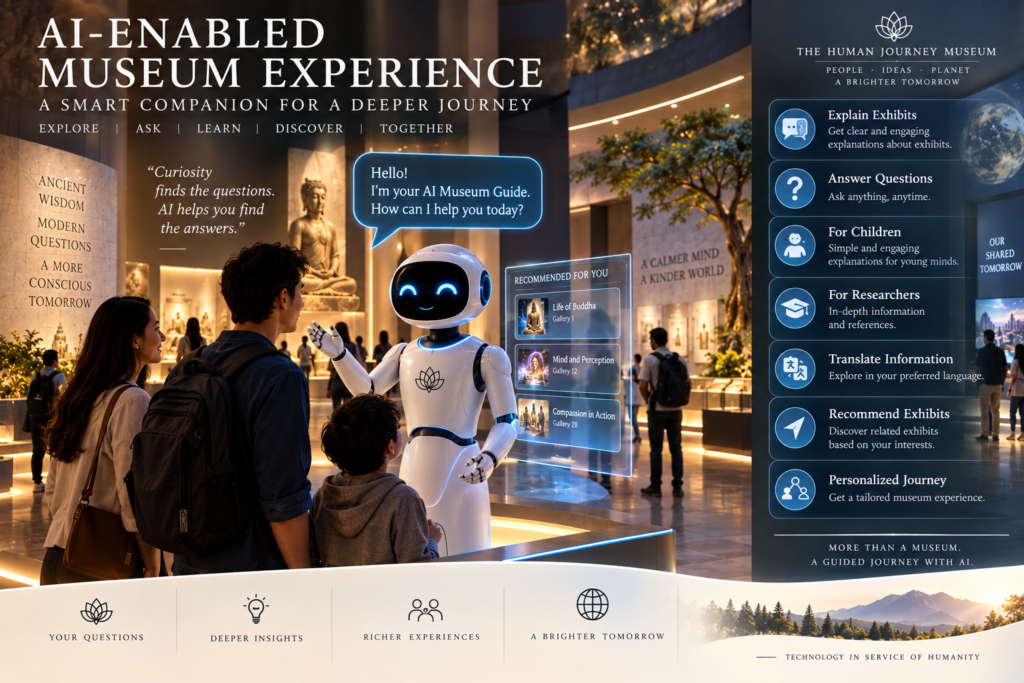
27. AI-ENABLED MUSEUM EXPERIENCE
A conceptual:
AI MUSEUM GUIDE
can assist visitors throughout the museum.
It can:
- explain exhibits;
- answer questions;
- provide simple explanations for children;
- provide deeper explanations for researchers;
- translate information;
- recommend related exhibits;
- create personalized museum journeys.
The AI should function as an educational assistant, not as a religious authority or representation of Buddha.
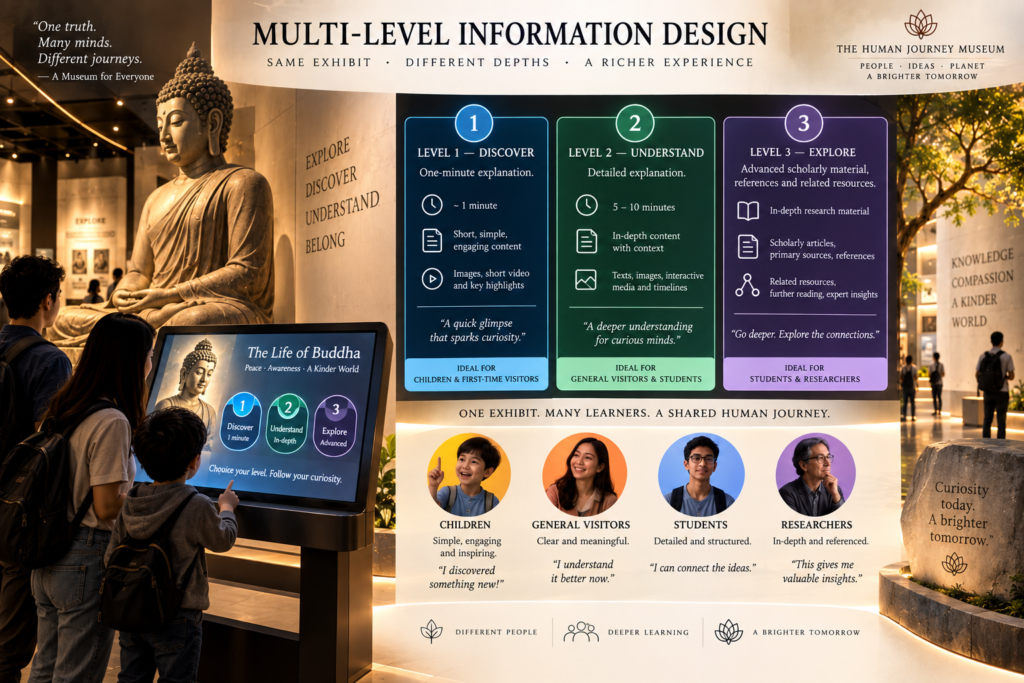
28. MULTI-LEVEL INFORMATION DESIGN
Every important exhibit can provide three levels of information.
Level 1 — Discover
One-minute explanation.
Level 2 — Understand
Detailed explanation.
Level 3 — Explore
Advanced scholarly material, references and related resources.
This enables the same museum to serve:
Children + General Visitors + Students + Researchers
29. CHILDREN’S EXPERIENCE
The museum should have age-appropriate learning opportunities.
Children can explore:
- Buddha stories;
- kindness;
- emotions;
- attention;
- compassion;
- puzzles;
- interactive games;
- storytelling;
- simple meditation;
- ethical decision-making.
A dedicated children’s zone may be called:
Little Minds, Big Wisdom

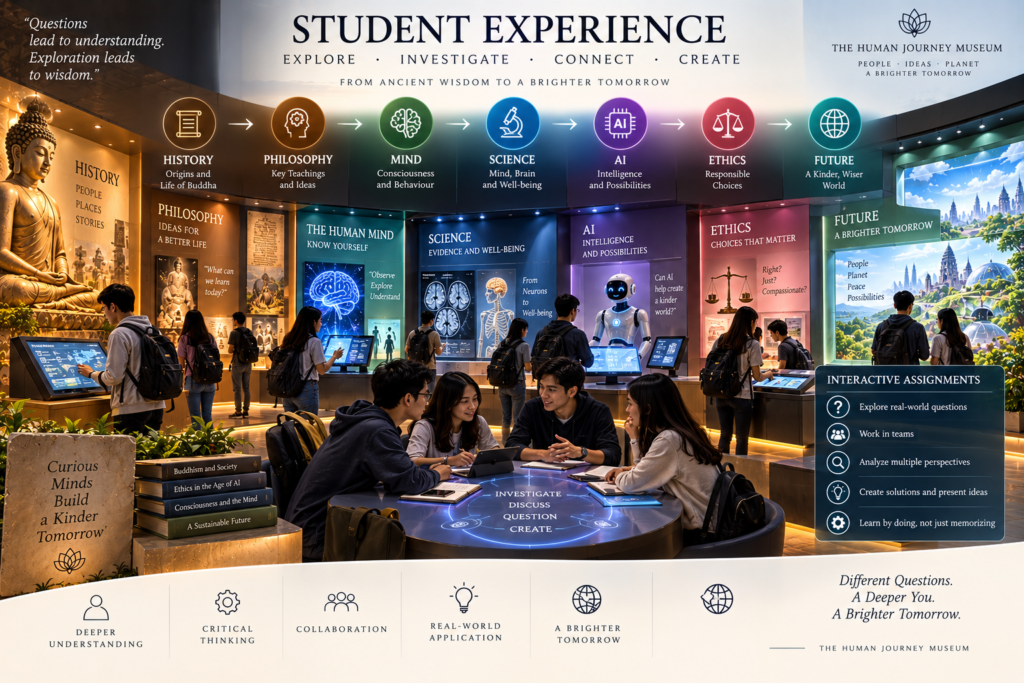
30. STUDENT EXPERIENCE
Students can explore:
History → Philosophy → Mind → Science → AI → Ethics → Future
Interactive assignments can encourage students to investigate questions rather than memorize information.
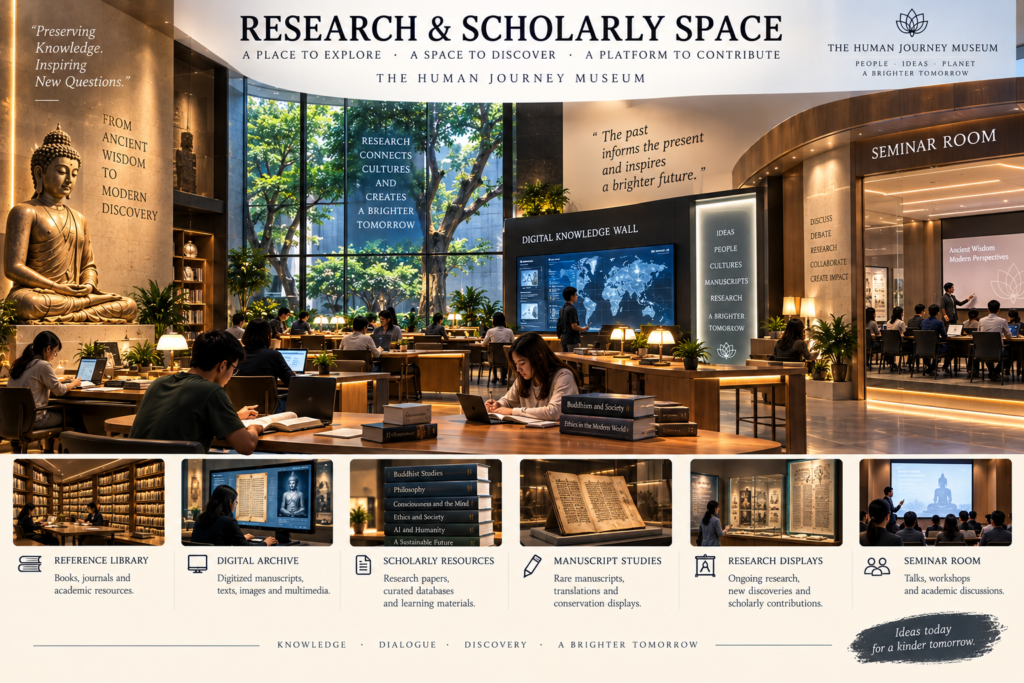
31. RESEARCH & SCHOLARLY SPACE
Although the report is limited to conceptual museum design, the museum should reserve space conceptually for:
- reference library;
- digital archive;
- scholarly resources;
- manuscript studies;
- research displays;
- seminar room.
This strengthens the museum’s educational character.
32. MEDITATION & CONTEMPLATION SPACES
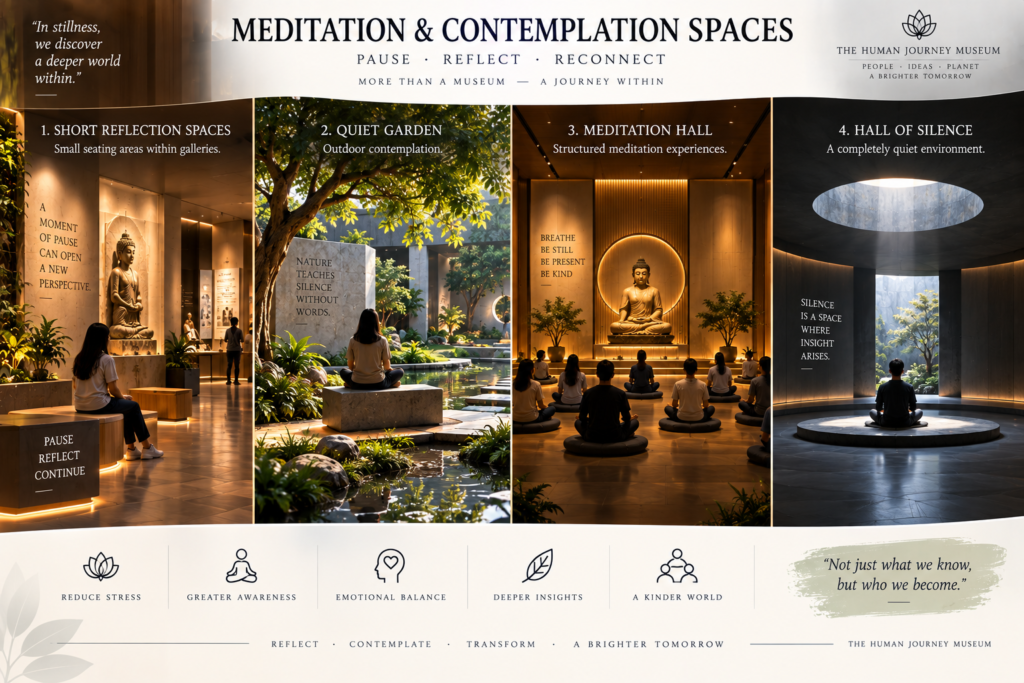
The museum should provide multiple levels of contemplation.
Short Reflection Spaces
Small seating areas within galleries.
Quiet Garden
Outdoor contemplation.
Meditation Hall
Structured meditation experiences.
Hall of Silence
A completely quiet environment.
This prevents the museum from becoming only an intellectual experience.
33. OUTDOOR MUSEUM EXPERIENCE
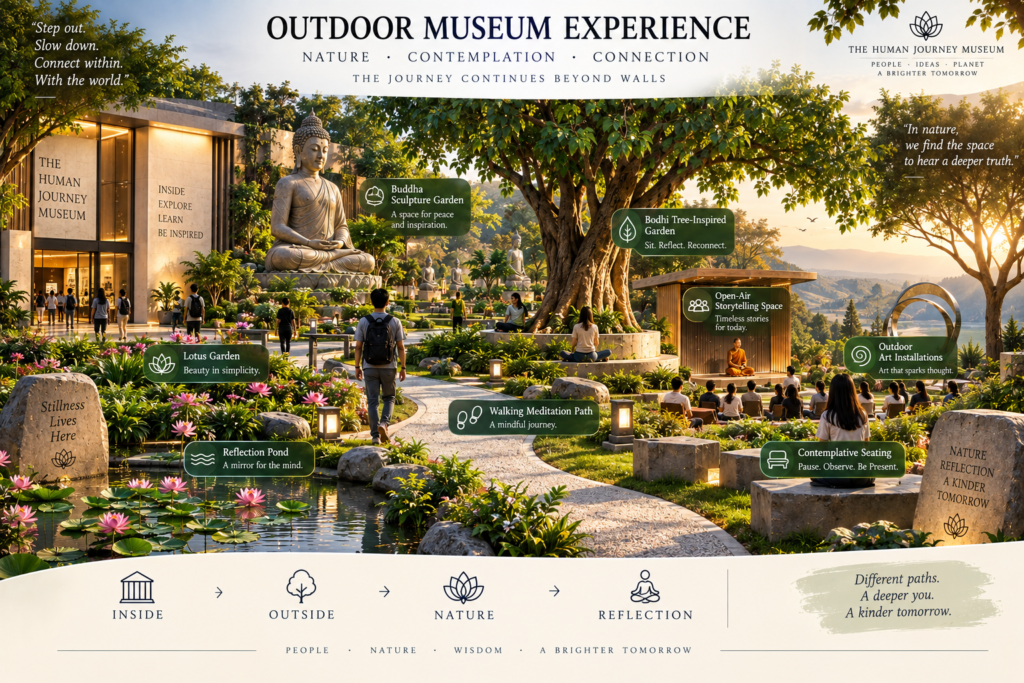
The museum experience should extend outside the building.
Potential elements:
- Buddha sculpture garden;
- walking meditation path;
- lotus garden;
- reflection pond;
- Bodhi tree-inspired garden;
- open-air storytelling space;
- contemplative seating;
- outdoor art installations.
The visitor journey can therefore continue:
Inside → Outside → Nature → Reflection
34. UNIVERSAL DESIGN
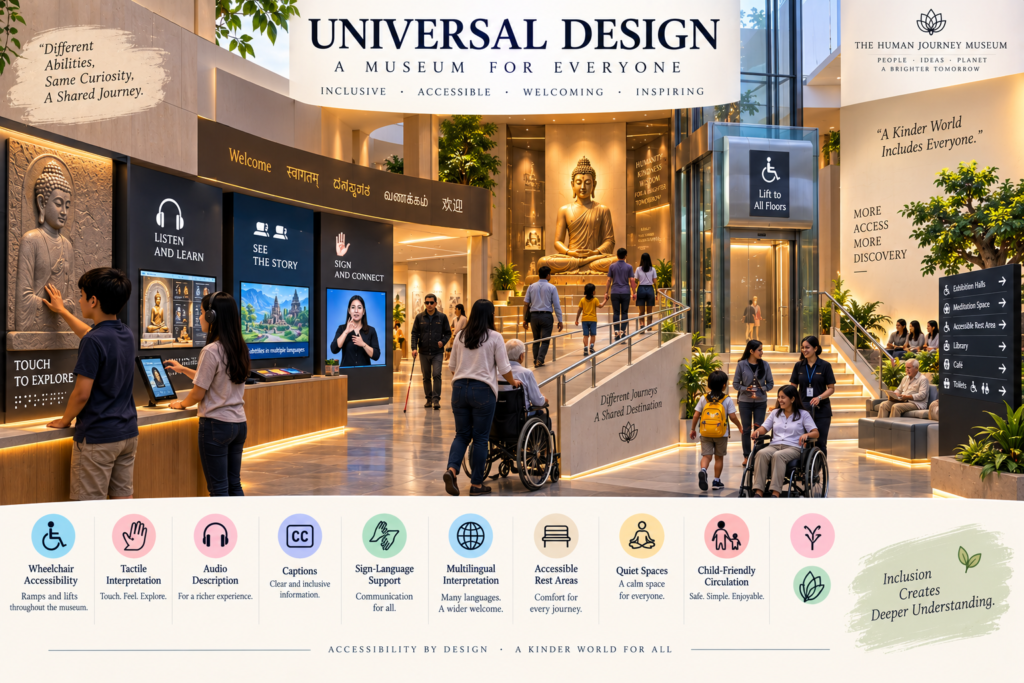
The museum should be designed for visitors of different ages and abilities.
Important provisions include:
- wheelchair accessibility;
- ramps and lifts;
- tactile interpretation;
- audio description;
- captions;
- sign-language support;
- multilingual interpretation;
- accessible rest areas;
- quiet spaces;
- child-friendly circulation.
Accessibility should be considered from the beginning of the conceptual design.
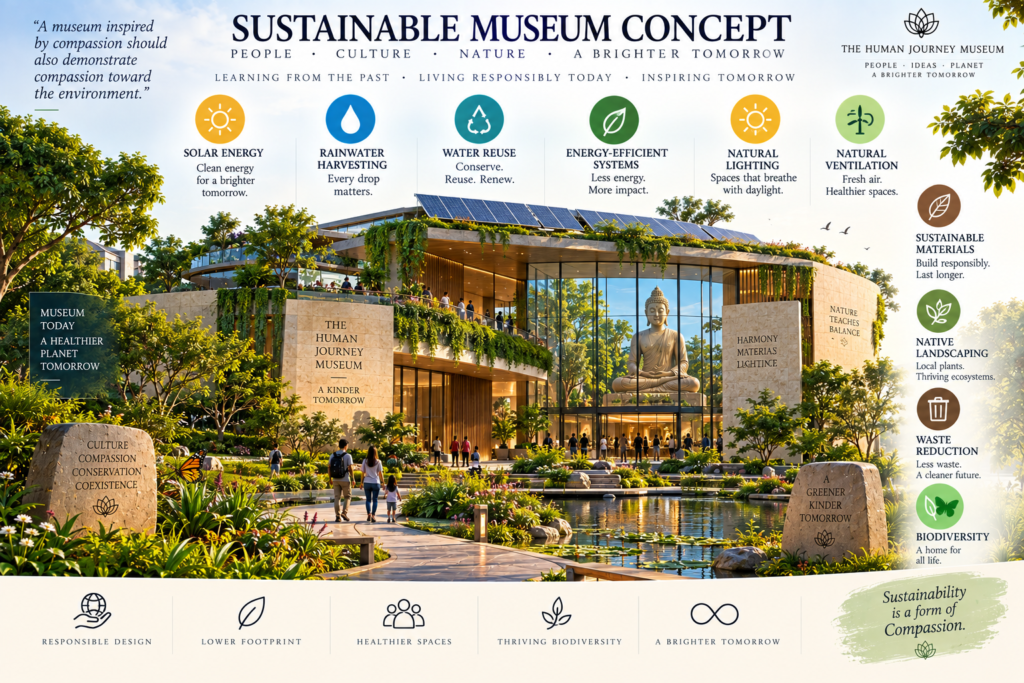
35. SUSTAINABLE MUSEUM CONCEPT
The museum can itself demonstrate responsible environmental design.
Potential principles:
- solar energy;
- rainwater harvesting;
- water reuse;
- energy-efficient systems;
- natural lighting;
- appropriate natural ventilation;
- sustainable materials;
- native landscaping;
- waste reduction;
- biodiversity.
The building can communicate: “A museum inspired by compassion should also demonstrate compassion toward the environment.”
36. MUSEUM MASTER PLAN — CONCEPTUAL COMPONENTS
The conceptual site plan may include:
- Main entrance plaza
- Reception and orientation
- Main exhibition building
- Buddha life galleries
- Philosophy galleries
- Human Mind galleries
- Mindfulness and meditation spaces
- Buddhist art and heritage galleries
- Science and contemporary knowledge galleries
- Future and peace galleries
- Children’s discovery centre
- Learning spaces
- Reference library
- Digital experience centre
- Temporary exhibition gallery
- Central courtyard
- Meditation garden
- Sculpture garden
- Reflection pond
- Visitor amenities
- Café
- Museum store
- Administrative and support areas
These are conceptual components and should be refined through professional museum planning and architectural studies.

37. TEMPORARY EXHIBITION SPACE
A dedicated temporary exhibition area should allow the museum to evolve.
Possible exhibitions:
- Buddha and Art;
- Buddha and Science;
- Buddhism Across Asia;
- Mindfulness and Modern Life;
- AI and Humanity;
- Consciousness;
- Peace and Conflict;
- Buddhist Manuscripts;
- Buddhist Architecture;
- Future Humanity.
This prevents the museum from becoming static.

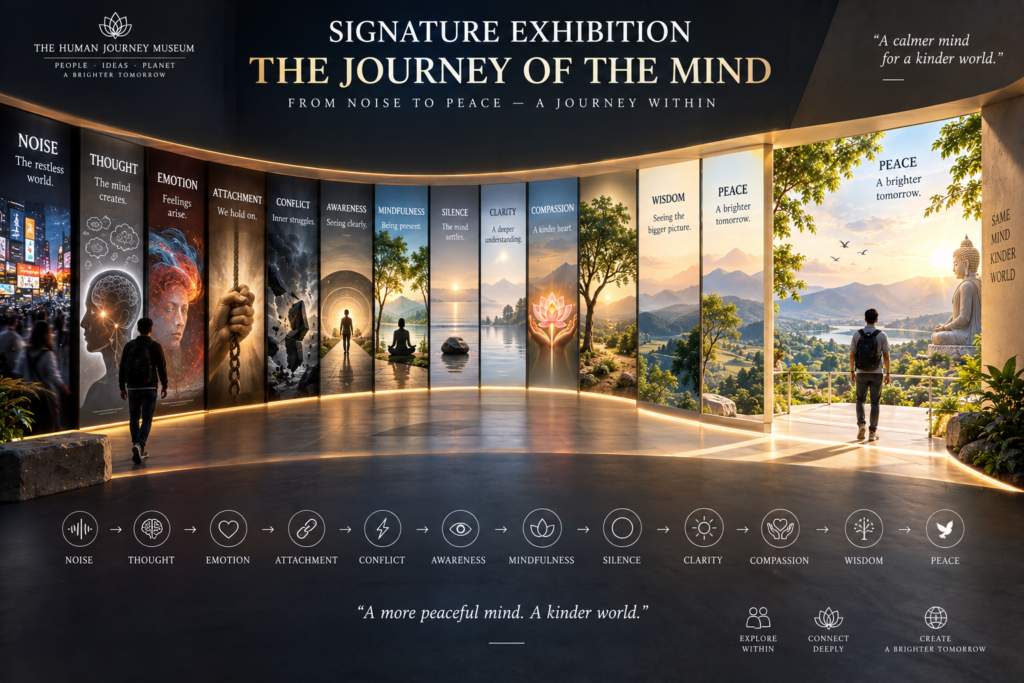
38. SIGNATURE EXHIBITION
The museum should have one defining experience:
THE JOURNEY OF THE MIND
The visitor moves through a sequence: Noise, Thought, Emotion, Attachment, Conflict, Awareness, Mindfulness, Silence, Clarity, Compassion, Wisdom and Peace. The experience ends with natural light and an open view. This can become the conceptual identity of the museum.
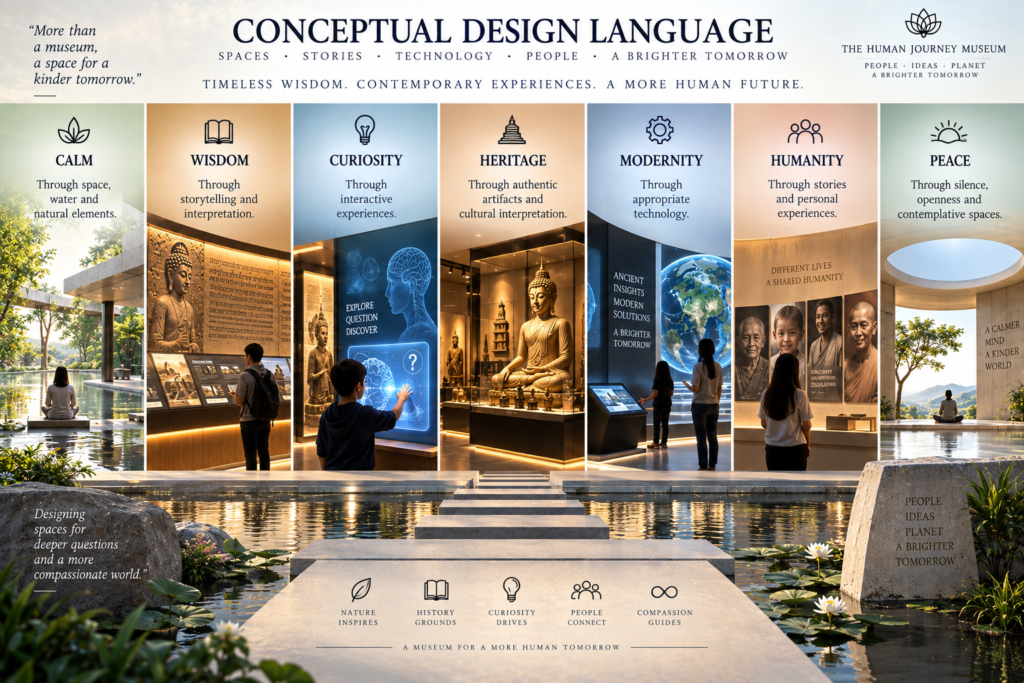
39. CONCEPTUAL DESIGN LANGUAGE
The visual identity of the museum should communicate:
Calm : Through space, water and natural elements.
Wisdom: Through storytelling and interpretation.
Curiosity: Through interactive experiences.
Heritage: Through authentic artifacts and cultural interpretation.
Modernity: Through appropriate technology.
Humanity: Through stories and personal experiences.
Peace: Through silence, openness and contemplative spaces.
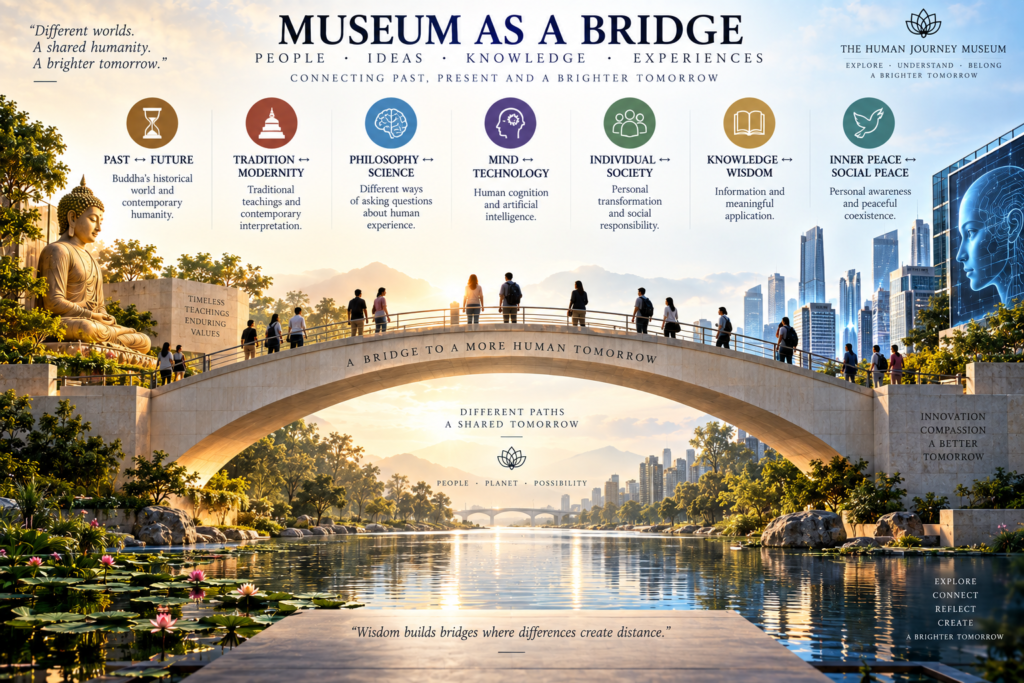
40. MUSEUM AS A BRIDGE
The conceptual design should create bridges between apparently different domains:
Past ↔ Future
Buddha’s historical world and contemporary humanity.
Tradition ↔ Modernity
Traditional teachings and contemporary interpretation.
Philosophy ↔ Science
Different ways of asking questions about human experience.
Mind ↔ Technology
Human cognition and artificial intelligence.
Individual ↔ Society
Personal transformation and social responsibility.
Knowledge ↔ Wisdom
Information and meaningful application.
Inner Peace ↔ Social Peace
Personal awareness and peaceful coexistence.
41. PROPOSED CONCEPTUAL DIAGRAM

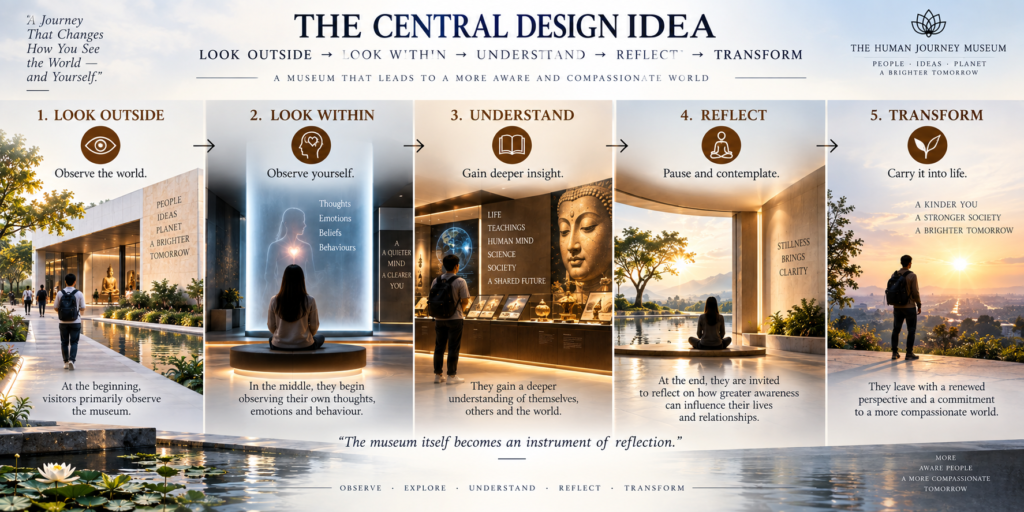
42. THE CENTRAL DESIGN IDEA
The museum can be built around a simple philosophical transition:
LOOK OUTSIDE → LOOK WITHIN → UNDERSTAND → REFLECT → TRANSFORM
At the beginning, visitors primarily observe the museum.
In the middle, they begin observing their own thoughts, emotions and behaviour.
At the end, they are invited to reflect on how greater awareness can influence their lives and relationships.
Thus the museum itself becomes an instrument of reflection.
43. WHAT MAKES THIS MUSEUM DISTINCTIVE?
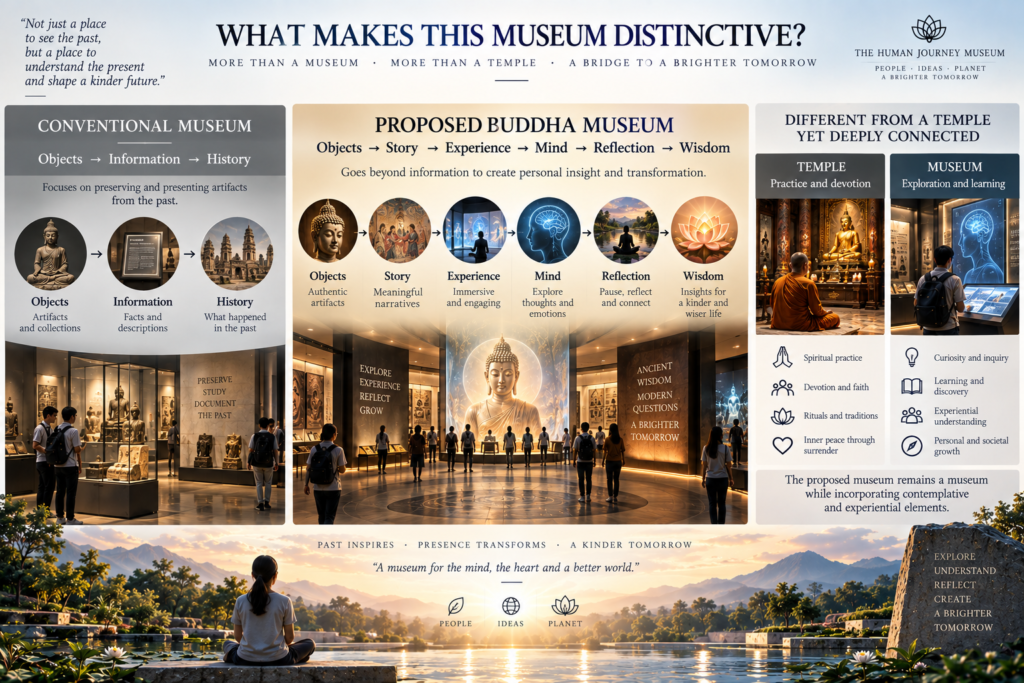
The proposed Buddha Museum is different from a conventional heritage museum in several ways.
Conventional Museum
Objects → Information → History
Proposed Buddha Museum
Objects → Story → Experience → Mind → Reflection → Wisdom
It is also different from a temple.
Temple
Practice and devotion
Museum
Exploration and learning
The proposed museum therefore remains a museum while incorporating contemplative and experiential elements.
44. CONCEPTUAL DESIGN OUTCOME
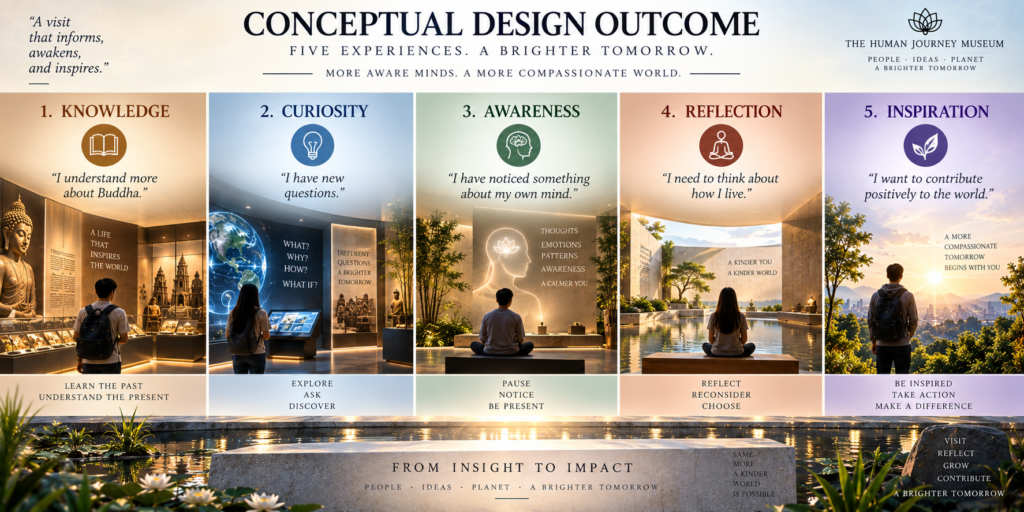
At the completion of the visitor journey, the museum should ideally create five experiences:
1. KNOWLEDGE : “I understand more about Buddha.”
2. CURIOSITY: “I have new questions.”
3. AWARENESS: “I have noticed something about my own mind.”
4. REFLECTION: “I need to think about how I live.”
5. INSPIRATION: “I want to contribute positively to the world.”
45. PROPOSED FINAL EXPERIENCE
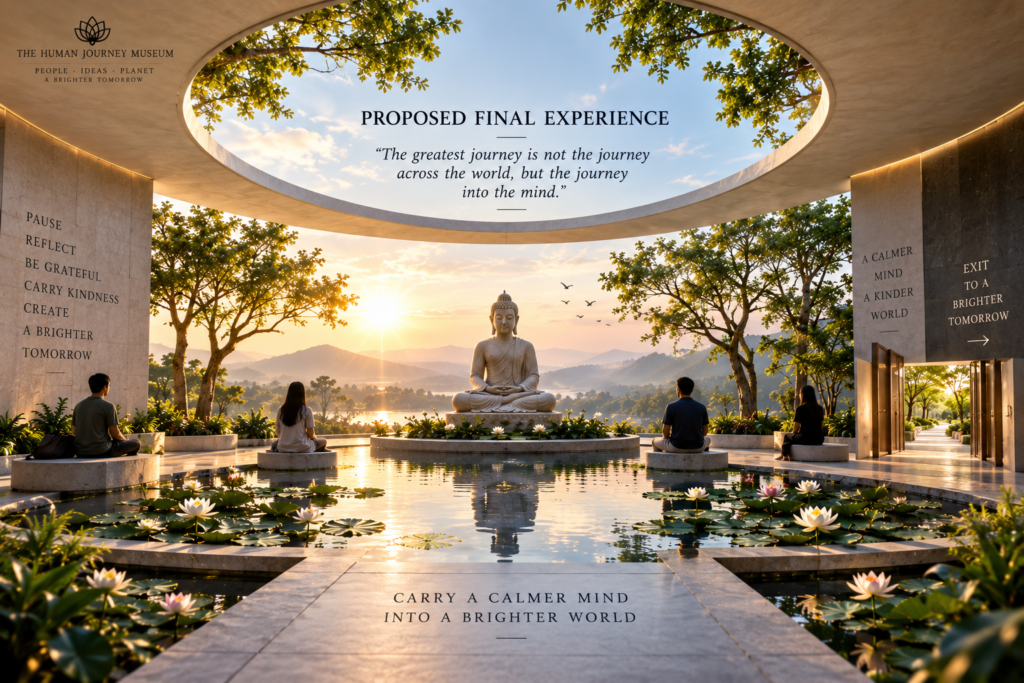
The final space should be visually simple.
Perhaps:
- open sky;
- water;
- trees;
- lotus;
- natural light;
- seating;
- a Buddha image or carefully selected symbolic element.
A final message may be displayed:
“The greatest journey is not the journey across the world, but the journey into the mind.”
The visitor then exits through an open pathway rather than immediately returning to a commercial environment.
46. CONCEPTUAL DESIGN SUMMARY
The proposed Buddha Museum can therefore be understood through the following framework:
| Component | Concept |
|---|---|
| Historical Core | Life of Buddha |
| Philosophical Core | Teachings and wisdom |
| Human Core | Mind and behaviour |
| Experiential Core | Awareness and mindfulness |
| Ethical Core | Compassion and responsible living |
| Cultural Core | Art and heritage |
| Knowledge Core | Contemporary science and scholarship |
| Future Core | AI, consciousness and emerging questions |
| Contemplative Core | Silence and meditation |
| Social Core | Peace and peaceful coexistence |
47. PROPOSED CONCEPTUAL IDENTITY
The Buddha Museum should ultimately be perceived not merely as:
A museum containing Buddha artifacts
but as:
A JOURNEY INTO WISDOM
and more specifically:
A JOURNEY FROM BUDDHA TO THE HUMAN MIND
The visitor begins by asking:
“Who was Buddha?”
and gradually arrives at:
“What can I understand about myself?”
The journey then expands:
“How should I live?”
and ultimately:
“How can human beings live together peacefully?”
48. CONCLUSION
The proposed Buddha Museum is conceived as an integrated cultural, educational, experiential and contemplative environment centred on Buddha’s life, teachings, wisdom and continuing relevance to humanity.
The conceptual design deliberately moves beyond a conventional object-oriented museum toward a visitor-centred journey of discovery.
The museum begins with history, progresses through philosophy, enters the human mind, provides experiences of awareness and mindfulness, explores compassion, ethics and wisdom, presents Buddhist art and heritage, and finally opens a dialogue with science, technology, consciousness, humanity’s future and peace.
Its architectural and exhibition design should reinforce this progression through:
space → light → sound → water → nature → objects → stories → interaction → silence → reflection.
The central design philosophy can therefore be expressed as:
FROM HISTORY TO WISDOM
FROM KNOWLEDGE TO AWARENESS
FROM AWARENESS TO COMPASSION
FROM INNER REFLECTION TO PEACEFUL HUMAN LIFE
The museum should not tell visitors what they must believe.
Instead, it should invite them to discover, question, understand and reflect.
Its ultimate success will not be measured only by the number of artifacts displayed or visitors attracted, but by the quality of the experience it creates:
A visitor enters with curiosity, discovers Buddha’s journey, encounters the questions of the human mind, experiences moments of awareness, reflects upon wisdom, and leaves with a deeper appreciation of peaceful and compassionate living.
BUDDHA MUSEUM
Explore Wisdom. Understand the Mind. Experience Peace.
Dr.Thyagaraju G S