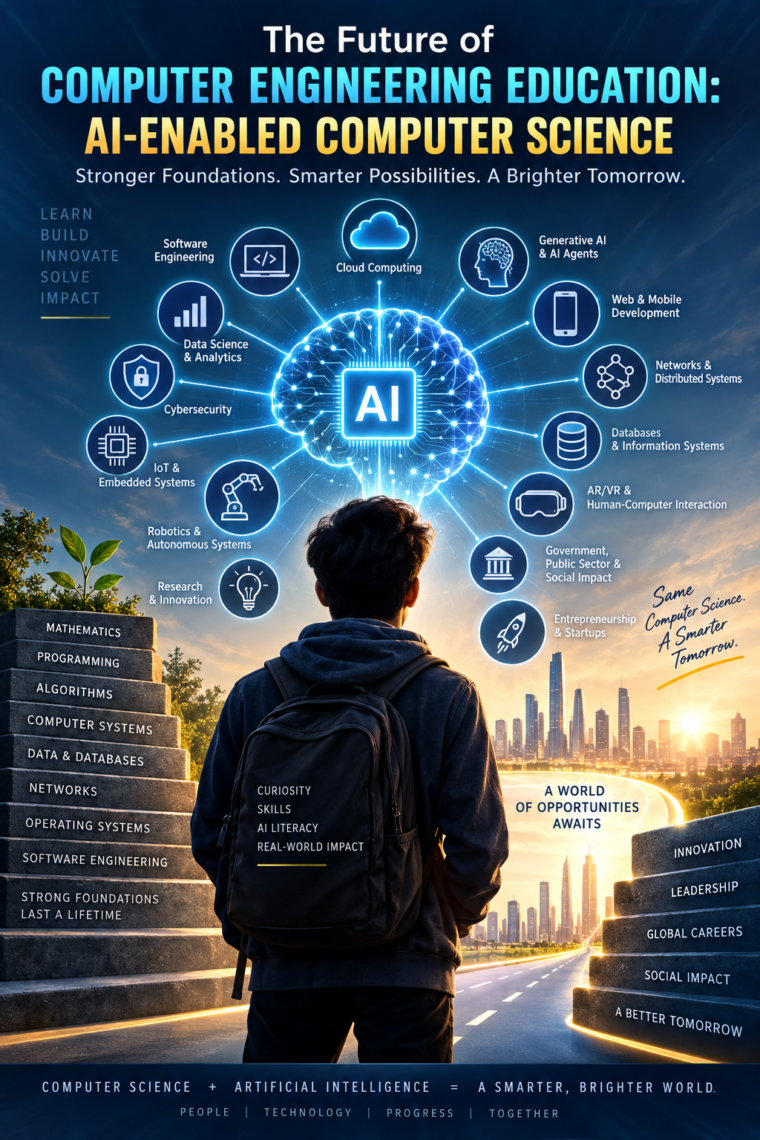
Why the next generation of Computer Science professionals will be AI-enabled—not merely AI-specialized
Computer Science and Engineering is entering one of the most significant transformations in its history.
For decades, Computer Science education focused on programming, algorithms, data structures, operating systems, databases, computer networks, software engineering and computer architecture. These fundamentals remain essential. However, the nature of computing has changed dramatically with the emergence of Artificial Intelligence (AI), Machine Learning (ML), Generative AI, Large Language Models, intelligent agents, robotics and autonomous systems.
The important question today is not: “Should a student study Computer Science or Artificial Intelligence?”
The more relevant question is: “How can Computer Science education become AI-enabled so that a Computer Science graduate can work across every major computing domain?”
This is where the concept of AI-Enabled Computer Science (AI-enabled CSE) becomes powerful.
1. From Computer Science to AI-Enabled Computer Science
The evolution can be viewed as:
Computer Engineering → Computer Science → Internet & Cloud Computing → Data-Driven Computing → AI-Enabled Computing → Agentic & Autonomous Computing
AI is no longer confined to a separate subject called Artificial Intelligence.
It is becoming a capability embedded across Computer Science.
A software engineer uses AI-assisted development.
A cybersecurity engineer uses AI for threat detection.
A database engineer uses AI for intelligent querying and optimization.
A cloud engineer uses AI for resource optimization and anomaly detection.
A network engineer uses AI for traffic prediction and autonomous network management.
A data scientist uses ML and Generative AI.
A robotics engineer combines AI with perception, planning and control.
A developer builds applications using foundation models and AI agents.
Therefore, AI is increasingly becoming a horizontal technology layer across Computer Science rather than merely another vertical specialization.
2. AI Will Not Eliminate Computer Science—It Will Expand It
There is a common fear among students: “If AI can write programs, will Computer Science jobs disappear?”
The answer is more nuanced. AI can automate portions of programming, testing, documentation and debugging. But building reliable computing systems requires much more than writing code. A modern computing professional needs to understand:
Problem → Requirements → Architecture → Algorithms → Data → Models → Software → Infrastructure → Security → Deployment → Monitoring → Governance
AI can assist at almost every stage. Consequently, the professional who understands both Computer Science fundamentals and AI capabilities can become more valuable. The programmer of the future may not simply be someone who writes thousands of lines of code. The programmer may become someone who can:
- define the problem,
- design the architecture,
- select appropriate AI models,
- communicate effectively with AI systems,
- validate AI-generated code,
- integrate multiple systems,
- evaluate performance,
- ensure security,
- manage data,
- deploy applications,
- and take responsibility for the final system.
That is AI-enabled Computer Science.
3. The Biggest Advantage: AI-Enabled CSE Opens Almost Every Computing Career
One of the strongest arguments for AI-enabled Computer Science education is its career breadth. A student who develops strong CSE fundamentals and adds AI skills can potentially enter almost every major computing domain.
| Computer Science Domain | How AI Is Transforming the Domain | Potential Careers |
|---|---|---|
| Software Engineering | AI-assisted coding, testing and maintenance | Software Engineer, AI-Assisted Developer |
| Web Development | AI-generated interfaces, intelligent applications | Full-Stack Developer, AI Application Developer |
| Mobile Computing | On-device AI, intelligent assistants | Mobile AI Developer |
| Data Science | Automated analytics, predictive modelling | Data Scientist, Data Analyst |
| Machine Learning | Intelligent prediction and decision systems | ML Engineer |
| Generative AI | LLMs, multimodal systems, RAG | GenAI Engineer |
| AI Agents | Autonomous task execution | AI Agent Engineer, Agentic AI Developer |
| Cybersecurity | AI threat detection and response | AI Security Engineer |
| Cloud Computing | Intelligent infrastructure and operations | Cloud/AI Cloud Engineer |
| DevOps / MLOps | AI-driven automation and model deployment | MLOps Engineer |
| Computer Networks | Intelligent traffic and anomaly management | Network AI Engineer |
| Databases | Natural-language querying and optimization | Database/AI Data Engineer |
| Computer Vision | Image/video understanding | Computer Vision Engineer |
| Natural Language Processing | Language understanding and generation | NLP Engineer |
| Robotics | Perception, planning and autonomy | Robotics/AI Engineer |
| IoT | Intelligent edge devices | IoT AI Engineer |
| Embedded Systems | Edge AI and intelligent devices | Embedded AI Engineer |
| Distributed Systems | Intelligent workload optimization | Distributed Systems Engineer |
| High Performance Computing | AI workloads and accelerated computing | HPC/AI Engineer |
| Quantum Computing | AI-assisted quantum algorithms and optimization | Quantum Software/AI Researcher |
| Blockchain/Web3 | Intelligent analytics and security | Blockchain/AI Engineer |
| AR/VR/XR | AI-generated immersive environments | XR/AI Developer |
| Human-Computer Interaction | Natural-language interfaces | AI UX/HCI Engineer |
| Software Testing | AI-generated tests and autonomous debugging | AI Testing Engineer |
| Systems Engineering | AI-based monitoring and optimization | Intelligent Systems Engineer |
| IT Operations | AIOps and predictive monitoring | AIOps Engineer |
| Research & Development | New AI/computing technologies | AI/CSE Research Scientist |
| Academia | AI-enabled teaching and research | Professor, Researcher |
| Government Technology | AI, e-Governance, defence and public systems | Scientist, Technical Officer |
| Entrepreneurship | AI-native products and platforms | AI Startup Founder |
This is the central strength of the model: AI-enabled CSE does not close career doors; it opens additional doors.
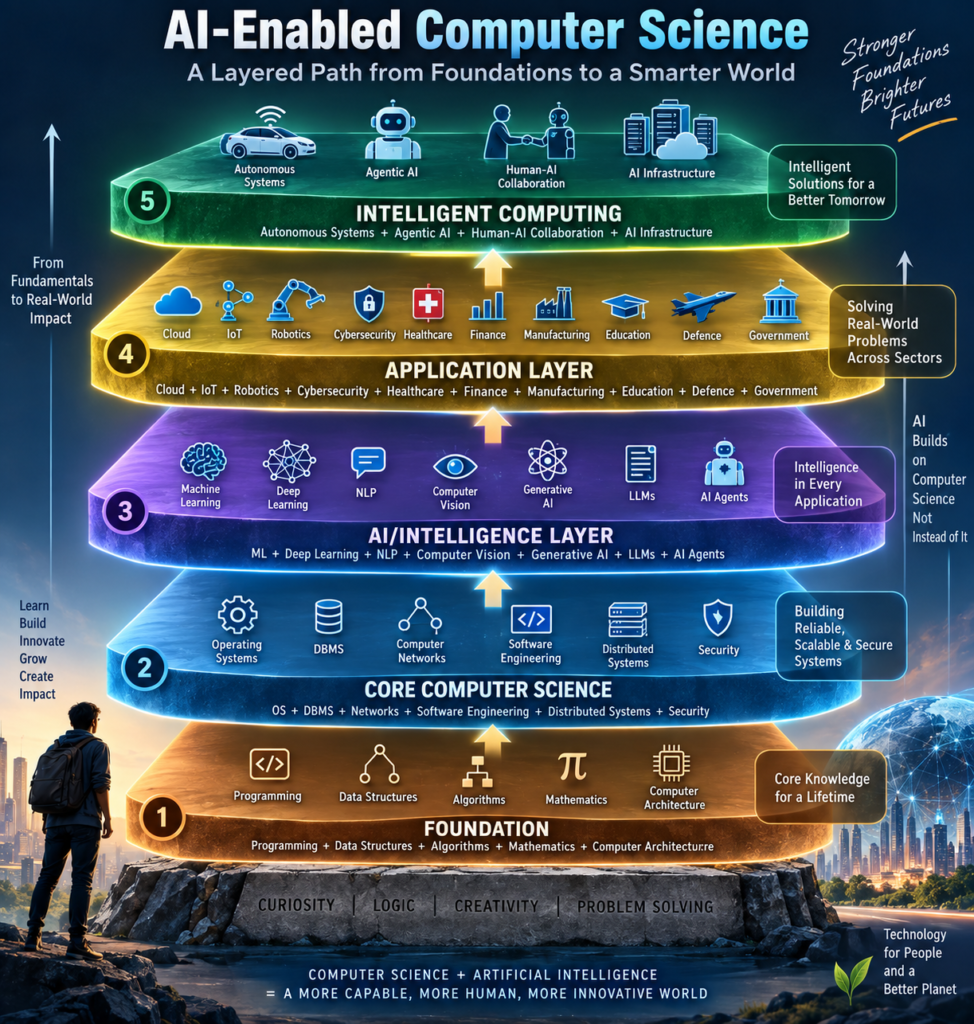
4. The Emerging “AI Layer” Across Computer Science
5. What Happens to Traditional Computer Science Domains?
An important misconception is that AI will make traditional CSE subjects irrelevant.
The opposite may be true.
Algorithms
AI can generate code, but understanding algorithmic complexity remains essential for deciding whether a solution is efficient.
Operating Systems
AI applications require enormous computing resources, memory management, scheduling and distributed execution.
Computer Networks
AI workloads depend on high-speed, reliable communication between devices, data centres and edge systems.
DBMS
AI systems are fundamentally dependent on data, databases, vector databases and information retrieval.
Cybersecurity
As AI becomes more powerful, securing AI systems and protecting AI-generated applications becomes increasingly important.
Software Engineering
AI can generate software, but architecture, requirements, testing, verification, maintainability and reliability remain essential.
Computer Architecture
AI has created enormous demand for GPUs, NPUs, accelerators, edge processors and specialized computing architectures.
Thus: AI increases the importance of Computer Science fundamentals rather than eliminating them.
6. Generative AI Changes the Meaning of Programming
Programming itself is undergoing a transformation.
Earlier:
Human → Code → Computer
Increasingly:
Human → Natural Language / Intent → AI → Code → Computer
But this does not mean that programming knowledge becomes unnecessary.
Rather, the programmer’s role moves upward—from merely writing instructions to designing, directing, validating and integrating intelligent systems.
This creates new competencies:
- Prompt Engineering
- Context Engineering
- AI-assisted Programming
- Retrieval-Augmented Generation
- LLM Application Development
- AI Evaluation
- AI Safety
- AI Security
- Agentic Workflow Design
- Model Integration
- AI System Architecture
The future Computer Science graduate therefore needs to be both a programmer and an AI orchestrator.
7. Agentic AI Could Be the Next Major Transformation
Generative AI primarily generates content.
The next stage is increasingly about AI systems that can reason, plan, use tools, interact with software and execute multi-step tasks.
Consider:
Traditional software: User → Application → Output
Generative AI : User → Prompt → AI → Response
Agentic AI: Goal → AI Agent → Reason → Plan → Tools → APIs → Data → Actions → Feedback → Result
This creates an entirely new category of Computer Science opportunities.
Students will need knowledge of:
- AI agents
- tool calling
- APIs
- distributed systems
- databases
- security
- software architecture
- workflows
- reasoning systems
- human-AI interaction
Again, these are not isolated AI skills.
They are Computer Science + AI.
8. The Future Job Market Will Reward “T-Shaped” Professionals
The traditional specialist model is:
Deep knowledge in one narrow area
The emerging model is:
T-Shaped Computer Professional
Broad foundation
CSE + mathematics + programming + systems + data
Deep specialization
AI / ML / Cybersecurity / Cloud / Data Science / Robotics / Quantum Computing / etc.
This is particularly important for students.
Instead of choosing between:
CSE OR AI
a stronger strategy may be: CSE foundation + AI capability + one domain specialization
For example:
CSE + AI + Cybersecurity
CSE + AI + Cloud
CSE + AI + Robotics
CSE + AI + Data Science
CSE + AI + Quantum Computing
CSE + AI + Healthcare
This produces professionals who can understand both the computing foundation and the intelligent layer.
9. AI-Enabled CSE and Government Careers
The transformation is not limited to private industry.
Government organisations increasingly require expertise in:
- Artificial Intelligence
- Cybersecurity
- Data Analytics
- Software Systems
- Cloud Computing
- Digital Governance
- Defence Technology
- Computer Vision
- Robotics
- High Performance Computing
- Emerging Technologies
Therefore, students interested in government R&D, scientific organisations, public-sector technology and teaching should not abandon core Computer Science.
A broad CSE foundation combined with strong AI capability can provide flexibility across both traditional computing roles and emerging AI-oriented roles.
10. What Should Universities Teach?
If the industry is changing, Computer Science education must change with it.
A future-oriented CSE curriculum should have four components.
Layer 1 — Timeless Fundamentals
- Programming
- Data Structures
- Algorithms
- Discrete Mathematics
- Computer Architecture
- Operating Systems
- DBMS
- Computer Networks
- Software Engineering
Layer 2 — Modern Computing
- Cloud Computing
- Distributed Systems
- DevOps
- Cybersecurity
- Big Data
- IoT
- Edge Computing
Layer 3 — Intelligence
- Artificial Intelligence
- Machine Learning
- Deep Learning
- NLP
- Computer Vision
- Generative AI
- LLMs
- RAG
- AI Agents
Layer 4 — Future Computing
- Autonomous Systems
- Robotics
- Responsible AI
- AI Security
- Quantum Computing
- Quantum AI
- Human-AI Collaboration
- AI Entrepreneurship
This creates a graduate who is not simply AI-trained, but AI-enabled.
11. The Role of Teachers Must Also Change
AI-enabled Computer Science education requires an AI-enabled teacher.
The teacher of the future should move beyond: “I teach students how to write programs.”
towards:
“I teach students how to understand problems, design solutions, use AI intelligently, verify results and build reliable computing systems.”
Teachers will increasingly become:
- mentors,
- problem designers,
- research guides,
- AI facilitators,
- project supervisors,
- technology strategists,
- and learning architects.
The classroom can move from code memorization to problem solving.
From:
“Write a program for this problem.”
to:
“Design an intelligent solution to this real-world problem.”
That is a much more powerful form of Computer Science education.
12. The Opportunity Is Not Only in Technology Companies
Another important point is that the future demand for AI-enabled Computer Science professionals will not be restricted to IT companies.Almost every sector is becoming a computing sector.
Healthcare:
AI diagnostics, medical imaging, healthcare analytics, clinical decision support.
Banking & Finance
Fraud detection, risk analysis, algorithmic systems, intelligent customer services.
Manufacturing
Predictive maintenance, robotics, digital twins and intelligent automation.
Agriculture
Precision farming, crop monitoring, computer vision and intelligent irrigation.
Education
AI tutors, adaptive learning and automated assessment.
Defence
Autonomous systems, surveillance, cybersecurity and intelligence analytics.
Retail
Recommendation systems, demand forecasting and conversational commerce.
Transportation
Autonomous vehicles, traffic optimisation and intelligent logistics.
Government
e-Governance, citizen services, document intelligence and policy analytics.
Energy
Smart grids, demand prediction and infrastructure optimisation.
Thus:
The future job market for Computer Science is not limited to the software industry. Computer Science is becoming the digital foundation of almost every industry.
13. A New Definition of a Computer Science Engineer
The definition of a Computer Science Engineer may therefore need to evolve.
Yesterday
Computer Engineer = Person who develops software and computing systems.
Today
Computer Engineer = Person who designs software, data and computing systems using digital technologies.
Tomorrow
AI-Enabled Computer Engineer = Person who designs, develops, orchestrates and governs intelligent computing systems that can learn, reason, generate, predict and act.
This is a profound transformation.
14. CSE vs AI: The Better Question
Students and parents often ask: “Should I choose CSE or AI?”
The answer depends on the student’s goals.
If a student wants maximum flexibility across software, systems, government, teaching, research and emerging technologies, a strong CSE foundation remains extremely valuable.
If a student wants deep specialization in AI/ML research and development, a dedicated AI programme can be highly attractive.
But there is a third and increasingly powerful approach: Computer Science + Artificial Intelligence
This combines breadth with specialization.
It provides the ability to move from:
Software → Data → Cloud → Security → AI → GenAI → Agents → Robotics → Emerging Computing
rather than being locked into a single technological niche.
15. The Strategic Message for Students
Students entering engineering today should not ask only: “Which branch has the highest placement?”
They should ask:
“Which combination of knowledge will remain valuable when technology changes?”
The answer is unlikely to be a single programming language or a single AI model.
It is more likely to be:
Strong fundamentals + computational thinking + AI literacy + problem-solving + domain knowledge + continuous learning
A student who learns only a particular technology may become obsolete when that technology changes.
A student who understands Computer Science principles and knows how to leverage AI can adapt to the next technology.
16. The Future Belongs to AI-Enabled Professionals
The most important transformation may therefore not be the replacement of Computer Science by Artificial Intelligence.
It is the augmentation of Computer Science by Artificial Intelligence.
We may see a future in which:
- Software Engineers become AI-assisted Software Engineers.
- Data Scientists become AI-augmented Data Scientists.
- Cybersecurity Engineers become AI-enabled Security Engineers.
- Cloud Engineers become AI-driven Cloud Engineers.
- Network Engineers become AI-enabled Network Engineers.
- Database Engineers work with AI-native data systems.
- Teachers become AI-enabled educators.
- Researchers use AI as a research collaborator.
- Entrepreneurs build AI-native businesses.
The common denominator is Computer Science enhanced by AI.
Conclusion: CSE Is Not Ending—It Is Becoming Intelligent
The emergence of AI should not be viewed as the end of Computer Science education.
It should be viewed as its next evolutionary stage.
The evidence from Karnataka’s 2026 engineering-seat landscape already shows CSE coexisting with, and increasingly being combined with, AI/ML, Data Science, Cybersecurity, Robotics and other emerging specializations.
The strategic direction is therefore not:
CSE → AI
but:
CSE + AI → Intelligent Computing
And eventually:
Computer Science → AI-Enabled Computer Science → Agentic & Autonomous Computing
The Computer Science engineer of the future will not merely write code.
They will design intelligent systems.
They will not merely use software.
They will orchestrate AI, data, software, infrastructure and people.
They will not merely prepare for today’s jobs.
They will possess the fundamental knowledge required to create tomorrow’s jobs.
The future of Computer Engineering education is therefore not “Artificial Intelligence instead of Computer Science.”
It is AI-Enabled Computer Science.
And that future has opportunities across virtually every major domain of computing—from software engineering and cybersecurity to cloud, data science, robotics, quantum computing, GenAI, agentic AI, research, education, government and entrepreneurship.
The winning engineer of the coming decade may not be the person who knows only AI.
It may be the Computer Science engineer who knows how to make AI work across Computer Science.