Introduction
For decades, Artificial Intelligence has been driven by a single objective: building smarter machines. Researchers and engineers have continuously pushed the boundaries of computational power, machine learning algorithms, neural networks, and large language models to create systems capable of performing increasingly complex tasks. From defeating world champions in chess and Go to generating human-like text, images, and code, AI has achieved remarkable milestones.
However, as AI systems become deeply embedded in critical sectors such as healthcare, transportation, education, finance, defense, manufacturing, and space exploration, a fundamental question emerges:
Is intelligence alone sufficient for long-term autonomy?
The answer is increasingly becoming “No.”
The future of AI will not be determined solely by how intelligent a machine is, but by how effectively it can maintain, adapt, recover, and sustain its cognitive capabilities under uncertainty, complexity, and change.
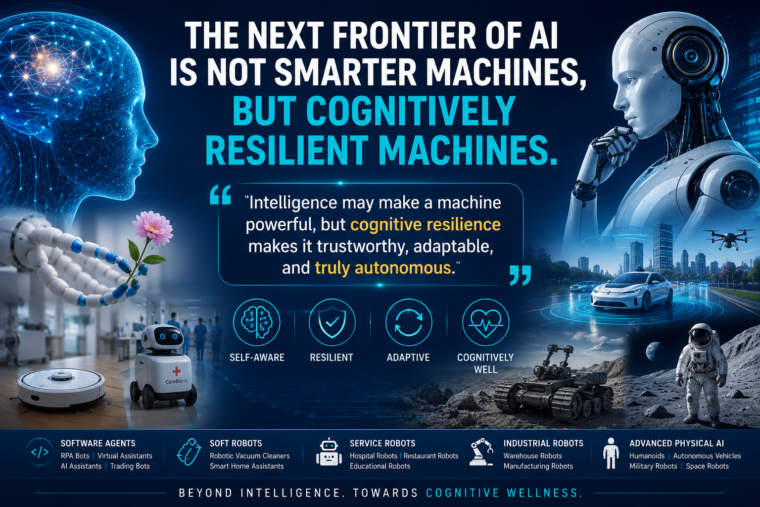
The next frontier of AI is therefore not smarter machines, but cognitively resilient machines.
From Intelligence to Cognitive Resilience
Human beings provide an important analogy. Intelligence alone does not guarantee success. A highly intelligent individual who suffers from chronic stress, burnout, cognitive overload, poor decision-making under pressure, or inability to adapt to change may perform worse than a moderately intelligent but psychologically resilient individual.
Similarly, today’s AI systems are extraordinarily intelligent in narrow domains but often lack resilience.
Consider a modern AI system:
- It can recognize millions of images.
- It can answer complex questions.
- It can generate software code.
- It can drive vehicles autonomously.
Yet these systems can fail unexpectedly when:
- Context changes.
- Sensors malfunction.
- Data distributions shift.
- Objectives conflict.
- Novel situations arise.
Intelligence without resilience creates fragile autonomy.
What Is Cognitive Resilience?
Cognitive resilience refers to the ability of an intelligent system to:
- Maintain reliable performance under uncertainty.
- Adapt to changing environments.
- Recover from failures.
- Manage cognitive overload.
- Detect degradation in its own reasoning.
- Sustain long-term operational health.
- Continuously learn and self-improve.
Just as mental health supports human cognition, cognitive resilience supports artificial cognition.
The Hidden Problem of Cognitive Degradation
Current AI research focuses heavily on performance optimization. Benchmarks measure:
- Accuracy
- Precision
- Recall
- Speed
- Efficiency
However, very little attention is given to the gradual degradation of cognitive performance.
Examples include:
Context Overload
An AI customer service agent may receive thousands of diverse customer requests simultaneously.
Over time:
- Context becomes noisy.
- Responses become inconsistent.
- Decision quality declines.
Model Drift
A financial fraud detection system trained on historical data may become less effective as fraud strategies evolve.
Sensor Uncertainty
An autonomous vehicle operating in fog, rain, or snow may receive conflicting sensor inputs.
Goal Conflicts
A hospital robot may simultaneously receive:
- Medicine delivery requests
- Emergency assistance requests
- Navigation constraints
These situations create cognitive stress within the system.
The Emergence of Cognitive Wellness
A new research paradigm is emerging:
Cognitive Wellness for AI Systems
Instead of asking:
“How intelligent is the system?”
We begin asking:
- How healthy is its decision-making process?
- How stable are its cognitive states?
- How adaptable is its reasoning?
- How resilient is it to uncertainty?
- Can it recognize its own limitations?
This shift mirrors the evolution from treating human illness to promoting human wellness.
Example 1: Autonomous Hospital Robot
Imagine a hospital service robot named CareBot-X.
Its responsibilities include:
- Delivering medicines.
- Assisting patients.
- Navigating crowded corridors.
- Responding to emergency requests.
At 2:00 PM, the robot receives:
- 15 medicine deliveries.
- 3 emergency alerts.
- Multiple navigation obstacles.
Traditional AI attempts to maximize task completion.
A cognitively resilient AI additionally monitors:
- Cognitive load.
- Decision stability.
- Sensor reliability.
- Resource exhaustion.
When overload is detected, it can:
- Prioritize tasks.
- Request assistance.
- Reallocate resources.
- Adapt behavior.
The result is safer and more reliable operation.
Example 2: Autonomous Vehicles
Self-driving cars represent one of the most demanding AI applications.
A vehicle must continuously process:
- Cameras
- LiDAR
- Radar
- GPS
- Traffic conditions
- Pedestrian behavior
Traditional AI focuses on making the correct decision.
Cognitively resilient AI focuses on:
- Confidence assessment.
- Uncertainty estimation.
- Cognitive state monitoring.
- Predictive failure analysis.
The vehicle not only decides but also evaluates the quality of its own decision-making process.
Example 3: Software AI Agents
Cognitive resilience is not limited to physical robots.
Consider an AI-powered research assistant.
The assistant processes:
- Research papers
- Citations
- Notes
- User queries
As knowledge evolves:
- Information becomes outdated.
- Context expands.
- Contradictions emerge.
A cognitively resilient agent can:
- Detect knowledge obsolescence.
- Identify uncertainty.
- Adapt context selection.
- Update reasoning strategies.
This creates more trustworthy AI systems.
Adaptive Multimodal Context AI Agents
One promising solution is the development of Adaptive Multimodal Context AI Agents.
These agents continuously analyze multiple sources of information:
Internal Context
- Task history
- Cognitive load
- Decision logs
- Resource utilization
External Context
- Environment
- Sensors
- User interactions
- Operational conditions
Learning Context
- Model performance
- Knowledge updates
- Error patterns
The agent dynamically selects the most relevant context to maintain cognitive wellness.
Digital Twins for Cognitive Wellness
An important innovation is the Cognitive Digital Twin.
A digital twin is a virtual representation of a physical or software system that evolves in real time.
For AI systems, a Cognitive Digital Twin can model:
- Decision quality
- Adaptability
- Learning health
- Cognitive stress
- Resilience
This allows systems to predict future degradation before failures occur.
Instead of repairing systems after breakdowns, we can maintain cognitive wellness proactively.
Explainable AI and Trust
Cognitive resilience requires transparency.
A future AI system should not simply state:
“Decision made.”
It should explain:
“Decision confidence decreased because sensor reliability dropped and contextual uncertainty increased.”
Such explanations improve:
- Trust
- Accountability
- Safety
especially in high-stakes applications.
Towards Self-Healing AI
The ultimate goal is self-healing intelligence.
Future systems should:
- Detect their own weaknesses.
- Diagnose cognitive issues.
- Adapt strategies.
- Learn from failures.
- Restore performance autonomously.
Just as the human immune system protects biological health, cognitive wellness mechanisms will protect artificial intelligence.
Beyond Smart Machines
Historically, AI has focused on creating machines that can think.
The next stage is creating machines that can sustain healthy thinking.
This distinction is profound.
A machine that is intelligent but fragile may succeed in controlled environments.
A machine that is intelligent and cognitively resilient can thrive in the real world.
The Future Vision
The future of AI will be defined by systems that continuously answer three questions:
- What is happening?
- Why is it happening?
- How healthy is my cognition while responding to it?
This marks a transformation from Artificial Intelligence to Sustainable Intelligence.
The most advanced AI systems of the future may not be those with the largest models or fastest processors, but those capable of maintaining cognitive wellness, adapting to uncertainty, recovering from adversity, and continuously evolving over time.
In that future, intelligence becomes only the starting point.
Cognitive resilience becomes the true measure of autonomy.
Conclusion
The journey of AI began with automation. It evolved into intelligence. The next evolution is cognitive resilience.
As autonomous software agents, service robots, autonomous vehicles, humanoid systems, and future physical AI become integral parts of society, their long-term success will depend not merely on how intelligently they act, but on how effectively they sustain their cognitive well-being.
The future belongs to AI systems that do more than think.
The future belongs to AI systems that can continuously care for the quality, stability, and resilience of their own thinking.