1. Introduction
The evolution of Artificial Intelligence (AI) has moved from simple rule-based systems to advanced machine learning models and now to autonomous intelligent agents capable of perceiving, reasoning, and acting in complex environments. However, most of these systems are still grounded in classical computation, which operates on binary logic (0 and 1). As we approach the limits of classical computing, a new paradigm is emerging at the intersection of Quantum Computing and Intelligent Agents.
Quantum computing introduces concepts such as superposition, entanglement, and probabilistic measurement, enabling systems to process multiple possibilities simultaneously. When these principles are integrated into intelligent agents, we get Quantum Agents—systems capable of exploring vast solution spaces more efficiently than classical agents. Extending this further, the idea of a Quantum Mind introduces a new way of modeling cognition, where decision-making is not strictly deterministic but probabilistic and multi-dimensional.
The combination of these ideas leads to a powerful concept: Agents with Quantum Mind. These agents are envisioned as systems that not only compute using quantum principles but also “think” in a quantum-inspired way, opening new frontiers in AI, cognition, and complex problem-solving.
2. Quantum Agent and Its Characteristics
A Quantum Agent is an intelligent system that leverages the principles of quantum mechanics to perform perception, reasoning, and decision-making tasks. Unlike classical agents, which process information sequentially, quantum agents can evaluate multiple possibilities simultaneously due to quantum superposition.
One of the defining characteristics of a quantum agent is its ability to operate on qubits instead of classical bits. Qubits can exist in multiple states at once, allowing the agent to explore a wide range of solutions in parallel. Another important feature is entanglement, which enables strong correlations between different parts of the system, allowing coordinated decision-making across distributed components.
Quantum agents also utilize quantum probability models, which differ from classical probability by allowing interference effects. This can lead to more efficient decision-making in uncertain environments. Additionally, these agents may employ quantum algorithms such as Grover’s search or quantum optimization techniques to enhance performance.
In practical terms, quantum agents may operate in hybrid environments, combining classical AI techniques with quantum computation. Their characteristics include:
- Parallel exploration of multiple solutions
- Enhanced optimization capabilities
- Probabilistic and non-deterministic reasoning
- Ability to model complex systems more efficiently
These features make quantum agents particularly suitable for applications in optimization, cryptography, drug discovery, and strategic decision-making.
3. What is Quantum Mind
The concept of a Quantum Mind is a theoretical framework that applies principles of quantum mechanics to explain cognitive processes such as thinking, decision-making, and consciousness. Unlike classical models of the mind, which assume deterministic and sequential reasoning, the quantum mind suggests that human cognition may involve probabilistic and superposed mental states.
In this framework, thoughts can exist in a state of superposition, meaning multiple possibilities are considered simultaneously before a final decision is made. This aligns with real-world human experiences, where individuals often entertain multiple options before arriving at a conclusion. The process of making a decision can be compared to quantum measurement, where the superposed state collapses into a single outcome.
Another key idea is entanglement in cognition, where different thoughts or decisions are interconnected, influencing each other instantly. This can explain complex decision-making scenarios where multiple factors are deeply interdependent.
Quantum mind theories also use quantum probability models to better explain human behavior, especially in situations where classical probability fails, such as paradoxical decision-making or ambiguity.
Although still largely theoretical, the quantum mind provides a promising framework for:
- Modeling human-like reasoning
- Understanding uncertainty and ambiguity
- Designing more natural and adaptive AI systems
4. Quantum Agents with Quantum Mind
Concept
Quantum Agents with Quantum Mind represent a fusion of computational power and cognitive modeling. These agents not only use quantum computing for faster and more efficient processing but also adopt quantum-inspired cognitive frameworks for decision-making.
In simple terms: A Quantum Agent processes information quantum mechanically, while a Quantum Mind defines how it thinks.
This combination allows agents to:
- Maintain multiple hypotheses simultaneously
- Make decisions under uncertainty more effectively
- Adapt dynamically to complex environments
Architecture
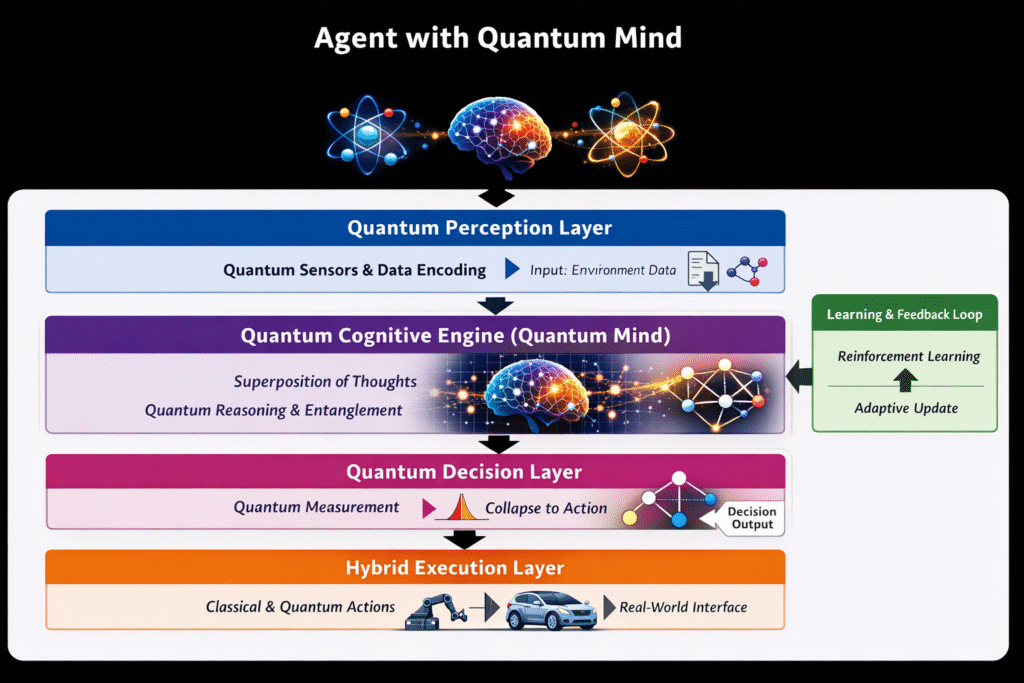
Architecture Components
- Quantum Perception Layer
- Converts real-world inputs into quantum states
- Encodes data using qubits
- Quantum Cognitive Engine (Quantum Mind Core)
- Maintains superposition of beliefs and thoughts
- Uses quantum probability for reasoning
- Models uncertainty naturally
- Quantum Decision Layer
- Applies quantum measurement principles
- Collapses multiple possibilities into a final decision
- Hybrid Execution Layer
- Executes actions in classical or quantum environments
- Interfaces with real-world systems
- Learning & Feedback Loop
- Uses reinforcement learning (quantum or hybrid)
- Continuously updates internal states
Example of Quantum Agent with Working
Scenario: Smart Research Assistant
A Quantum Agent with Quantum Mind is tasked with generating innovative research ideas.
Working Process:
- Input Stage
- Receives thousands of research papers
- Quantum Processing
- Represents multiple hypotheses in superposition
- Explores various combinations of ideas simultaneously
- Cognitive Reasoning
- Evaluates possibilities using quantum probability models
- Maintains multiple competing theories
- Decision (Collapse)
- Selects the most promising idea after measurement
- Output
- Suggests novel research directions with higher innovation potential
This approach significantly reduces the time required for exploration and enhances creativity.
5. Research Scope
The field of Quantum Agents with Quantum Mind is still emerging, offering vast opportunities for research and innovation.
Key Research Areas
- Quantum Cognitive Modeling
- Developing mathematical models for quantum-based reasoning
- Hybrid Quantum-Classical Architectures
- Integrating quantum circuits with AI models
- Quantum Reinforcement Learning
- Designing agents that learn in quantum environments
- Quantum Natural Language Processing
- Representing language meaning using quantum states
- Multi-Agent Quantum Systems
- Studying entanglement-based coordination among agents
- Quantum Consciousness Studies
- Exploring links between quantum mechanics and awareness
Challenges
- Limited availability of scalable quantum hardware
- Noise and decoherence in quantum systems
- Complexity in interpreting quantum decisions
- Ethical concerns regarding advanced autonomous systems
Future Opportunities
- AI systems with human-like reasoning under uncertainty
- Breakthroughs in optimization and scientific discovery
- New interdisciplinary fields combining AI, physics, and cognitive science
Conclusion
Agents with Quantum Mind represent a transformative step beyond traditional AI. By combining quantum computational power with quantum-inspired cognition, these systems promise to redefine how machines think, learn, and interact with the world. The future of intelligence may not just be faster—it may be fundamentally quantum in nature.