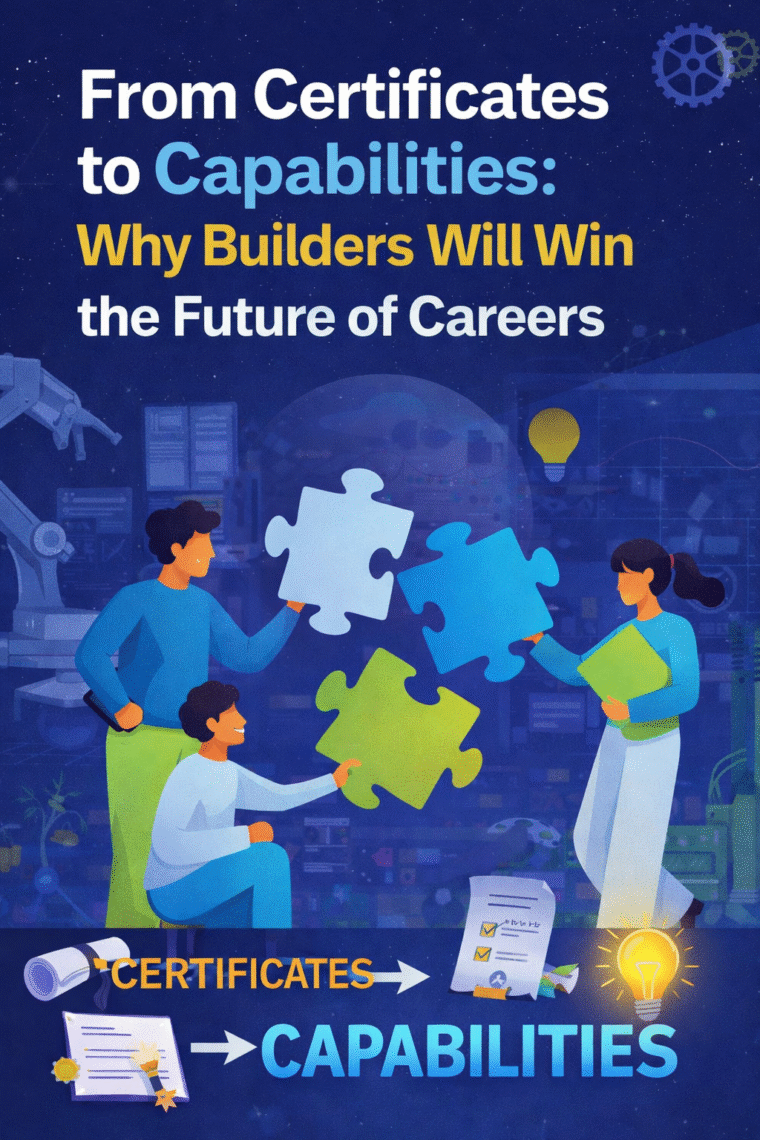
For years, students and professionals have believed that collecting courses and certificates is the safest path to career success. The result is a generation that completes multiple online courses, earns badges, edits resumes repeatedly, and still struggles to secure meaningful opportunities. The problem is not lack of effort. The problem is that course-based upskilling and resume polishing alone no longer translate into employability.
Today’s job market has changed faster than traditional education and training models. Recruiters no longer ask, “Which course did you complete?” They ask, “What have you built?” and “What problems have you solved?” In a world of rapid technological change, certificates signal exposure, but projects signal capability. Courses show what is possible; projects prove what you can actually do.
Traditional upskilling often emphasizes watching videos, memorizing concepts, and completing predefined tasks. Such learning paths tend to be generic, use outdated examples, avoid real-world complexity, and end with certificates instead of skills. They rarely simulate industry constraints such as messy data, ambiguous requirements, time pressure, trade-offs, or stakeholder expectations. As a result, learners may know the theory, but they lack the confidence and competence to perform in real professional environments.
Resumes, too, have become over-optimized documents. Students keep improving templates, adding keywords, and listing more certificates. But recruiters spend only a few seconds scanning resumes and look for one thing: evidence of real problem-solving ability. Statements like “completed a course” or “learned Python” do not establish credibility. What counts is proof—something built, something deployed, something used by real users, or something that created measurable improvement. Weak projects that are copy-paste, tutorial-based, or built on toy datasets fail to convince employers because they do not tell a professional story.
The missing piece in most upskilling journeys is industry-style project experience. Real skill is formed when learners work on authentic problem statements, use real datasets with constraints, collaborate in teams, make design decisions, face trade-offs, and take ownership of outcomes. One strong project that solves a real problem is often worth more than ten certificates. Experience compounds; certificates do not.
This signals a deeper shift in how careers are built. Learning must move from “watch and complete” to “build, validate, and ship.” Careers grow from evidence, not from templates. The future belongs to builders, not course collectors.
What Skilling Is Required as per Current Trends (2026 and Beyond)
To stay relevant in the current and emerging job market, learners need a shift in both what they learn and how they learn.
1. Industry-Grade Problem Solving
Learners must practice solving open-ended, ambiguous problems, not just textbook exercises. This includes:
- Framing the right problem
- Understanding user needs
- Working under constraints (time, data quality, cost, ethics)
- Making trade-offs and justifying decisions
2. Project-Centric Learning
Skills must be demonstrated through:
- End-to-end projects (problem → design → build → deploy → iterate)
- Real datasets and real users
- Clear outcomes and impact metrics
- Documentation of decisions, failures, and improvements
3. AI-Augmented Thinking (Not Just AI Usage)
As AI tools automate coding and content creation, the valuable skill is not “using AI,” but:
- Asking the right questions
- Designing workflows with AI as a co-pilot
- Validating AI outputs
- Applying domain knowledge and judgment
This shifts the focus from tool proficiency to thinking, framing, and verification.
4. Systems and Context Thinking
Modern problems are not isolated. Learners must develop:
- Systems thinking (how components interact)
- Context engineering (defining goals, constraints, prompts, and environments clearly)
- Understanding business, social, ethical, and operational contexts
5. Collaboration and Ownership
The workplace values people who can:
- Work in cross-functional teams
- Take ownership of outcomes
- Communicate decisions clearly
- Handle feedback and iteration cycles
6. Outcome-Oriented Mindset
Instead of asking “What course should I take next?”, learners should ask:
- What real problem can I solve next?
- What measurable outcome can I create?
- How can I show impact through a working solution?
Conclusion
The employability crisis is not a lack of learning—it is a mismatch between learning methods and industry reality. Certificates show exposure. Resumes open doors. But proof of building, problem-solving, and execution gets people hired. In an era where AI is automating routine tasks and knowledge is abundant, human value lies in framing problems, making decisions, integrating tools, and creating real-world impact.
The future of skilling is clear:
Don’t collect courses. Build capabilities. Don’t polish resumes. Produce proof.
Reference: LinkedIn Posts