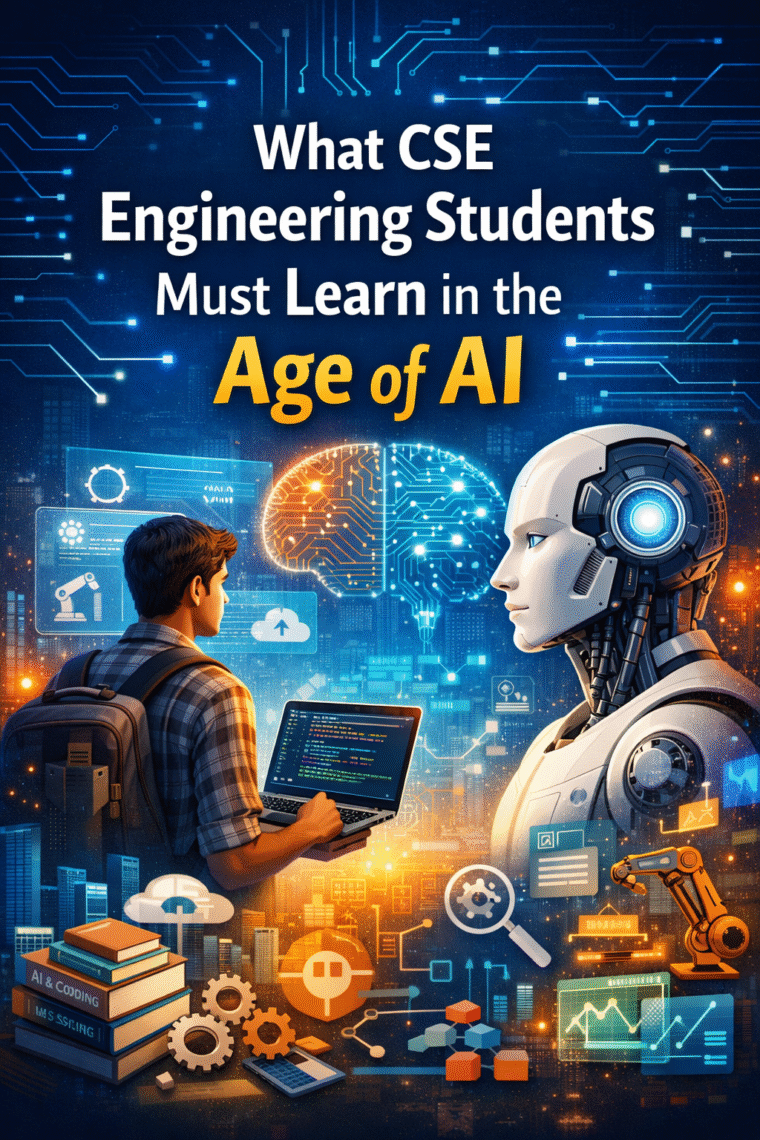
Artificial Intelligence, generative tools like ChatGPT, and automation are reshaping how technology is built and used. For Computer Science and Engineering (CSE) students in India, this transformation brings exciting opportunities and a clear message: the value of a CSE degree is growing, and the skill set required is becoming richer and more impactful.
Success in 2026 and beyond depends not just on learning to code, but on learning to design intelligent systems, work alongside AI tools, and solve meaningful real-world problems.
The Evolving Role of CSE Graduates
Modern engineers are becoming solution architects and technology integrators. AI tools can assist with routine programming, documentation, and testing. This allows students to focus on higher-value work such as problem understanding, system design, decision-making, and deployment at scale. Engineers who combine human judgment with AI assistance will create faster, smarter, and more reliable solutions.
Core Foundations Every CSE Student Must Master
Strong fundamentals remain essential for long-term growth:
- Computer Science Foundations:
Data Structures & Algorithms (Complexity, Graph Algorithms, Hashing, Trees and Memory trade off) , Operating Systems (Threads, Processes, Synchronization, Dead locks, and parallel execution) , DBMS, Computer Networks, OOP - AI Literacy:
Understanding how AI models and Agents work, prompt design, context engineering, validating outputs, handling bias and errors. - System Design Thinking:
Load balancing, APIs, microservices, Distributed Systems, Caching Strategies, Fault Tolerance, Data base Sharding, cloud fundamentals (Docker, Kubernetics, AWS or GCP Fundamentals, CI/CD pipelines and Observability) scalability, security basics - Problem Solving & Design:
Translating real-world needs into technical architectures - Project-Based Learning:
End-to-end projects with users, deployment, documentation, and measurable impact
Additional strengths: System design patterns, Software architecture, and Responsible AI practices.
High-Value Skills for the AI-Driven Tech Industry
To stand out in placements and early careers, students should build:
- Problem framing and requirements engineering
- AI-assisted development workflows
- Data understanding and model evaluation
- Cloud, DevOps, and deployment basics
- Cybersecurity and privacy awareness
- Communication, teamwork, and technical storytelling
- Ethics, governance, and societal impact of AI
Emerging advantages: product thinking, UX awareness, and domain expertise (healthcare, fintech, smart manufacturing, education).
Learning Priorities in an AI-Enabled Workflow
With AI handling repetitive patterns efficiently, students can prioritize:
- Designing robust system architectures
- Writing high-quality specifications and test strategies
- Reviewing, improving, and optimizing AI-generated code
- Ensuring reliability, security, and performance
- Making informed trade-offs between cost, scale, and user value
This approach builds engineers who are trusted decision-makers.
What Companies Look for During Placements
Recruiters increasingly value:
- Strong CS fundamentals
- Effective use of AI tools with clear reasoning
- Real-world projects, internships, hackathons, open-source work
- Ability to explain design choices and trade-offs
- Basics of system design and deployment
- Professional communication and teamwork
Portfolio tips: Maintain a strong GitHub profile with problem statements, architecture diagrams, demos, documentation, and deployed links.
Why Learning AI Strengthens Your Career
Learning AI is about expanding your thinking capacity. AI becomes a powerful collaborator that helps explore ideas, test assumptions, and accelerate development. Engineers who learn to guide AI thoughtfully will lead innovation, shape products, and create reliable systems that serve real users.
Job Roles for CSE Students in the Age of AI
These roles need thinking with AI, not competing with AI:
- AI Engineer / ML Engineer
- Applied AI Engineer
- Data Scientist / Analytics Engineer
- MLOps Engineer
- Prompt Engineer / AI Workflow Designer
- Software Engineer (Backend / Platform)
- System Design Engineer
- Cloud Engineer / Solutions Architect
- DevOps Engineer / Platform Engineer
- Site Reliability Engineer (SRE)
- Cybersecurity Analyst / Security Engineer
- AI Governance Engineer / Responsible AI Specialist
- Privacy Engineer / Compliance Engineer
- Quality Engineer (AI Systems Testing & Validation)
- Product Engineer (bridge between product + tech)
- Technical Product Manager (TPM)
- Business Analyst (Tech-focused)
- Solutions Consultant / Cloud Consultant
- AI Solutions Architect
- Research Engineer (AI / Systems / Robotics)
- Human-AI Interaction Engineer
- AI Ethics & Policy Technologist
- Innovation Engineer / R&D Engineer
- HealthTech Engineer
- FinTech Engineer
- EdTech Engineer
- Smart Manufacturing / Industry 4.0 Engineer
- GovTech / Smart Cities Engineer
Conclusion
The age of AI is opening a new chapter for CSE students—one that emphasizes thinking, design, collaboration, and impact. By mastering strong foundations, building meaningful projects, and working effectively with AI tools, students can build careers that are both future-ready and purpose-driven.
“The less deeply you think, the more replaceable you become. The deeper you think, the more irreplaceable you become.”
Key takeaway:
Learn to think with AI, design intelligent systems, and create value for society.
“In an age of AI, shallow thinking is replaceable; deep thinking is irreplaceable.”
Bottom Line (Placement-Ready Insight)
CSE students don’t need to compete with AI at typing code. They compete best in roles that require:
Thinking, designing, integrating, validating, securing, and deploying intelligent systems.
Reference: