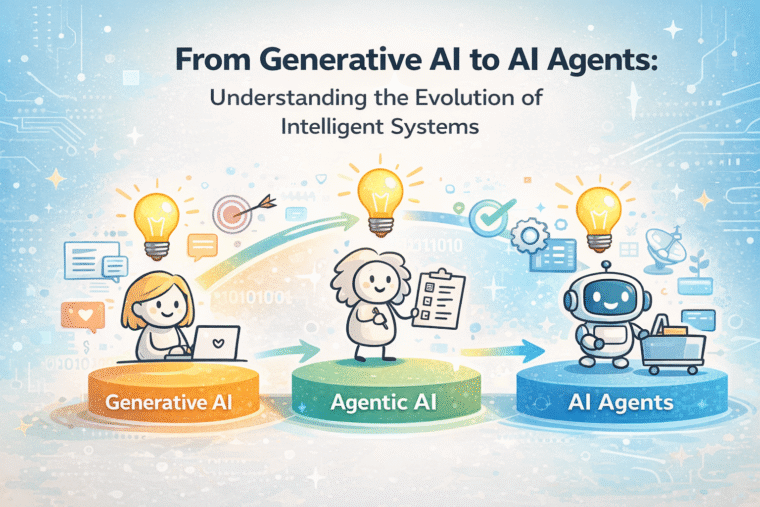
Artificial Intelligence is evolving rapidly, moving beyond simple content generation to systems that can plan, decide, and act autonomously. Three key concepts define this evolution: Generative AI, Agentic AI, and AI Agents. While they are closely related, each represents a different level of intelligence and autonomy.
1. Generative AI – The Creator
Generative AI refers to systems that can create new content such as text, images, audio, or code by learning patterns from large datasets.
🔹 Key Characteristics:
- Reactive in nature
- Produces outputs based on prompts
- No independent decision-making
- Focuses on content creation
🔹 Example:
Imagine you ask: “Write a blog on AI in education.”
A Generative AI model will:
- Analyze your prompt
- Generate structured content
- Provide a complete article instantly
🔹 Real-World Use Cases:
- Blog writing
- Image generation (e.g., design tools)
- Code generation
- Chat responses
👉 Think of Generative AI as a smart assistant that responds when asked.
2. Agentic AI – The Planner
Agentic AI goes beyond generation. It can plan, reason, and execute tasks toward a goal.
🔹 Key Characteristics:
- Proactive behavior
- Goal-driven
- Can break tasks into steps
- Adjusts strategy dynamically
🔹 Example:
Goal: “Create and publish a blog on AI in education.”
An Agentic AI system will:
- Decide topic structure
- Generate the article
- Optimize for SEO
- Save as draft
- Notify for approval
👉 It doesn’t just respond—it plans and executes a workflow.
🔹 Real-World Use Cases:
- Automated content pipelines
- Business process automation
- AI research assistants
- Workflow orchestration
👉 Think of Agentic AI as a project manager that organizes and executes tasks.
3. AI Agents – The Doers
AI Agents are systems that can interact with environments and perform actions—digital or physical.
🔹 Key Characteristics:
- Executes real-world actions
- Interacts with systems (APIs, databases, devices)
- Operates with higher autonomy
- Can run continuously
🔹 Example:
On your website: A user asks: “What courses do you offer?”
An AI Agent will:
- Search your website database
- Retrieve relevant information
- Respond instantly
- Optionally suggest enrollment
Another example: “Generate and publish a blog”
The AI Agent:
- Generates content
- Uploads to WordPress
- Sets it as draft or publishes
👉 It not only thinks—it acts.
🔹 Real-World Use Cases:
- Website chatbots
- Customer support automation
- Smart home assistants
- Autonomous systems (robots, IoT)
👉 Think of AI Agents as workers that perform tasks in real-time.
🔮 Conclusion
The shift from Generative AI to AI Agents marks a transformation from passive tools to active digital collaborators. Businesses, educators, and developers can leverage this evolution to build systems that not only assist—but also operate independently.
For your website, combining these technologies can create:
- Automated content pipelines
- Intelligent user interaction
- Scalable digital services
👉 The next step is not just using AI—but building AI systems that work for you.