Palguni G T
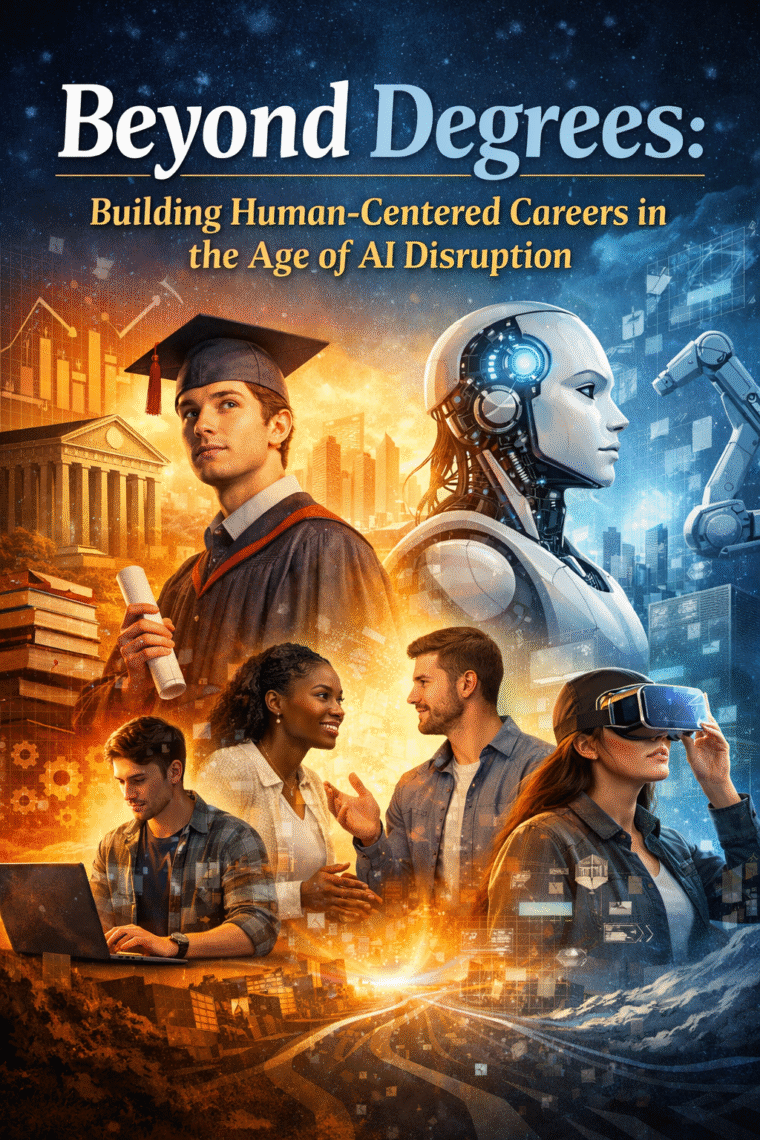
For decades, the promise was simple: study hard, earn a degree, land a stable job, and retire with security. In the age of artificial intelligence, that promise is cracking. As AI systems rapidly absorb technical tasks—from coding and analytics to diagnostics and legal research—the return on traditional degrees is no longer guaranteed. Even advanced credentials like PhDs, once considered the ultimate hedge against uncertainty, are being questioned by leaders who helped build today’s AI revolution.
Former Google generative-AI founder Jad Tarifi warns that the pace of AI innovation may outstrip the relevance of long academic programs. By the time a doctoral student finishes years of specialized study, the tools they trained for may already be obsolete. His argument isn’t anti-education; it’s anti-delay. He urges young people to invest less in credential accumulation and more in human capabilities—deep connection, emotional awareness, agency, and original thinking. These are qualities machines don’t replicate well and organizations increasingly value when technology commoditizes technical skill.
This skepticism echoes across Silicon Valley. Mark Zuckerberg questions whether colleges prepare students for today’s jobs at all, especially as tuition rises and curricula lag behind industry needs. Sam Altman goes further, noting that modern AI can already converse at a “PhD-level” across many domains. When expertise becomes accessible on demand, the advantage shifts from knowing to doing: framing the right problems, integrating insights across domains, and making judgment calls in messy human contexts.
Yet the picture isn’t simply “degrees are dead.” AI PhDs remain highly sought after by industry, with most graduates moving into private-sector roles. The tension is elsewhere: academia faces brain drain, while students increasingly exit early for lucrative offers. Meanwhile, IT services—especially in markets like India—are under pressure as AI automates routine work. Outsourcing models based on headcount are giving way to outcome-based pricing. Markets have reacted nervously, signaling a broader truth: stable career ladders are dissolving into shifting pathways.
So what replaces the old linear model of education → job → retirement? A portfolio career built on continuous learning, adaptability, and collaboration with AI. The winners won’t be those who merely “learn AI to copy,” but those who learn AI to think—using it as a partner to amplify creativity, decision-making, and impact. Engineering education must evolve from static syllabi to living curricula: problem-first learning, interdisciplinary projects, ethics and systems thinking, communication, entrepreneurship, and real-world immersion with AI tools. For young learners, the goal is not to chase a single credential, but to build learning velocity—the ability to re-skill faster than the technology changes.
Employment won’t simply vanish; it will reshape. Routine roles will shrink, but new roles will emerge at the intersection of humans and machines: AI product strategists, system integrators, domain translators, safety and governance leads, human-centered designers, and educators who can teach learning itself. The future of work belongs to those who can evolve their identity as often as their skillset—anchored not in a degree, but in purpose, perspective, and the uniquely human art of connection.
References: