
Palguni GT With ChatGPT
Introduction
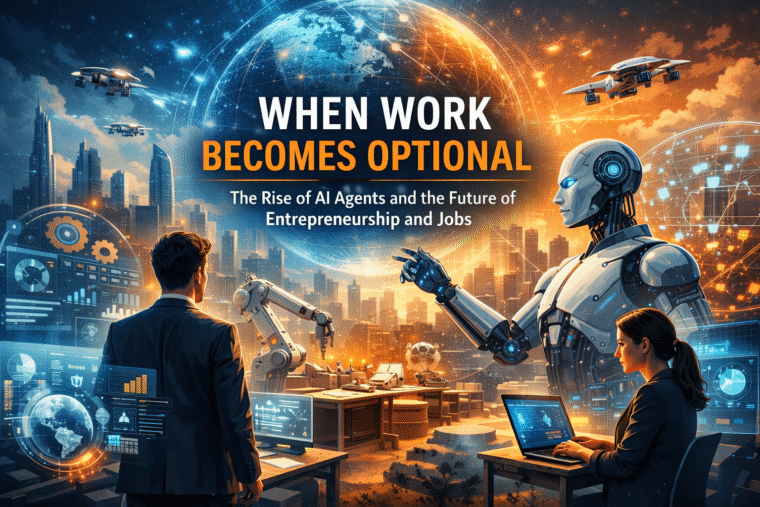
Recent technology discussions have highlighted a bold prediction: within the next 10–20 years, traditional work may become optional as artificial intelligence and robotics dramatically increase productivity. The underlying argument is that intelligent systems could produce goods and services at scale, reducing the economic necessity of conventional employment. Rather than remaining a speculative idea, this vision is supported by the rapid evolution of autonomous AI technologies capable of performing complex cognitive and operational tasks.
At the center of this transformation are AI Agents — autonomous digital entities capable of planning, reasoning, learning, and executing tasks with minimal human supervision. As organizations begin to integrate AI Agents into daily operations, entrepreneurship models and employment structures are expected to change fundamentally.
From Traditional Work to AI-Driven Productivity
The prediction that work may become optional is rooted in the possibility that AI systems will significantly enhance productivity. Intelligent agents can automate a wide range of activities including research, programming, customer support, and decision-making processes.
AI Agents are already demonstrating early capabilities such as:
- Automating coding, documentation, and testing
- Conducting data-driven research and analysis
- Managing digital workflows and operations
- Providing continuous customer engagement
As AI Agents become more autonomous and capable of collaboration, they may perform many routine and analytical tasks traditionally handled by humans. This transition suggests a future in which employment is driven more by creativity and purpose rather than economic necessity.
The New Era of Entrepreneurship: Founders with AI Workforces
The idea that work may become optional also implies a shift in how businesses are created and managed. AI Agents will allow entrepreneurs to build and operate ventures with smaller human teams and highly automated processes.
AI-Native Startups
Future entrepreneurs may deploy AI Agents to handle:
- Product development and software engineering
- Market research and digital marketing
- Financial forecasting and business analytics
- Customer service and operations management
This reduces startup costs, accelerates development cycles, and democratizes innovation.
The Changing Role of Entrepreneurs
Instead of managing large teams, entrepreneurs will increasingly:
- Design and orchestrate AI Agent ecosystems
- Define strategic vision and ethical boundaries
- Focus on innovation, leadership, and problem-solving
Entrepreneurship will evolve from operational management to intelligent system design.
Continuous Autonomous Innovation
AI Agents will monitor trends, generate new ideas, test solutions, and refine products autonomously. Businesses will become more adaptive, data-driven, and responsive to changing market conditions.
Transformation of Jobs in the Age of AI Agents
The shift toward AI-driven productivity will redefine employment patterns.
Decline of Routine Knowledge Work
Administrative tasks, repetitive data processing, and basic analytical roles may be increasingly automated by AI Agents, leading to changes in traditional job structures.
Emergence of New Professions
New opportunities will arise, including:
- AI Agent Architects and Trainers
- Human-AI Collaboration Designers
- Ethical AI Governance Specialists
- Digital Transformation Strategists
- Autonomous Systems Managers
Work as Purpose Rather than Necessity
If AI Agents can provide essential services and productivity, individuals may pursue work aligned with personal interests such as creativity, education, social impact, and innovation.
Autonomous Organizations and Digital Economies
AI Agents will enable the emergence of autonomous enterprises capable of:
- Self-management and real-time decision-making
- Automated supply chains
- Continuous business optimization
Entrepreneurs will oversee networks of intelligent agents operating across global digital ecosystems, creating new models of decentralized and highly efficient organizations.
Challenges and Societal Considerations
While the future appears promising, several concerns must be addressed:
- Transition challenges and job displacement
- Access inequality in advanced AI technologies
- Ethical risks in autonomous decision-making
- Psychological implications of reduced traditional work roles
Responsible AI governance, inclusive education, and adaptive economic policies will be essential to ensure equitable progress.
Education and Skills for the AI Agent Economy
Preparing for an AI Agent-driven future requires:
- AI literacy and human-AI collaboration skills
- Systems thinking and computational creativity
- Entrepreneurial and innovation-focused education
- Ethical reasoning and responsible AI design
- Lifelong learning and continuous reskilling
Educational systems must shift from rote learning toward experiential and interdisciplinary approaches.
Conclusion
The vision of a future where work becomes optional reflects a profound shift in economic and social structures. AI Agents will redefine entrepreneurship by enabling individuals to build intelligent, autonomous enterprises while transforming jobs into roles centered on creativity, strategy, and human values.
Rather than diminishing human purpose, the rise of AI Agents may empower individuals to pursue meaningful work aligned with passion and societal contribution. As intelligent systems handle routine production and operations, humans will increasingly focus on innovation, empathy, and imagination — redefining the very nature of work in the decades ahead.
Reference : Tesla CEO Elon Musk says work will be optional in 10–20 years: Here’s why