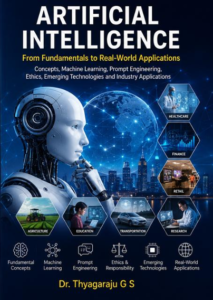
Dr.Thyagaraju G S, Palguni G T .
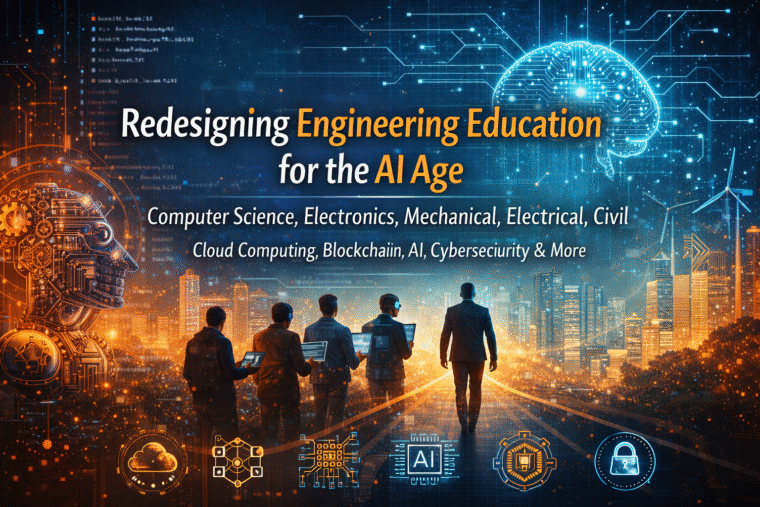
AI is changing how technical work gets done. New models can write code, check code, help design systems, and speed up many routine tasks. Because of this, engineering schools must change what and how they teach so graduates stay useful and find good jobs. Below is a simple, practical article that explains what to change, why, and how.
(Key recent facts used below: leading AI labs released more powerful models and report that many internal coding tasks are now AI-assisted; tools like Copilot increase developer speed; McKinsey and other studies show AI will shift tasks across jobs rather than simply remove all jobs). [ Introducing Claude Opus 4.6 ]
1. Short diagnosis: what is happening to engineering work
- Routine technical tasks (boilerplate coding, basic drafting, repeated testing, simple simulations) are being automated faster than before. [ Ref ]
- Powerful new AI models (example: recent Opus model release) make it easier to automate larger, more complex tasks. [Ref ]
- Companies and labs report that internal development workflows now rely heavily on AI assistance — shifting humans toward oversight, design, and evaluation work. [ Ref ]
2. Main idea: What should education aim for?
Instead of training students to only perform technical tasks, train them to:
- Define problems and goals — choose what to automate and why.
- Design systems — combine hardware, software, networks, and people.
- Verify and govern AI — ensure safety, fairness, and accountability.
- Work with AI tools — supervise, validate, and extend AI outputs.
- Lead cross-disciplinary teams — communicate with non-engineers and stakeholders.
3. Comparative table — jobs and likely change (simple forecast)
| Job / Task type | Short-term (1–5 yrs) | Mid-term (5–15 yrs) | Why |
|---|---|---|---|
| Routine coding, boilerplate work | ↓ Decrease | ↓ Further decrease | AI generates common patterns and tests. [ Ref ] |
| Complex system design & integration | ↗ Increase | ↗ Stronger increase | Humans needed to set goals and integrate parts. |
| AI safety, auditing, governance | ↗ Increase | ↗ Large increase | Need human judgement and ethics. [Ref ] |
| Human-AI interface & UX | ↗ Increase | ↗ Increase | People must trust and use AI effectively. |
| Hardware & sensor design (edge AI) | ↗ Stable / Increase | ↗ Increase | Devices still require physical design and constraints. |
| Research assistants (data cleaning) | ↓ Decrease | ↓ Decrease | AI can clean/prepare much of the data. |
(Notes: ↓ = likely decline; ↗ = likely growth or shift.)
4. Curriculum changes — roadmap (simple actions)
A. Core courses to add or strengthen (all branches)
- Human–AI Collaboration — how to use AI tools, evaluate outputs, set goals.
- AI Safety & Ethics — bias, fairness, privacy, explainability.
- Systems Thinking — how large systems behave; socio-technical view.
- Project-Based Learning Lab — multidisciplinary projects with real problems.
- Communication & Leadership — writing, presentation, teamwork, negotiation.
B. Discipline-specific changes (short table)
| Stream | What to keep | New or stronger focus |
|---|---|---|
| CSE (Computer Science) | Algorithms, programming | AI orchestration, MLOps, secure AI pipelines, human-AI design |
| ECE (Electronics & Comm) | Circuits, signal processing | Edge AI, sensor systems, neuromorphic hardware, low-power AI chips |
| ME (Mechanical) | Mechanics, CAD | Simulation+AI co-design, human-robot interaction, additive manufacturing w/ AI |
| EEE (Electrical) | Power systems, controls | Smart grids, AI for energy optimization, embedded AI controllers |
| Civil | Structural analysis, materials | Digital twins, AI for infrastructure monitoring, climate-resilient design |
5. Teaching methods — replace old exams with meaningful evaluation
- From closed-book recall → to open-ended projects: students must define the problem, choose data, run experiments, and explain why their solution is safe and useful.
- Use AI as a teammate in assignments: allow students to use AI tools but require a written section: “What did AI do? What did I check?”
- Interdisciplinary capstone projects: teams with students from CSE, ECE, ME, EEE, Civil, and business/ethics.
- Assess “judgement” and “communication”: oral defense and stakeholder presentation, not just code or formulas.
6. Practical course map (one semester example for 3rd/4th year)
- Week 1–4: Systems thinking + ethics modules (short lectures + case studies)
- Week 5–8: AI tools workshop (Copilot, model evaluation, MLOps basics). [ Ref ]
- Week 9–14: Team project: real-world problem (deploy prototype + safety report)
- Week 15: Public demo + reflection report (what AI did, what students added, risks)
7. Comparative analysis: AI coding tools vs. human learning
- Productivity: Studies show AI pair-programmers can speed coding tasks (example: GitHub Copilot trials). [ Ref ]
- Skill shift: As speed increases, the human role shifts to design, validation, debugging complex cases and ethics. [ Ref ]
- Risk: Over-reliance causes skill atrophy and “AI fatigue” — humans may lose deep problem-solving practice and feel cognitive overload validating many AI outputs. [ Ref]
8. How to teach AI without producing “copying graduates”
- Explicitly grade the student’s judgment — ask why they chose an AI-generated solution and what checks they performed.
- Require reproducibility & explainability — students must produce a short, readable model of how the AI reached a conclusion.
- Rotate tasks between manual and AI-assisted — preserve core skills while teaching AI use.
- Teach failure modes and adversarial cases — students must show how AI could fail and how to detect/fix it.
9. Emerging technologies to include (short list)
- Cloud computing & MLOps — how to deploy models safely and scale.
- Blockchain basics — secure logging, provenance for data/models.
- Data Science — clean data, feature engineering, validation.
- Quantum computing (intro) — where quantum helps and its limitations.
- Cybersecurity — AI-powered attacks and AI for defense.
(Why: These fields combine with AI and are already changing job roles. McKinsey finds companies adopting AI widely but needing skills to scale safely.) [ Ref ]
10. Two simple tables for faculty to use
Table A — Learning outcome mapping (example)
| Course / Module | Outcome (student should be able to) | Assessment |
|---|---|---|
| Human–AI Collaboration | Use AI tools, document decisions, supervise AI outputs | Project + supervision report |
| AI Safety & Ethics | Identify bias, propose fixes, legal & social impact analysis | Case-study essay + oral defense |
| Systems Lab | Integrate sensors, cloud, model, UI | Team demo + stakeholder feedback |
| Communication | Explain technical work to non-technical audience | Presentation + one-page policy brief |
Table B — Quick resource plan (1-year start)
| Resource | Action |
|---|---|
| Faculty training | Short FDPs on AI tools & safety |
| Lab upgrades | Cloud credits + small edge devices for students |
| Partnerships | Industry co-designed projects (local companies) |
| Assessment change | Rubrics that include “judgement” and “ethics” |
11. Recent AI developments impacting regular jobs
- Powerful models with better coding & planning: Anthropic’s Opus 4.6 shows models planning longer tasks and scaling context windows — meaning larger code and design tasks can be AI-assisted.
- AI writing code inside labs: Reports that some AI labs use AI to generate most internal code mean that basic coding tasks will be less common as job filters. Humans now oversee and validate AI outputs.
- Productivity studies: GitHub Copilot and experiments show significant speedups for many coding tasks — this changes how time is spent in development.
- Industry analyses: McKinsey finds firms adopting AI widely but stresses the need to raise skills; adoption changes tasks and raises demand for governance and integration skills.
12. Risks and how education reduces them (practical)
Risk: Graduates can use AI blindly → produce unsafe or biased systems.
Solution in curriculum: Teach verification, ethics, and require “what-if” reports.
Risk: Students lose core skills (e.g., algorithmic thinking).
Solution: Alternate between manual tasks and AI-assisted tasks in assignments.
Risk: Burnout and AI fatigue.
Solution: Teach healthy workflows, limit continuous AI use in labs, and emphasize deep work.
13. Concluding meaning and a realizable solution (simple plan)
Meaning: AI will change what engineers do. Education must change how engineers learn. The goal is not just employment — it’s meaningful, responsible impact.
A realizable 3-step solution (for any engineering college to start next academic year):
- Run a 1-week Faculty Development Program (FDP) on AI tools, safety, and new assessment methods. (Use cloud credits and invite industry.)
- Redesign one core course per department into a “Systems + AI” course with a live team project and an ethics module (replace one theory-to-memorize exam with a project).
- Create industry-linked capstones where students solve an actual engineering problem with an AI-assisted pipeline and deliver: working prototype + safety & impact report.
Start small, measure outcomes, then scale. Repeat every year.
Short checklist for department chairs
- Add a Human–AI Collaboration module to second/third year.
- Make at least one capstone interdisciplinary.
- Change at least 30% of assessments from closed-book to project-based.
- Run one FDP for faculty this year.
- Partner with local industry for realistic projects.
References (select recent, authoritative sources used)
- Anthropic — Introducing Claude Opus 4.6 (model release).
- Fortune — Top engineers at Anthropic, OpenAI say AI now writes 100% of their code (reporting on labs’ internal practices).
- GitHub Blog — Quantifying Copilot’s impact on developer productivity (research & results).
- McKinsey — Superagency in the workplace / State of AI reports (AI adoption and skills gap).
- ArXiv / academic studies — AI pair programmer experiments showing speed gains (research evidence).
- Business Insider — Reporting on AI fatigue among engineers (human costs to rapid AI adoption).